
Choose an AI Automation Topic for a Tailored Article
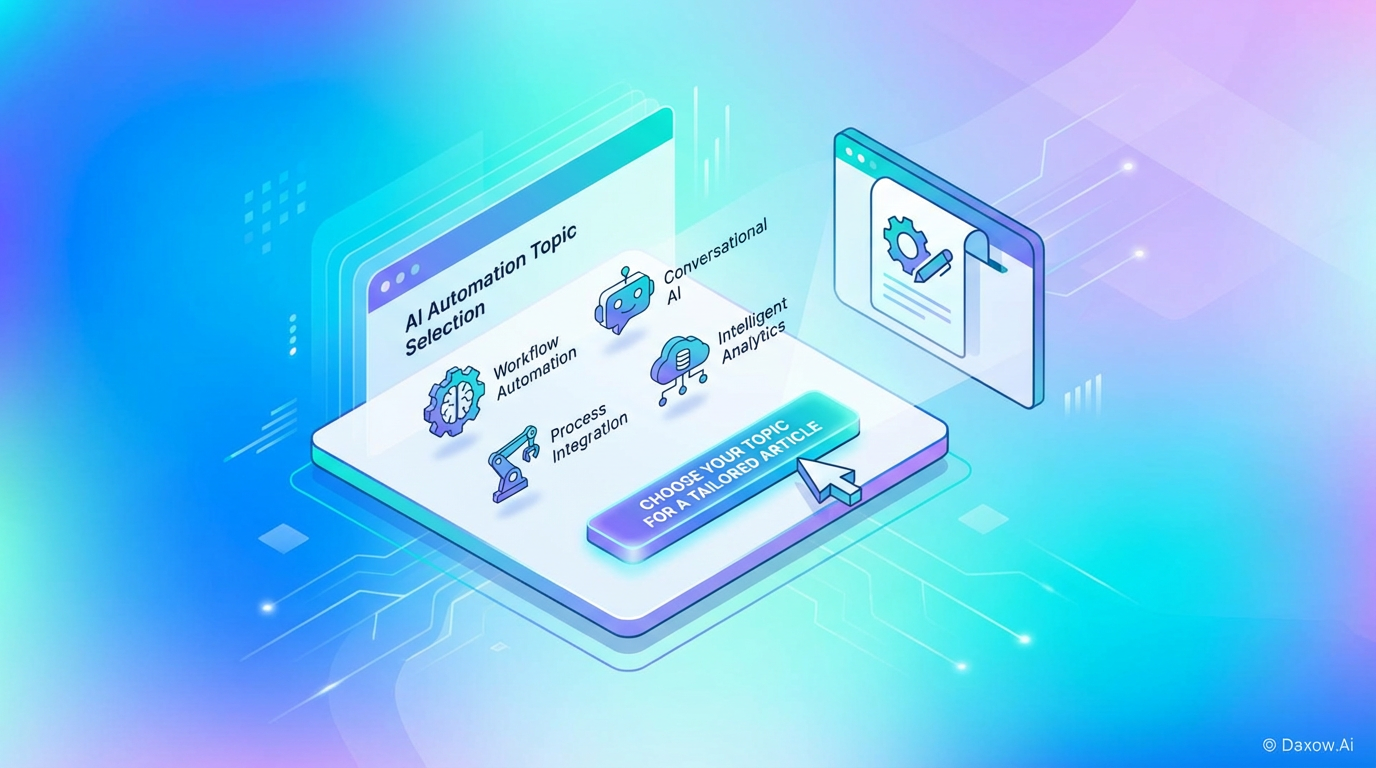
Request for readers to select a trending AI/automation topic, optional industry details, and keywords to guide a tailored 1500–2000 word article.
AI Agents and Workflow Optimization: Revolutionizing Business Productivity
Estimated reading time: 8 minutes
Key Takeaways
- AI agents play a critical role in enhancing workflow automation and reducing manual tasks.
- Implementing AI agents improves productivity and drives effective business automation.
- Use cases of AI agents span customer support automation, sales automation, and internal processes.
- Workflow optimization through AI agents leads to scalable and more agile business models.
- Partnering with platforms like Daxow.ai solutions accelerates AI agent integration.
Understanding AI Agents
Artificial Intelligence (AI) agents are specialized software entities designed to autonomously perform tasks, interact with systems, and optimize business processes. Unlike traditional scripts, these agents use machine learning, natural language processing, and decision-making algorithms to adapt and improve their performance over time.
In the context of workflow automation, AI agents serve as intelligent intermediaries that streamline operations, minimize human intervention, and enhance overall efficiency. They can seamlessly handle repetitive tasks, analyze data patterns, and provide actionable insights that empower businesses to focus on strategic activities.
The Role of AI in Workflow Optimization
Workflow optimization involves refining processes to deliver better outcomes with fewer resources. AI automation introduces a transformative dimension by enabling continuous process improvements and dynamic adaptation to real-time conditions.
AI agents facilitate:
- Automatic task allocation and prioritization based on urgency and complexity.
- Data-driven decision-making by analyzing large volumes of operational data.
- Proactive identification and resolution of bottlenecks before they escalate.
Key Business Benefits
Integrating AI agents into business workflows yields measurable benefits, such as:
- Increased Productivity: By automating routine activities, employees can prioritize high-value work, boosting overall output.
- Cost Reduction: AI agents minimize human error and repetitive labor costs, enabling leaner operations.
- Enhanced Customer Experience: Automating customer support tasks ensures timely responses and personalized interactions, raising satisfaction levels.
- Scalability: AI-driven workflows adapt easily to growing demands without requiring proportional resource increases.
- Data-Driven Insights: Continuous monitoring and learning generate insights to refine strategies and improve decision-making.
Use Cases of AI Agents
AI agents have become indispensable across multiple domains. Significant applications include:
- Customer Support Automation: AI chatbots and virtual assistants handle common inquiries, troubleshoot problems, and escalate issues as needed, freeing human agents to tackle complex concerns.
- Sales Automation: AI agents qualify leads, schedule follow-ups, and provide insights on customer preferences to streamline the sales funnel.
- Internal Process Optimization: In finance and SaaS industries, smart agents automate invoicing, compliance checks, and system monitoring to reduce manual oversight.
- Workflow Orchestration: Coordinating multi-step processes by integrating disparate systems ensures end-to-end automation and error minimization.
Explore detailed solutions in workflow automation and business automation at Daxow.ai to amplify these use cases within your organization.
Implementing AI Agents Effectively
Successful deployment of AI agents requires strategic planning and continuous optimization:
- Identify Target Processes: Focus on high-volume, repetitive tasks with clear outcome metrics.
- Integrate with Existing Systems: Seamless connectivity with ERP, CRM, or customer support platforms ensures smooth automation flows.
- Train and Monitor AI Models: Use quality data to progressively enhance AI agents’ accuracy and responsiveness.
- Incorporate Human Oversight: Maintain human-in-the-loop workflows to handle exceptions and maintain customer trust.
- Iterate and Scale: Use performance analytics to refine workflows, expanding automation scope as confidence grows.
For implementation guidance and cutting-edge tools, visit the Daxow.ai resource center to access expert insights and case studies.
Future Trends in AI Automation
The future of AI agents and workflow automation is poised for exciting developments including:
- Increased Autonomy: Agents will manage more complex tasks with minimal human input.
- Hyperautomation: Combining AI agents with robotic process automation (RPA) and analytics to create fully automated workflows.
- Personalized AI Agents: Tailoring agents for specific roles or customer segments will boost effectiveness and engagement.
- Cross-Platform AI Collaboration: Multiple AI agents working synergistically across systems to deliver cohesive business automation.
Staying ahead requires adopting flexible AI automation strategies and leveraging partners like Daxow.ai for ongoing innovation.
Frequently Asked Questions
What are AI agents in workflow automation?
AI agents are intelligent software entities that perform automated tasks, analyze data, and optimize processes within workflows, minimizing the need for manual intervention.
How can AI agents improve productivity?
By reducing manual tasks, prioritizing workflows, and assisting in decision-making, AI agents allow human workers to focus on higher-value responsibilities, enhancing overall productivity.
Are AI agents suitable for small businesses?
Absolutely. AI agents can be customized to fit the scale of operations, and even small businesses benefit from automating repetitive processes to reduce costs and increase efficiency.
What industries benefit most from AI automation?
Industries such as finance, healthcare, ecommerce, SaaS, and customer service see substantial gains from AI automation because of their process-heavy and data-driven nature.