
AI Workflow Automation: End-to-End Guide by Daxow.ai
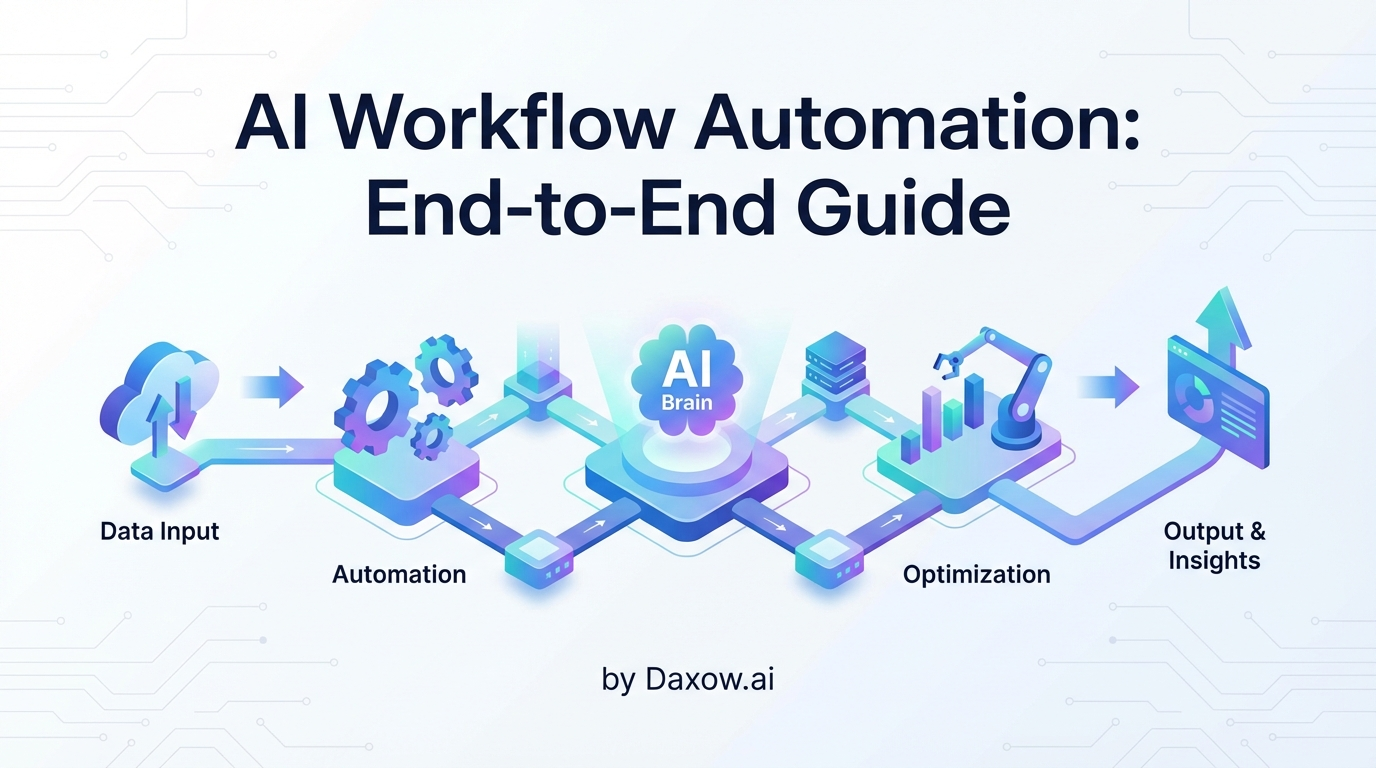
Discover how AI workflow automation transforms operations, reduces costs, and boosts CX. Use cases, implementation roadmap, and Daxow.ai's end-to-end solutions.
AI Workflow Automation: Transforming Business Operations for the AI Era
Estimated reading time: 15 minutes
Key Takeaways
- AI workflow automation integrates AI to enable autonomous business process execution, reducing manual intervention and costs.
- Businesses see 30–50% faster process times, fewer errors, and improved customer satisfaction through AI automation.
- Daxow.ai designs custom AI systems and agents to automate end-to-end workflows across industries such as e-commerce, healthcare, finance, and real estate.
- Successful implementation requires defined objectives, data preparation, tool integration, cross-functional teams, and continuous monitoring.
- ROI is measurable through reduced cycle times, cost savings, productivity gains, and improved customer experience within months.
Table of Contents
- AI Workflow Automation: Transforming Business Operations for the AI Era
- What AI Workflow Automation Means for Your Business
- Practical Use Cases Across Industries
- How AI Agents and Automation Drive Business Impact
- Implementation Roadmap and Best Practices
- Measuring ROI and Business Value
- How Daxow.ai Delivers End-to-End AI Automation
- Next Steps — Start Your AI Workflow Automation Journey
- Frequently Asked Questions
AI Workflow Automation: Transforming Business Operations for the AI Era
AI workflow automation integrates artificial intelligence into routine business processes so tasks execute autonomously with minimal human intervention. The result is a shift from labor-intensive operations to scalable, intelligent systems that deliver:
- Faster processing times and reduced cycle times.
- Lower operational costs and fewer errors.
- Better decision-making through predictive analytics.
- Improved customer experiences via context-aware automation.
Key outcomes organizations see include 30–50% reductions in process times, significant error reduction, and measurable increases in customer satisfaction. For decision-makers this means scalable operations that adapt to changing demand while enabling staff to focus on strategic, revenue-generating activities.
What AI Workflow Automation Means for Your Business
AI workflow automation is more than simple scripting or RPA. It combines machine learning, natural language processing (NLP), and intelligent orchestration to handle both structured and unstructured data. When implemented with governance and a business-first mindset, it creates value across front-office and back-office functions.
- Automate repetitive, rule-based tasks. Data entry, invoice processing, routine customer queries and ticket triage are prime targets.
- Extract insights in real time. Predictive models and NLP enable better forecasting and faster issue resolution.
- Reduce manual tasks and human error. Standardize outcomes and free people for higher-value work.
- Scale without linear headcount growth. Add capacity by expanding automated workflows rather than hiring.
At Daxow.ai, we start by mapping existing workflows and identifying high-impact automation opportunities. We then design AI systems and AI agents that execute tasks end-to-end — from data extraction and validation to actioning results in your CRM or ERP.
Practical Use Cases Across Industries
E-commerce
Use case:
- Order-to-cash automation, inventory reconciliation, returns handling, and conversational shopping assistants.
Impact:
- Faster order processing and fewer fulfillment errors.
- Improved conversions via personalized recommendations and instant chat support.
- Chatbots and AI agents handle common queries, freeing support teams for complex issues.
How Daxow helps:
- Build chatbots integrated with your commerce platform and CRM.
- Automate inventory updates and exception handling with AI-driven reconciliation workflows.
- Deploy AI agents that trigger fulfillment or returns processes without manual approval.
Healthcare
Use case:
- Patient scheduling, medical records extraction, triage assistants, and preliminary diagnostic support.
Impact:
- Up to 40% reduction in administrative time, improved compliance, and faster patient throughput.
- Better prioritization of urgent cases via intelligent triage.
How Daxow helps:
- Implement secure data extraction and document automation compliant with privacy regulations.
- Deploy AI agents that integrate with EHRs to automate scheduling and pre-visit workflows.
- Provide governance and monitoring to ensure ongoing accuracy and compliance.
Finance
Use case:
- Invoice reconciliation, fraud detection, KYC automation, and compliance checks.
Impact:
- Faster transaction approvals, fewer reconciliation exceptions, and reduced fraud losses.
- Shorter audit cycles and improved regulatory reporting.
How Daxow helps:
- Integrate anomaly detection models into payment and accounting systems.
- Automate document ingestion, matching invoices to purchase orders, and flagging exceptions.
- Connect AI agents with payment platforms and ERPs to complete reconciliations autonomously.
Real Estate
Use case:
- Lead qualification, property matching, contract review, and tenant onboarding.
Impact:
- Faster response times to leads, higher-quality meetings, and reduced time-to-contract.
- Improved agent productivity by automating administrative tasks.
How Daxow helps:
- Create AI agents that score leads, schedule viewings, and populate contracts.
- Automate document analysis for leases and compliance checks.
- Integrate with CRMs and calendar systems to orchestrate end-to-end lead-to-lease workflows.
HR and Recruitment
Use case:
- Resume screening, candidate prequalification, onboarding automation, and performance analytics.
Impact:
- Reduced hiring cycle times, more consistent evaluation, and lower administrative overhead.
- Better candidate experience through automated communications.
How Daxow helps:
- Build models to screen and rank candidates against role requirements.
- Automate offer letter generation, document collection, and onboarding checklists.
- Deploy dashboards and reporting to monitor hiring KPIs and diversity metrics.
How AI Agents and Automation Drive Business Impact
AI agents are autonomous software entities that perceive environments, make decisions, and act. They extend simple automation by adding contextual understanding and adaptive behavior.
- Integration-first approach: AI agents connect with CRMs, ERPs, and collaboration tools for seamless data flow.
- Intelligent decisioning: Agents apply predictive models to qualify leads, prioritize support tickets, or detect anomalies.
- Continuous learning: Agents retrain on fresh data to maintain accuracy and reduce model drift.
- Operational scale: Handle large volumes of transactions and communications without proportional increases in headcount.
Examples of agent-driven outcomes:
- An AI agent triages support tickets using sentiment analysis, routes urgent issues to senior agents, and resolves common questions autonomously — increasing first-contact resolution and reducing average response time.
- A sales AI agent qualifies inbound leads and schedules discovery calls, increasing conversion by ensuring sales resources focus on high-intent prospects.
Daxow.ai builds and deploys such AI agents as part of complete workflow automation solutions. We integrate them with your systems, design governance and retraining pipelines, and ensure they execute real tasks while providing audit trails and performance metrics.
Implementation Roadmap and Best Practices
1. Define Clear Objectives
- Conduct audits to identify inefficiencies and low-hanging automation targets.
- Set measurable goals (e.g., reduce invoice processing time by 30%, cut support response SLA from 24 to 2 hours).
- Prioritize workflows with high volume and predictable outcomes for quick wins.
2. Assess and Prepare Data
- Audit data for quality, completeness, and regulatory constraints.
- Standardize formats, clean noisy records, and build ingestion pipelines.
- Ensure privacy and compliance by design.
3. Select and Integrate Tools
- Choose platforms that support NLP and machine learning and integrate with your tech stack.
- Favor scalable, secure solutions and consider low-code/no-code tools for rapid prototypes.
- Design APIs and connectors for CRMs, ERPs, ticketing systems, and databases.
4. Build Cross-Functional Teams
- Assemble a team of business SMEs, data engineers, ML engineers, and UX designers.
- Invest in change management and user training to drive adoption.
- Establish governance, roles, and ownership to manage models and workflows post-deployment.
5. Prototype, Measure, and Scale
- Start with pilot projects on non-critical workflows.
- Define KPIs and measure outcomes: speed, accuracy, cost per transaction, and user satisfaction.
- Iterate and expand automation footprints once pilots demonstrate value.
6. Monitor, Govern, and Optimize
- Monitor for model drift, performance degradation, and compliance risks.
- Retrain models regularly with new data and incorporate user feedback loops.
- Maintain logging and audit trails for traceability.
Best practices summary:
- Focus on high-impact workflows first.
- Design for security and compliance from day one.
- Use low-code tools for faster experimentation.
- Commit to continuous improvement and governance.
Daxow.ai follows this roadmap: we begin with process discovery, build prototypes, validate impact, and scale automation while embedding governance and monitoring.
Measuring ROI and Business Value
AI workflow automation delivers both direct and indirect returns. Organizations typically measure success through a combination of operational and financial KPIs.
Key metrics:
- Process cycle time reductions (often 30–50% on repetitive tasks).
- Cost per transaction and cost savings from reduced manual processing.
- Error rates and exception volumes.
- Employee productivity and redeployment of staff to higher-value tasks.
- Customer satisfaction scores (often rising 20–30% with improved automation and responsiveness).
- Payback period commonly within 6–12 months for focused pilots.
Examples:
- Finance teams reduce reconciliation cycles and manual audit effort, accelerating month-end close.
- E-commerce companies increase conversion and decrease cart abandonment through personalized, automated interactions.
- Customer support organizations lower average response times and resolve more tickets without additional hires.
Daxow.ai helps quantify expected ROI during the discovery phase and validates gains with real-world metrics during pilot deployments. We provide dashboards and reporting so stakeholders can track improvements and make data-driven decisions about scaling.
How Daxow.ai Delivers End-to-End AI Automation
Daxow.ai, founded in Estonia in 2024, specializes in designing and delivering custom AI systems that automate workflows across the enterprise. Our services include:
- AI Agents: Autonomous agents that perceive, decide, and act to complete tasks.
- Workflow Automation: Design and implementation of end-to-end process automation.
- Chatbots & Customer Support Automation: Conversational AI for scalable support and sales interactions.
- Lead Qualification & Sales Automation: Intelligent scoring, scheduling, and CRM updates to accelerate pipeline conversion.
- Data Extraction & Document Automation: OCR, NLP, and structured data pipelines to remove manual data entry.
- Integrations with Business Tools and CRMs: Seamless connectivity to tools you already use.
Our approach:
- Discovery and process mapping to identify high-impact workflows.
- Rapid prototyping using low-code tools and custom models where needed.
- Production deployment with secure integrations and scalable architecture.
- Ongoing monitoring, governance, and optimization to maintain performance.
How we reduce costs and improve ROI:
- Automate manual steps to lower headcount-driven costs.
- Reduce error rates to cut rework and compliance penalties.
- Increase throughput and speed to generate revenue faster.
- Provide measurable KPIs and transparent reporting for stakeholders.
Next Steps — Start Your AI Workflow Automation Journey
AI workflow automation is a strategic lever that transforms operations, reduces manual tasks, and unlocks productivity gains. Whether your priority is customer support automation, sales automation, document automation, or building AI agents to execute real tasks, Daxow.ai can design a solution tailored to your systems and objectives.
- Book a free consultation with our team to map your processes and identify quick wins.
- Request a process analysis for your company to quantify potential ROI and timelines.
- Contact us to build a custom AI system that integrates with your CRM, ERP, and collaboration tools.
Take the first step toward smarter, faster operations. Book a free consultation with Daxow.ai and discover how AI workflow automation can deliver measurable impact across your business.
Frequently Asked Questions
What is AI workflow automation?
AI workflow automation combines artificial intelligence technologies such as machine learning and NLP with process automation to enable business tasks to execute autonomously, improving speed, accuracy, and scalability.
How does Daxow.ai customize AI automation for industries?
Daxow.ai begins with workflow mapping and identifies high-impact opportunities, then builds custom AI systems and agents tailored to specific industry needs, seamlessly integrating with existing CRMs, ERPs, and business tools.
What ROI can businesses expect from AI automation?
Organizations typically see 30–50% reductions in process times, cost savings, reduced errors, and improved customer satisfaction, often with a payback period within 6-12 months from pilot deployments.
Is AI workflow automation secure and compliant?
Yes. Security and regulatory compliance are embedded into design from the start, especially for sensitive industries like healthcare and finance, with ongoing governance and monitoring to maintain data privacy and integrity.