
Mastering AI Workflow Automation for Business in 2026
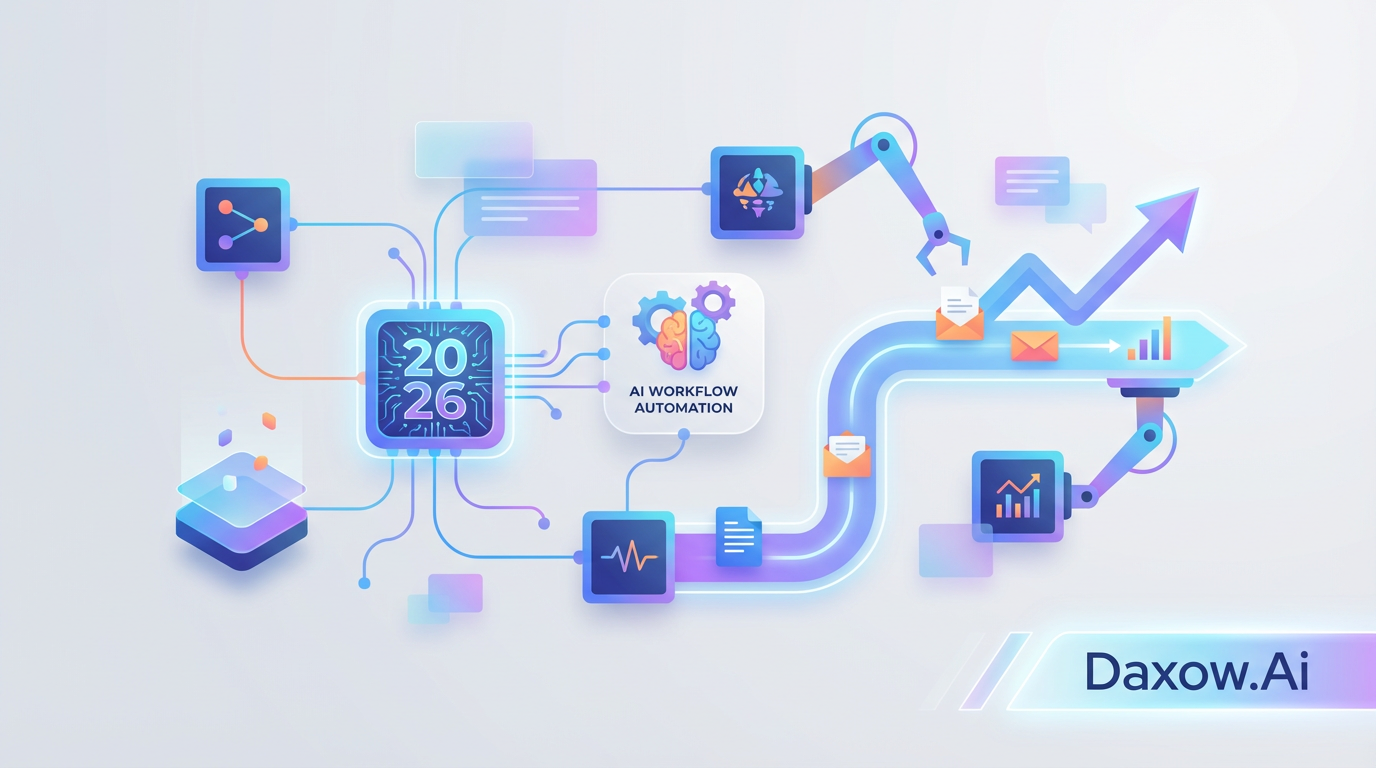
Practical 2026 roadmap: deploy AI agents to automate workflows, cut costs, save time, improve compliance, and scale automation with measurable ROI.
Mastering AI Workflow Automation: Transforming Business Operations in 2026
Estimated reading time: 15 minutes
Key Takeaways
- AI workflow automation combines machine learning, NLP, computer vision, and orchestration to enable hyperautomation across industries.
- Strategic benefits include cost reductions up to 50%, time savings up to 60%, and error rates reduced by as much as 90%.
- Industry-specific use cases demonstrate measurable KPIs in e-commerce, healthcare, finance, real estate, and HR.
- A phased implementation roadmap ensures data quality, technology fit, and cross-functional collaboration for sustainable success.
- Tracking ROI with focused KPIs enables scaling automation initiatives from pilots to enterprise-wide adoption.
- Daxow.ai delivers end-to-end AI automation solutions, from process analysis through continuous governance and scaling.
Table of Contents
- Mastering AI Workflow Automation: Transforming Business Operations in 2026 — Strategic Overview
- Why Prioritize AI Automation Now
- Practical Use Cases Across Industries
- Implementation Roadmap — From Pilot to Enterprise-Grade Automation
- Common Challenges and Mitigations
- Measuring ROI and Business Value
- How Daxow.ai Delivers End-to-End AI Automation and AI Agents
- Getting Started — Practical Steps for Business Leaders
- Frequently Asked Questions
Mastering AI Workflow Automation: Transforming Business Operations in 2026 — Strategic Overview
AI workflow automation integrates machine learning, natural language processing, computer vision, and orchestration tools to automate entire processes end-to-end, not just isolated tasks. When organizations pair robotic process automation (RPA) with intelligent AI agents they achieve hyperautomation: systems that can reason, adapt, and trigger downstream actions without human intervention.
Key strategic benefits:
- Lower operational costs: Targeted areas can see cost reductions of 30–50% by eliminating manual processing and rework.
- Higher productivity: Teams report 40–60% time savings on routine tasks, enabling staff to focus on higher-value work.
- Improved quality and compliance: Error rates fall dramatically — in some processes by up to 90% — through standardized, auditable automation.
- Faster decision-making and personalization: Predictive models and AI agents unlock tailored customer interactions and faster time-to-market.
AI agents play a central role. Unlike traditional scripts, AI agents reason over data, trigger multi-step workflows, interact with customers or systems, and continuously improve through retraining. This combination of intelligence and orchestration is what turns automation into a strategic differentiator.
Why Prioritize AI Automation Now
Market dynamics and competitive advantage
Competitive pressure, rising labor costs, and the need for faster customer response make AI automation essential. Organizations that deploy AI agents to handle complex tasks — from fraud detection to supply chain forecasting — free up human talent for innovation, giving them a strategic edge.
Common business problems solved by automation
- Slow response times: Automate customer triage and routing to cut resolution time.
- High operational cost: Replace repetitive manual work in finance and HR to reduce overhead.
- Data silos and inconsistent data: Integrate systems to produce a single source of truth for decision-making.
- Volume spikes: Scale operations automatically during demand peaks using predictive agents.
Practical Use Cases Across Industries
E-commerce — Increase conversion and reduce operational friction
- Use case: Automate order-to-cash, returns processing, and personalized recommendations.
- Components: Inventory prediction models, conversational AI for returns, dynamic pricing agents, order orchestration workflows.
- Business impact: Reduce cart abandonment by improving checkout flow, optimize stock levels to reduce carrying costs, and enable personalized promotions that increase average order value.
- KPI targets: 15–20% lift in customer lifetime value, 20–30% faster order fulfillment, 30–50% reduction in manual returns processing.
Healthcare — Streamline administration and improve patient experience
- Use case: Automate patient scheduling, claims triage, and document extraction from medical records.
- Components: NLP-based intake chatbots, document automation for claims, anomaly detection for billing errors, integration with EHR systems.
- Business impact: Cut administrative overhead, accelerate claims processing, and free clinicians to focus on patient care while maintaining compliance.
- KPI targets: 25–40% reduction in scheduling wait times, significant cut in claims adjudication time, improved patient satisfaction scores.
Finance — Real-time risk management and efficient back-office processing
- Use case: Automated invoice processing, transaction monitoring, and compliance checks.
- Components: OCR and document classification, fraud detection models, automated reconciliation workflows, integration with accounting systems.
- Business impact: Reduce audit time, detect fraud earlier, and accelerate month-end close.
- KPI targets: $500K+ annual savings on invoice processing for a mid-sized firm, faster audit cycles, lower compliance penalties.
Real Estate — Faster lead qualification and market forecasting
- Use case: Automate listing ingestion, lead qualification, and buyer-seller matching.
- Components: Lead scoring agents, automated property descriptions, predictive pricing models, CRM integrations.
- Business impact: Shorten sales cycles, improve lead conversion, and provide real-time market intelligence to agents.
- KPI targets: 20–30% faster lead response times, higher conversion rates from qualified leads.
HR — Better hiring throughput and employee experience
- Use case: Resume screening, onboarding automation, and retention prediction.
- Components: Resume parsing, automated interview scheduling, employee sentiment analysis, personalized learning plans.
- Business impact: Reduce time-to-hire, standardize onboarding, and proactively address turnover risk.
- KPI targets: 30–50% reduction in screening time, improved retention metrics.
Implementation Roadmap — From Pilot to Enterprise-Grade Automation
1. Define clear objectives
- Begin with business outcomes: reduce manual tasks by X%, cut processing time by Y hours, or improve NPS by Z points.
- Use process audits and process mining to quantify inefficiencies.
2. Identify high-impact processes
- Prioritize repetitive, high-volume tasks with clear rules and measurable outcomes.
- Start with non-critical processes to build momentum and user trust.
3. Ensure data quality and accessibility
- Standardize data formats and remove silos.
- Build secure pipelines that comply with privacy and industry regulations.
- Recognize: poor data will produce poor automation decisions.
4. Select technology and architecture
- Choose platforms that support integration, security, and scalability.
- Evaluate NLP, OCR, predictive analytics, and agent orchestration capabilities.
- Prefer flexible architectures that allow phased integration with legacy systems.
5. Build cross-functional teams
- Combine technical experts, business owners, and compliance/legal partners.
- Train end users and establish governance to prevent shadow AI.
6. Prototype, deploy, and iterate
- Launch pilots with clear KPIs and short feedback loops.
- Monitor for model drift and bias; retrain models with fresh data.
- Incorporate user feedback to refine automations.
7. Measure and scale
- Define KPIs: time saved, cost reduction, error rates, customer satisfaction, and revenue uplift.
- Use results from pilots to scale automation across departments.
Common Challenges and Mitigations
- Data silos: Mitigation — Standardize formats, build ETL pipelines, and centralize critical datasets.
- Legacy integration: Mitigation — Use phased, API-first approaches and middleware to bridge systems.
- Skill gaps: Mitigation — Cross-train teams, adopt low-code/no-code tools, and use vendor support for complex models.
- Model drift and compliance: Mitigation — Implement continuous monitoring, automated retraining, and governance processes.
Measuring ROI and Business Value
To justify and expand automation initiatives, track both tactical and strategic KPIs.
Key metrics to monitor:
- Time saved on routine tasks (hours per week / per employee).
- Cost reduction in targeted areas (percentage, absolute dollars).
- Error and rework rate reductions.
- Customer experience improvements (NPS, CSAT).
- Revenue impacts from personalization or faster go-to-market.
Example ROI scenarios:
- A mid-sized firm automating invoice processing can save approximately $500,000 annually in labor and overhead.
- Companies routinely report 40–60% time savings on routine tasks and error reductions up to 90%.
- AI-driven personalization can increase customer lifetime value by 15–20%.
Use these KPIs to build a clear business case. Track short-term wins to fund broader, strategic automation that transforms how your organization operates.
How Daxow.ai Delivers End-to-End AI Automation and AI Agents
Discovery and process analysis
- We map your workflows, identify high-impact automation candidates, and quantify potential savings.
- Deliverable: Prioritized automation roadmap tied to measurable KPIs.
Custom AI design and agent development
- We design AI agents that integrate with your systems to execute real tasks: qualify leads, process documents, route support tickets, or trigger supply chain actions.
- Agents are built with explainability, security, and retraining pipelines in mind.
Systems integration and data connectivity
- Daxow connects AI agents to CRMs, ERPs, ticketing systems, and data warehouses.
- We implement robust APIs and middleware to ensure reliable data flow without disrupting legacy systems.
Secure deployment and compliance
- Security and regulatory compliance are designed into every solution.
- We work with your legal and security teams to implement access controls, logging, and audit trails.
Continuous optimization and governance
- After deployment, we monitor performance, manage model retraining, and deliver incremental improvements.
- Governance frameworks prevent shadow AI and ensure responsible usage.
Results-focused scaling
- We measure ROI and use evidence from pilots to scale automation across departments.
- Our goal is to convert automation from a cost center into a value engine that grows with your business.
Getting Started — Practical Steps for Business Leaders
- Start with a focused pilot: choose a single process with clear KPIs and manageable risk.
- Assemble a cross-functional sponsor group including IT, operations, and the process owner.
- Allocate a small, dedicated budget for a rapid prototype and measurable outcomes.
- Plan for change management: train users, communicate benefits, and show early wins.
Frequently Asked Questions
What is AI workflow automation?
AI workflow automation uses artificial intelligence to automate and optimize entire business processes end-to-end, often combining machine learning, natural language processing, and robotic process automation technologies.
How does hyperautomation differ from traditional automation?
Hyperautomation extends traditional automation by integrating AI agents that can reason, adapt, and trigger multi-step workflows without human intervention, enabling more complex and scalable automation solutions.
Which industries benefit most from AI workflow automation?
Industries including e-commerce, healthcare, finance, real estate, and human resources have demonstrated significant benefits from AI workflow automation through cost savings, faster processing, and improved customer or employee experience.
How does Daxow.ai support AI automation implementation?
Daxow.ai offers end-to-end services including workflow analysis, custom AI agent design, systems integration, secure deployment, continuous optimization, and scalable automation deployment aligned with measurable KPIs.