
AI-Driven Process Automation: Agents, Workflows, and ROI
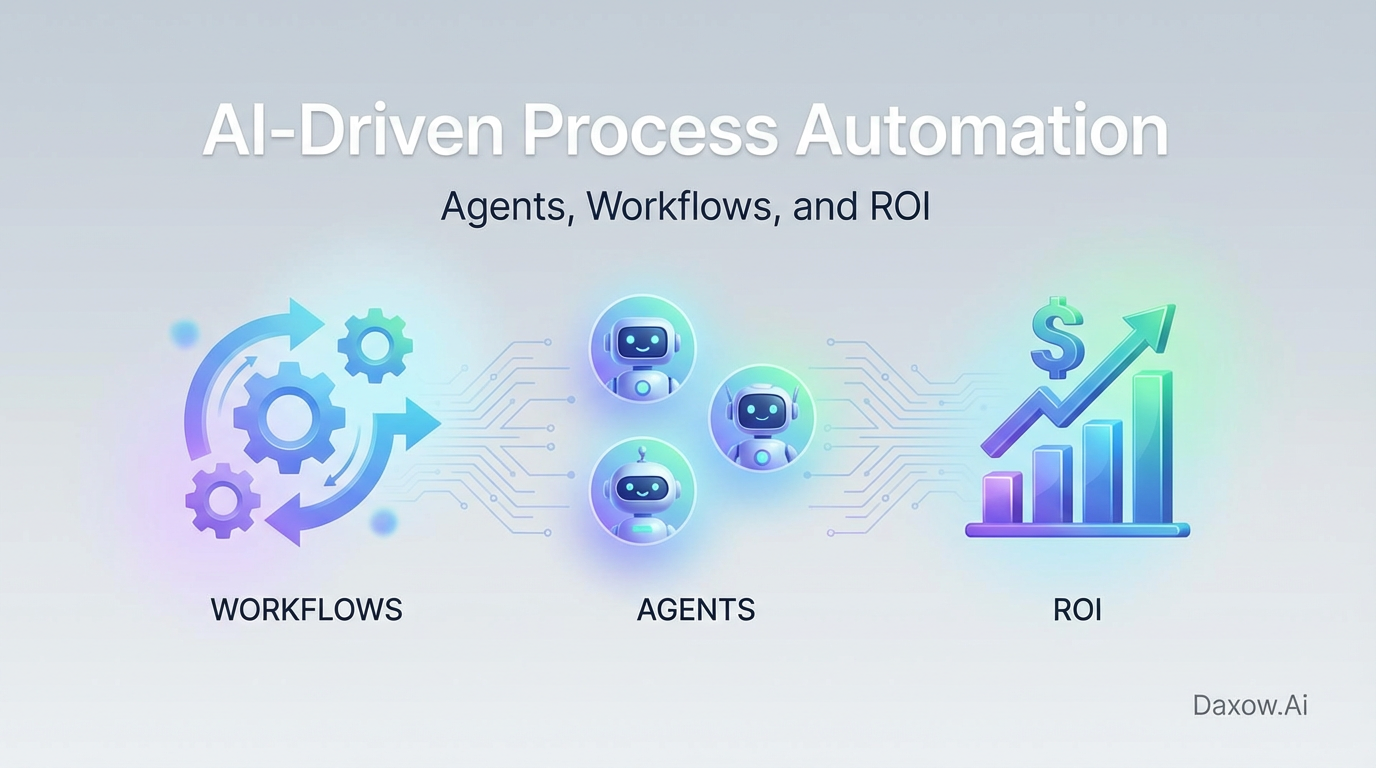
Learn how AI agents, workflow automation, and integrations cut manual work, lower costs, and deliver measurable ROI, with use cases and a 90-day Daxow.ai plan.
AI-driven process automation: How AI Agents and Workflow Automation Transform Business Operations
Estimated reading time: 15 minutes
Key Takeaways
- AI-driven process automation integrates AI agents with workflow orchestration to reduce manual work and boost productivity.
- Research shows significant efficiency, cost reduction, and scalability benefits from AI automation adoption.
- Core components include AI agents, workflow orchestration, intelligent data extraction, and secure integrations.
- A practical implementation framework involves discovery, proof-of-value, integration, monitoring, and scaling.
- Industry-specific use cases demonstrate measurable ROI in sales, e-commerce, finance, healthcare, real estate, and customer support.
- Daxow.ai offers tailored AI automation solutions from discovery to continuous improvement and support.
Table of Contents
- AI-driven process automation — What it is and why it matters
- Research-backed benefits of AI-driven process automation
- Core components of an AI-driven process automation solution
- Practical implementation framework: From discovery to scale
- Use cases across industries — Real-world examples of AI-driven process automation
- Measuring ROI and KPIs for AI-driven process automation
- Common pitfalls and how to avoid them
- How Daxow.ai accelerates AI-driven process automation for your business
- Getting started — A practical 90-day plan
- Conclusion and next steps
- Frequently Asked Questions
AI-driven process automation — What it is and why it matters
AI-driven process automation combines artificial intelligence, machine learning models, and automation orchestration to execute end-to-end business processes with little or no human intervention. Unlike basic rule-based automation, AI-driven systems can interpret unstructured data, make context-aware decisions, and adapt workflows dynamically.
Why it matters today
- Reduce manual tasks: AI automation takes on repetitive, high-volume work such as data entry, document triage, and routine customer inquiries.
- Boost productivity: Teams focus on higher-value activities while AI agents handle routine actions, accelerating throughput and improving accuracy.
- Improve customer experience: Faster, consistent responses through customer support automation and intelligent routing increase satisfaction.
- Cut operational costs: Automating labor-intensive tasks lowers error rates and reduces headcount required for scale.
- Enable strategic insights: Workflow automation instruments data flows and produces analytics for continuous process improvement.
Research-backed benefits of AI-driven process automation
Recent industry research shows clear business benefits from adopting AI automation and workflow automation:
Efficiency and cost reduction
- 30–70% reduction in manual processing time for routine workflows.
- 40–60% decrease in support ticket resolution times with customer support automation.
- Lower error rates in data extraction and compliance checks through intelligent document processing.
Productivity and workforce reallocation
- Employees spend less time on repetitive tasks and more on customer-facing or revenue-generating work.
- AI agents handle first-pass processing and triage, enabling human experts to focus on exceptions and complex decisions.
Scalability and resilience
- During peak seasons, automated systems maintain SLA levels without hiring temporary staff.
- Integrated automation decreases dependencies on single human operators and reduces process fragility.
Core components of an AI-driven process automation solution
AI Agents
- Autonomous task execution: AI agents perform sequence of actions—reading emails, extracting data, initiating transactions.
- Decision-making: Agents evaluate rules and model outputs to decide next steps or escalate to humans.
- Actionability: Agents integrate with business systems (CRM, ERP, ticketing) to make real changes.
Workflow Automation and Orchestration
- Process mapping: Define end-to-end workflows and decision points.
- Event-driven triggers: Start workflows from email, form submissions, or CRM updates.
- Human-in-the-loop: Blend automation with approvals for compliance and complex exceptions.
Intelligent Data Extraction and Document Automation
- NLP and OCR: Extract structured data from unstructured documents like invoices, contracts, and forms.
- Validation pipelines: Cross-check extracted data against business rules and external sources.
Integrations and Data Connectivity
- APIs and connectors: Integrate automation with CRMs, ERPs, messaging platforms, and databases.
- Secure data flows: Ensure encryption, access controls, and audit trails to meet compliance.
Practical implementation framework: From discovery to scale
1. Process discovery and prioritization
- Map current workflows and quantify manual effort and error rates.
- Prioritize processes with high volume, repetitive tasks, and clear rules.
- Use quick ROI calculators: estimate time saved, cost reduction, and projected payback period.
2. Proof of value (POV)
- Build a minimal viable AI agent for a focused subprocess (e.g., invoice processing, lead qualification).
- Measure KPIs: processing time, accuracy, reduction in manual hours.
- Iterate on models and rules while validating business assumptions.
3. Integration and orchestration
- Connect the AI agent to production systems using secure APIs.
- Implement orchestration layer to coordinate tasks, logging, and retries.
- Establish human-in-the-loop workflows where required.
4. Monitoring, governance, and continuous improvement
- Set up dashboards for performance, error rates, and cost savings.
- Define governance: model update cadence, access controls, and exception handling.
- Continuously retrain models using new labeled data and business feedback.
5. Scale and expand
- Identify adjacent processes for automation leveraging the same components.
- Standardize connectors and reusable templates for faster rollout.
- Track cumulative ROI and use savings to fund further automation.
Use cases across industries — Real-world examples of AI-driven process automation
Technology and SaaS — Lead qualification and sales automation
- Challenge: Sales teams waste time on unqualified leads.
- Solution: AI-driven lead qualification agents score inbound leads using enrichment data and engagement signals, push qualified leads to CRM, and schedule demo slots automatically.
- Business impact: increase conversion rates, reduce SDR manual outreach time, and accelerate time-to-revenue.
E-commerce — Order processing and returns automation
- Challenge: High volume of orders and returns with manual verification.
- Solution: AI agents validate orders against fraud signals, update inventory, and trigger fulfillment workflows. For returns, document automation extracts RMA data and automates approvals.
- Business impact: faster order fulfillment, reduced chargebacks, lower support workload, improved customer satisfaction.
Finance and Accounting — Invoice processing and accounts reconciliation
- Challenge: Manual invoice entry and reconciliation cause delays.
- Solution: Intelligent document processing extracts invoice fields, matches against purchase orders, and initiates payment approval workflows. AI agents reconcile accounts, surface exceptions, and post entries to ERP.
- Business impact: reduced processing costs, improved cash flow visibility, and shorter payment cycles.
Healthcare — Patient intake and claims processing
- Challenge: Manual form processing and claim adjudication slow throughput.
- Solution: Automated intake uses NLP to extract patient information, verify insurance eligibility, and pre-fill EHR fields. Claims automation validates coding and routes exceptions.
- Business impact: Lower administrative burden, faster reimbursements, and improved compliance.
Real Estate — Tenant onboarding and document automation
- Challenge: High-touch onboarding with many documents to verify.
- Solution: AI agents extract lease data, verify identity, run background checks via integrations, and trigger billing and access provisioning.
- Business impact: Shorter onboarding time, fewer errors, and consistent tenant experiences.
Customer Support — Customer support automation
- Challenge: High volume of repetitive queries drains support teams.
- Solution: Conversational AI agents handle 60–80% of routine inquiries (billing, status updates), escalate complex tickets to human agents with context and suggested responses.
- Business impact: faster resolution, lower cost-per-ticket, improved customer satisfaction.
Measuring ROI and KPIs for AI-driven process automation
Setting the right metrics ensures transparency and supports continued investment.
Key KPIs to track
- Time saved per transaction: Average reduction in manual processing time.
- Automation coverage: Percentage of process steps fully automated.
- Error reduction: Decrease in data entry and processing errors.
- Cost per transaction: Total operational cost divided by transactions processed.
- Customer satisfaction (CSAT/NPS): Improvements attributable to faster service.
Calculating ROI
- Estimate labor hours saved * fully loaded labor cost = annual labor savings.
- Add cost reductions from error prevention and faster cycle times.
- Subtract automation operating costs (cloud, licensing, development).
- Include strategic value: increased capacity to handle growth without hiring.
Common pitfalls and how to avoid them
Over-automation without governance
- Risk: Automating decisions without adequate guardrails causes compliance and quality issues.
- Mitigation: Implement human-in-the-loop checkpoints, audit logs, and rollback mechanisms.
Poor data quality
- Risk: Garbage in, garbage out — models underperform with noisy data.
- Mitigation: Establish data validation routines, enrichment, and feedback loops to improve model inputs.
Ignoring change management
- Risk: Teams resist automation if impacts to roles are unclear.
- Mitigation: Communicate value, provide retraining pathways, and involve stakeholders during design.
Siloed integrations
- Risk: Point-to-point automations create maintenance burdens.
- Mitigation: Adopt standardized connectors, API-driven architecture, and a centralized orchestration layer.
How Daxow.ai accelerates AI-driven process automation for your business
Tailored discovery and solution design
- We map your current workflows, quantify manual tasks, and prioritize opportunities based on ROI.
- Daxow.ai designs custom AI agents and workflows that address your unique operational constraints and compliance needs.
End-to-end implementation
- From model selection and training to secure integrations, Daxow builds production-ready automation.
- We deploy workflow automation and orchestration layers that connect CRMs, ERPs, and other business systems.
Reducing operational costs and improving ROI
- Our projects focus on rapid proof-of-value followed by iterative scaling.
- Daxow.ai targets measurable metrics (time saved, error reduction, cost per transaction) and aligns automation outcomes with business KPIs.
Building AI agents that execute real tasks
- Daxow develops AI agents capable of executing transactions, initiating approvals, and handling exceptions.
- Agents are delivered with governance, logging, and human-in-the-loop controls to ensure safety and compliance.
Continuous improvement and support
- We provide monitoring, retraining, and maintenance to keep models performing as data and processes evolve.
- Daxow supports change management, training, and documentation for seamless adoption.
Getting started — A practical 90-day plan
Days 0–30: Discovery and prioritization
- Conduct process mapping workshops.
- Select 1–2 high-impact processes for a proof of value.
- Define KPIs and success criteria.
Days 31–60: Build and validate
- Develop minimal AI agent and integrate with systems.
- Run controlled tests and iterate on accuracy and rules.
- Train staff on human-in-the-loop procedures.
Days 61–90: Deploy and measure
- Deploy to production for scaled usage.
- Monitor KPIs, collect feedback, and refine.
- Plan rollout for additional processes.
Conclusion and next steps
AI-driven process automation is no longer a speculative advantage; it is a practical lever for improving productivity, reducing manual tasks, and transforming customer and employee experiences. By combining AI agents, workflow automation, document intelligence, and robust integrations, organizations can cut costs, scale efficiently, and free talent to focus on strategic work.
Daxow.ai partners with businesses to design, build, and scale these systems end-to-end. If you are ready to reduce manual tasks, improve productivity, and realize measurable ROI through business automation, take the next step.
Contact Daxow.ai to book a free consultation or request a process analysis for your company and begin your AI-driven process automation journey today.
Frequently Asked Questions
What distinguishes AI-driven process automation from traditional automation?
AI-driven automation uses machine learning and AI to interpret unstructured data, make decisions, and dynamically adjust workflows, unlike traditional rule-based automation that follows static, pre-defined rules.
How quickly can my organization expect to see ROI from implementing AI automation?
ROI timelines vary, but with focused implementation and proof-of-value projects, measurable savings and efficiency gains can be seen within 3 to 6 months of deployment.
What industries benefit most from AI-driven process automation?
AI automation benefits a wide range of industries including technology, e-commerce, finance, healthcare, real estate, and customer support, particularly where repetitive, data-intensive tasks exist.
How does Daxow.ai ensure compliance and governance in AI-driven automation?
Daxow.ai incorporates human-in-the-loop controls, audit logs, role-based access, and continuous monitoring to ensure automation complies with industry regulations and internal governance standards.