
AI Automation for Business: Roadmap, Use Cases & ROI
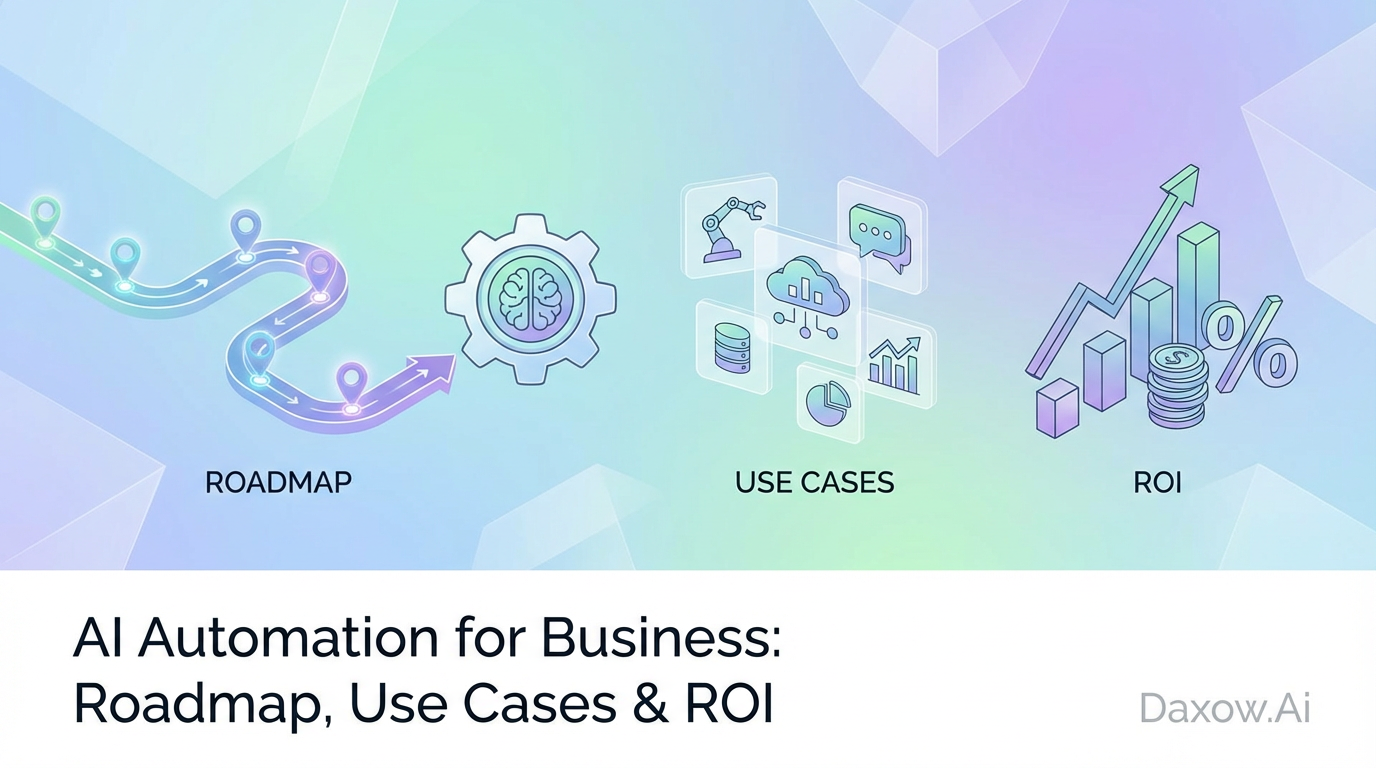
Transform business processes with AI automation — reduce costs, boost productivity, and follow a practical roadmap with industry use cases and Daxow.ai services.
AI Automation: Transforming Business Processes for Competitive Advantage
Estimated reading time: 12 minutes
Key Takeaways
- AI automation integrates AI and workflow automation to boost efficiency and reduce manual work across industries.
- Autonomous AI agents handle complex tasks beyond traditional RPA by learning, reasoning, and integrating deeply.
- Workflow automation orchestrates human-machine collaboration with governance and real-time monitoring.
- Daxow.ai offers expert end-to-end AI automation design, deployment, and governance for rapid ROI.
- Industries such as e-commerce, healthcare, finance, real estate, HR, and B2B sales benefit from tailored AI solutions.
- Measuring ROI with KPIs and avoiding pitfalls through data quality and governance are essential best practices.
Table of Contents
- AI Automation: Transforming Business Processes for Competitive Advantage
- How AI Agents and Workflow Automation Drive Transformation
- Implementation Steps and Best Practices — A Practical Roadmap
- Use Cases — Practical Examples Across Industries
- Measuring ROI and Business Value
- Avoiding Common Pitfalls — Practical Mitigations
- How Daxow.ai Delivers End-to-End Business Automation
- Getting Started — A Practical Checklist
- Frequently Asked Questions
AI Automation: Transforming Business Processes for Competitive Advantage
AI Automation: Transforming Business Processes for Competitive Advantage is no longer a future promise — it is a strategic imperative. Business leaders who deploy AI automation and workflow automation effectively unlock significant productivity gains, reduce manual tasks, and create differentiators in customer experience and operational cost. This article explains what AI automation means for businesses, shows how AI agents and workflow automation deliver measurable value, provides practical use cases across industries, and lays out a clear, actionable implementation path. Throughout, we show how Daxow.ai — an AI automation agency founded in Estonia in 2024 — partners with organizations to design, build, and scale custom AI systems that deliver rapid ROI.
What AI automation does for modern enterprises
AI automation combines artificial intelligence with workflow automation to handle both rule-based and cognitively complex tasks. The result is faster decision-making, fewer errors, and continuous operation at scale.
- Automate repetitive work: Routine data entry, invoice processing, and standard customer queries are automated to reduce manual tasks.
- Handle complex, unstructured data: AI agents extract meaning from documents, emails, and voice transcripts to make actionable decisions.
- Enable 24/7 responsiveness: Customer support automation and intelligent assistants provide immediate responses and triage outside business hours.
- Deliver measurable cost savings: Targeted automation can reduce process costs by 30–50% and cut data processing errors dramatically.
These capabilities position organizations to respond faster to market changes, make data-driven decisions, and free skilled staff to focus on higher-value activities.
How AI Agents and Workflow Automation Drive Transformation
What AI agents bring beyond traditional RPA
AI agents are autonomous systems that reason, learn, and act across applications and systems. Unlike traditional RPA, which follows rigid scripts, AI agents interpret unstructured inputs, make context-aware decisions, and interact with APIs and users.
- End-to-end task execution: An AI agent can read an incoming contract PDF, extract clauses, populate a contract management system, and alert legal for exceptions.
- Continuous learning: Agents retrain on new examples to improve accuracy in document extraction, classification, and decision-making.
- Seamless integrations: Agents connect with CRMs, ERPs, and cloud platforms to eliminate manual handoffs and data silos.
Workflow automation for orchestration and governance
Workflow automation structures how tasks flow between humans and machines. It enforces business rules, maintains audit trails, and triggers interventions when exceptions occur.
- Orchestrated handoffs: Automated approvals move from agent to manager only when thresholds are met.
- Real-time monitoring: Dashboards track throughput, accuracy, and cycle time to ensure KPIs are met.
- Governance: Policies for data privacy, model explainability, and versioning reduce risk of shadow AI.
Implementation Steps and Best Practices — A Practical Roadmap
1. Define objectives and map processes
- Use an AI-first scorecard to prioritize processes by volume, cost, and complexity.
- Set measurable targets: examples include 20% cost reduction in accounts payable, 40% faster response time in customer support, or a 25% increase in qualified leads.
- Map current-state processes and identify bottlenecks and integration points.
2. Assess data quality and connectivity
- Audit data sources for completeness and consistency.
- Standardize formats and create pipelines that feed clean data to models and agents.
- Ensure compliance with data privacy and regulatory requirements.
3. Prototype with a fail-fast mindset
- Start with a low-risk pilot — for example, automating standard refund requests or onboarding forms.
- Use small, cross-functional teams to validate value and operational impact.
- Measure accuracy, speed, and end-user satisfaction to determine readiness for scale.
4. Build integrations and scale incrementally
- Select API-first platforms and modular architectures to integrate with CRMs, ERPs, and collaboration tools.
- Automate observability, logging, and alerting to detect degradation early.
- Expand from pilot to adjacent processes once KPIs exceed predefined thresholds.
5. Monitor, iterate, and govern
- Track core KPIs: throughput, error rate, cost per transaction, and ROI.
- Incorporate human-in-the-loop for continuous improvement and edge-case handling.
- Enforce model governance, bias checks, and data lineage to ensure ethical AI use.
Use Cases — Practical Examples Across Industries
E-commerce — Order-to-cash and personalization
- Challenge: High volume of customer inquiries about orders, returns, and stock levels; manual reconciliation of orders and invoices.
- Solution: Deploy customer support automation with chatbots that resolve common queries and AI agents that reconcile orders with payments and trigger fulfillment if exceptions are low.
- Impact: Reduce manual tasks in order management by up to 60%; faster fulfillment and improved NPS through proactive status updates.
- Daxow.ai role: Build chatbots, integrate with inventory and payment systems, and create analytics to predict stockouts.
Healthcare — Clinical documentation and triage
- Challenge: Clinicians spend excessive time on documentation; appointment scheduling inefficiencies reduce capacity.
- Solution: AI agents transcribe and summarize clinical notes into EHRs, while chatbots triage patient inquiries and schedule appointments.
- Impact: Boost productivity by returning clinician hours to patient care; reduce administrative errors and wait times.
- Daxow.ai role: Ensure secure integrations with health records, implement privacy-first pipelines, and monitor model accuracy and compliance.
Finance — Invoice processing and risk surveillance
- Challenge: Manual invoice approvals and slow fraud detection increase cycle times and financial risk.
- Solution: Workflow automation routes invoices based on rules and AI agents extract line-item data for automated reconciliation. Agents continuously monitor transactions for anomalous patterns.
- Impact: Reduce processing costs by 30–50% and detect fraud faster, lowering financial exposure.
- Daxow.ai role: Automate invoice extraction, integrate with accounting systems, and deploy anomaly detection models with alerting.
Real estate — Lead qualification and valuation
- Challenge: High volume of inbound leads and time-consuming property valuations.
- Solution: AI agents qualify leads via conversational screening and run automated valuation models using market data and listing attributes.
- Impact: Increase sales productivity by focusing agents on high-value prospects and reducing time to close.
- Daxow.ai role: Connect lead sources, build AI qualification flows, and integrate valuation outputs into CRM workflows.
HR — Talent screening and onboarding
- Challenge: Manual resume screening and repetitive onboarding tasks slow hiring and increase time-to-productivity.
- Solution: AI automates resume scoring, schedules initial interviews via conversational assistants, and populates onboarding systems.
- Impact: Reduce manual tasks in hiring, decrease time-to-hire, and improve candidate experience.
- Daxow.ai role: Implement talent pipelines, ensure bias mitigation in screening models, and automate payroll and compliance workflows.
B2B Sales — Lead routing and proposal generation
- Challenge: Sales teams spend time on administrative work and repetitive proposal drafting.
- Solution: AI agents extract qualification data, prioritize leads, and generate customizable proposal drafts tailored to buyer signals.
- Impact: Increase win rates by enabling sellers to spend more time selling and delivering consistent, faster proposals.
- Daxow.ai role: Integrate with CRM, automate lead scoring, and build proposal templates linked to product and pricing catalogs.
Measuring ROI and Business Value
AI automation produces both quick wins and enduring strategic value. Typical outcomes observed across projects include:
- Time savings: 40–60% reduction on automatable tasks, freeing staff for higher-value work.
- Cost reduction: 30–50% cost savings on targeted processes.
- Productivity gains: Average improvement of 25% in throughput and responsiveness.
- Error reduction: Up to 90% reduction in data processing errors with automated extraction and validation.
- Rapid ROI: Clients focused on high-impact processes often see 3–5x ROI within 12 months.
To quantify ROI, measure baseline metrics before deployment, then track KPIs such as cycle time, error rate, full-time-equivalent (FTE) hours reclaimed, and revenue impact from improved customer engagement. Daxow.ai emphasizes measurable outcomes and produces a business case as part of every engagement.
Avoiding Common Pitfalls — Practical Mitigations
Implementations fail when organizations skip foundational work. Key pitfalls and mitigations include:
- Poor data quality: Mitigate with early data audits and repeatable cleaning pipelines.
- Integration hurdles: Choose API-rich platforms and involve IT from project inception.
- Team resistance: Build change management into projects, provide training, and demonstrate quick wins.
- Uncontrolled growth (shadow AI): Centralize governance and require review gates for new automations.
- Ethical and compliance risks: Implement bias checks, explainability measures, and privacy controls.
Daxow.ai embeds these mitigations into its delivery model, combining technical development with governance and stakeholder engagement.
How Daxow.ai Delivers End-to-End Business Automation
Daxow.ai’s approach is designed for speed, accountability, and business impact:
- Discovery & process analysis: We map processes, quantify opportunity, and prioritize use cases with clear KPIs.
- Custom AI system design: We architect AI agents and workflow automation tailored to your tech stack and compliance needs.
- Integration & deployment: We connect to CRMs, ERPs, communication channels, and data lakes to ensure seamless automation.
- Monitoring & continuous improvement: We set up dashboards, retraining pipelines, and human-in-the-loop processes.
- Governance & security: We implement model governance, access controls, and privacy safeguards to reduce risk.
By combining domain expertise with engineering discipline, Daxow.ai turns process automation into sustained competitive advantage. Our projects emphasize measurable outcomes — reduced operational costs, improved productivity, and higher customer satisfaction.
Getting Started — A Practical Checklist
- Identify 2–3 high-volume processes where manual work is concentrated.
- Gather samples of documents, recordings, and CRM records that feed these processes.
- Set clear KPIs and a timeline for a pilot (typically 6–12 weeks).
- Ensure IT and data teams are available for integration and security reviews.
- Commit to a governance framework for model performance and privacy.
Daxow.ai can accelerate every step. We provide a clear plan, rapid prototyping, and the operational scaffolding to scale successful automations.
Frequently Asked Questions
What is AI automation and how does it differ from traditional automation?
AI automation integrates artificial intelligence with workflow automation, enabling systems to handle both repetitive rule-based tasks and complex cognitive tasks that require understanding unstructured data and context-aware decision-making. Traditional automation like RPA typically follows fixed scripts without learning capability.
How can AI agents improve business processes?
AI agents can operate autonomously across systems, continuously learn from data, integrate seamlessly with business applications, and perform end-to-end task execution. This reduces manual handoffs, accelerates workflows, and improves accuracy and responsiveness.
What industries benefit most from AI automation?
Industries such as e-commerce, healthcare, finance, real estate, human resources, and B2B sales have shown significant gains by automating customer service, documentation, invoice processing, lead qualification, talent screening, and sales proposal generation.
How does Daxow.ai support organizations in AI automation?
Daxow.ai partners with organizations to design, build, and scale custom AI automation systems. We use a phased approach covering discovery, design, integration, monitoring, and governance to ensure rapid ROI and sustainable competitive advantage.
What are some common challenges when implementing AI automation?
Challenges include poor data quality, integration hurdles, team resistance, uncontrolled shadow AI growth, and ethical or compliance risks. Addressing these early with audits, stakeholder engagement, governance, and training is crucial to success.