
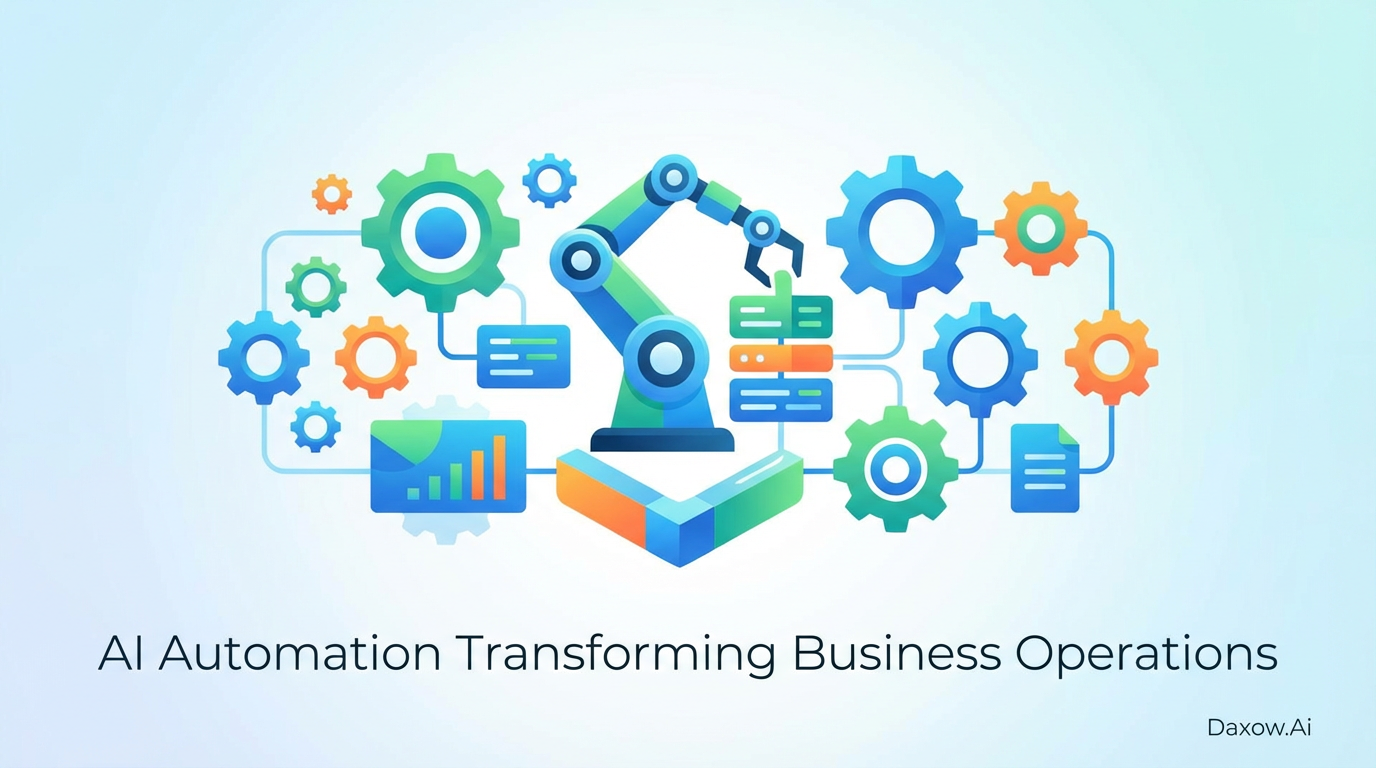
AI Automation Transforming Business Operations
Practical guide to using AI agents and workflow automation to cut costs, boost productivity, and measure ROI, with Daxow.ai implementation steps and use cases.
AI Automation: Transforming Business Operations for the Modern Enterprise
Estimated reading time: 15 minutes
Key Takeaways
- AI automation boosts productivity, reduces costs, and enhances customer experiences by automating repetitive business processes.
- AI agents and workflow automation enable autonomous, multi-step task execution with improved accuracy and speed.
- Industry-specific use cases demonstrate measurable benefits across e-commerce, healthcare, finance, real estate, HR, and customer support.
- A phased implementation roadmap ensures success from identifying opportunities to scaling and monitoring AI solutions.
- Measuring ROI with clear KPIs supports continuous investment and executive buy-in for AI automation initiatives.
- Daxow.ai offers end-to-end AI automation services tailored to business needs, from process assessment to autonomous operations.
Table of Contents
- Why AI Automation Matters
- How AI Agents and Workflow Automation Drive Business Value
- Practical Use Cases: Industry-Specific Applications
- Implementation Roadmap: From Idea to Production
- Measuring ROI and Business Impact
- How Daxow.ai Helps: From Assessment to Autonomous Operations
- Practical Examples: How Daxow.ai Applies AI Automation
- Getting Started: Practical Next Steps
- Conclusion and Call to Action
- Frequently Asked Questions
Why AI Automation Matters
Digital transformation initiatives increasingly converge on AI automation because it addresses core operational pain points: manual data handling, slow response times, and inconsistent service delivery. For business leaders, the promise is clear:
- Reduce operational costs by automating high-volume, repetitive processes.
- Improve productivity by freeing skilled employees from transactional work.
- Deliver superior customer experiences through faster, personalized service.
- Scale without linear headcount growth by deploying AI agents that execute real tasks.
Research and enterprise results consistently show measurable gains: targeted processes can see cost reductions of 20–50% and productivity improvements of 3–5x. These outcomes translate into faster decision-making, fewer errors, and improved margins—critical advantages in volatile markets.
How AI Agents and Workflow Automation Drive Business Value
AI agents combine natural language processing, machine learning, and systems integration to perceive context, make decisions, and take actions across systems. Unlike basic RPA, which mimics clicks and keystrokes, AI agents can handle multi-step journeys and maintain conversational context.
Key capabilities:
- Autonomous task execution: Process invoices end-to-end, escalate exceptions, and update ERP records without manual intervention.
- Conversational automation: Resolve customer queries through chatbots that escalate complex issues.
- Data extraction and document automation: Convert unstructured documents (invoices, contracts, forms) into structured data for downstream workflows.
- Predictive insights and routing: Use predictive models to prioritize leads, detect fraud, or preempt service issues.
Workflow automation orchestrates these capabilities across tools and systems. Together, AI agents and workflow automation reduce manual interventions in routine work by up to 70–80%, while improving accuracy and speed.
Practical Use Cases: Industry-Specific Applications
E-commerce and Retail
- Use case: Automate order-to-cash cycle, inventory reconciliation, and returns processing.
- AI automation components: Order validation agents, automated returns classification, personalized recommendation engines.
- Business outcomes: Faster fulfillment, lower cart abandonment, and improved inventory accuracy.
- KPI impact: Reduced order processing time, higher conversion rate, fewer fulfillment errors.
Healthcare
- Use case: Patient scheduling, pre-visit intake, billing reconciliation, and clinical documentation support.
- AI automation components: Document extraction from medical records, claim validation agents, appointment rescheduling bots.
- Business outcomes: Reduced administrative load for clinical staff, faster billing cycles, improved patient throughput.
- KPI impact: Lower claim denials, shorter wait times, higher patient satisfaction.
Finance and Banking
- Use case: Invoice processing, fraud detection, regulatory reporting, and customer onboarding.
- AI automation components: OCR-based invoice extraction, anomaly detection models, compliance rule engines, KYC automation.
- Business outcomes: Reduced errors and compliance risk, faster reconciliation, and lower operational costs.
- KPI impact: Fewer manual reconciliations, faster onboarding times, quantified fraud reductions.
Real Estate and Property Management
- Use case: Lead qualification, contract review, tenant onboarding, and maintenance request triage.
- AI automation components: AI agents for lead scoring, contract clause extraction, automated lease generation, and work order routing.
- Business outcomes: Shorter sales cycles, faster closings, and streamlined property operations.
- KPI impact: Higher lead conversion, lower time-to-contract, improved tenant satisfaction.
HR and People Operations
- Use case: Resume screening, interview scheduling, onboarding automation, and employee query resolution.
- AI automation components: Candidate matching engines, onboarding checklists executed by bots, HR chatbot for policy queries.
- Business outcomes: Faster hiring cycles, reduced administrative HR workload, and better new-hire experiences.
- KPI impact: Reduced time-to-hire (up to 40%), improved retention, and fewer HR support tickets.
Customer Support and Services
- Use case: Intelligent routing, first-contact resolution, and automated follow-ups.
- AI automation components: Multichannel chatbots, knowledge base augmentation, sentiment-aware escalation agents.
- Business outcomes: Higher first-contact resolution rates, reduced support headcount pressure, and consistent service quality.
- KPI impact: Lower average handle time, higher NPS, and reduced support costs.
Implementation Roadmap: From Idea to Production
1. Define objectives and identify target processes
- Start with measurable goals: reduce processing time, improve NPS, or cut processing costs.
- Audit workflows to find repetitive, high-volume tasks suitable for automation.
- Use process mapping to quantify cycle times, touchpoints, and exception rates.
- Prioritization criteria: ROI potential, data availability, and regulatory risk.
2. Assess data quality and accessibility
- Inventory data sources across systems: CRM, ERP, support platforms, document repositories.
- Standardize formats and address gaps in data quality.
- Ensure compliance with privacy and regulatory requirements before training models.
3. Select tools, platforms, and partners
- Choose scalable platforms that support API integrations, security standards, and observability.
- Evaluate vendors for model governance, retraining workflows, and enterprise-grade security.
- Assemble a cross-functional team: business owners, IT, data engineers, and change managers.
4. Develop AI agents and design workflows
- Define agent goals, conversation flows, decision rules, and fallback actions.
- Build knowledge bases and curate training examples for NLP models.
- Add guardrails for compliance, explainability, and safety.
- Emphasize error handling and human-in-the-loop paths for exceptions.
5. Test, pilot, and iterate
- Deploy in a controlled pilot with clear KPIs and rollback plans.
- Collect performance metrics, user feedback, and exception logs.
- Retrain models and refine business rules based on real-world usage.
6. Scale and monitor
- Roll out incrementally across teams and geographies.
- Monitor KPIs: processing time, error rate, cost per transaction, and customer satisfaction.
- Maintain continuous retraining, version control, and audit trails.
Best practices and pitfalls to avoid
- Best practice: Start with high-impact, low-risk processes to prove value quickly.
- Best practice: Define metrics upfront and instrument systems for measurement.
- Pitfall: Shadow AI—avoid ungoverned tools by involving stakeholders early.
- Pitfall: Ignoring data hygiene—poor data leads to unreliable models and user mistrust.
Measuring ROI and Business Impact
Quantifying value is essential for executive buy-in. Typical results observed across implementations include:
- Cost reductions: 20–50% in targeted, automated processes.
- Productivity gains: 3–5x improvements in throughput for reconciliations, claims, and support ticket handling.
- Faster time-to-service: Reduced processing times and improved customer response SLAs.
- Payback period: Mid-sized implementations typically recoup investments within 6–12 months.
Track these KPIs to validate impact:
- Cycle time per transaction
- Error or exception rate
- Volume handled per FTE
- Customer satisfaction (CSAT/NPS)
- Cost per transaction
These metrics create a defensible business case and support ongoing investment in AI automation.
How Daxow.ai Helps: From Assessment to Autonomous Operations
At Daxow.ai, we specialize in delivering end-to-end business automation tailored to your environment. Our approach focuses on measurable outcomes and seamless integration.
- Process discovery and analysis: We map your workflows, quantify manual effort, and identify automation targets to reduce manual tasks and increase productivity.
- Custom AI agents: We design AI agents that execute real tasks—conversational agents, document automation bots, and decision engines—configured to your business logic and compliance needs.
- Workflow automation and orchestration: We build robust workflows that integrate across CRMs, ERPs, support platforms, and cloud services to ensure reliable data flows and orchestration.
- Systems integration and data connectivity: We connect disparate systems, normalize data, and implement secure APIs to create a single operational fabric for automation.
- Implementation and change management: We run pilots, manage deployments, and train teams to adopt AI-first workflows, reducing operational friction and maximizing ROI.
- Monitoring, governance, and continuous improvement: We implement KPIs, retraining pipelines, and governance controls to keep models accurate, compliant, and aligned with business goals.
By combining technical expertise with business domain knowledge, Daxow.ai delivers solutions that reduce operational costs, improve customer support automation, and enable sales automation that converts more leads with less manual effort.
Practical Examples: How Daxow.ai Applies AI Automation
- For a mid-market e-commerce company, we implemented AI-powered order validation and returns processing, reducing manual handling by 60% and improving return cycle times.
- For a healthcare provider, we automated pre-visit intake and billing reconciliation, freeing nursing staff to focus on patient care and reducing billing errors.
- For a financial services firm, we deployed a fraud detection agent integrated with the transaction pipeline, reducing false positives and accelerating investigations.
- For a real estate group, we built lead qualification agents and contract extraction pipelines that shortened closing cycles and increased agent productivity.
Each engagement begins with a process analysis to define priorities and expected ROI, then progresses through pilot, scale, and governance phases. Learn more about our services to see how we can support your AI automation journey.
Getting Started: Practical Next Steps
- Conduct a quick process scan to identify 3–5 high-volume manual tasks.
- Define the business KPIs you want to influence (cost, speed, customer satisfaction).
- Run a small pilot with a clear success definition.
- Plan integrations and data access early to avoid delays.
- Establish monitoring and retraining practices from day one.
Conclusion and Call to Action
AI automation is no longer an optional experiment—it is a strategic capability that transforms operations, reduces manual tasks, and unlocks measurable productivity gains. Whether you need AI agents to handle customer interactions, workflow automation to orchestrate enterprise systems, or custom integrations to connect your data, Daxow.ai builds and delivers solutions that drive ROI and business resilience.
Book a free consultation with Daxow.ai to explore how AI Automation: Transforming Business Operations for the Modern Enterprise can be applied in your organization. Request a process analysis for your company and let us design a custom AI system that reduces costs, improves productivity, and scales with your business. Contact us today to get started.
Frequently Asked Questions
What types of business processes are best suited for AI automation?
Repetitive, high-volume tasks such as invoice processing, customer query resolution, document extraction, and lead qualification are ideal candidates for AI automation. These processes benefit most from improved speed, accuracy, and scalability.
How do AI agents differ from traditional robotic process automation (RPA)?
AI agents use natural language processing, machine learning, and decision-making capabilities to handle complex, multi-step operations with context awareness. Traditional RPA typically automates rule-based tasks by mimicking user actions but lacks adaptability and conversational context.
What industries can benefit most from implementing AI automation?
AI automation delivers value across industries such as e-commerce, healthcare, finance, real estate, human resources, and customer service. Each sector has unique processes that can be optimized for cost savings and improved customer experiences.
How should organizations measure the success of AI automation initiatives?
Success is typically measured by KPIs such as processing time per transaction, error or exception rates, volume handled per full-time employee, customer satisfaction scores (CSAT/NPS), and cost per transaction. Monitoring these metrics ensures ongoing value realization.