
Mastering AI Agents and Workflow Automation: A Business Roadmap
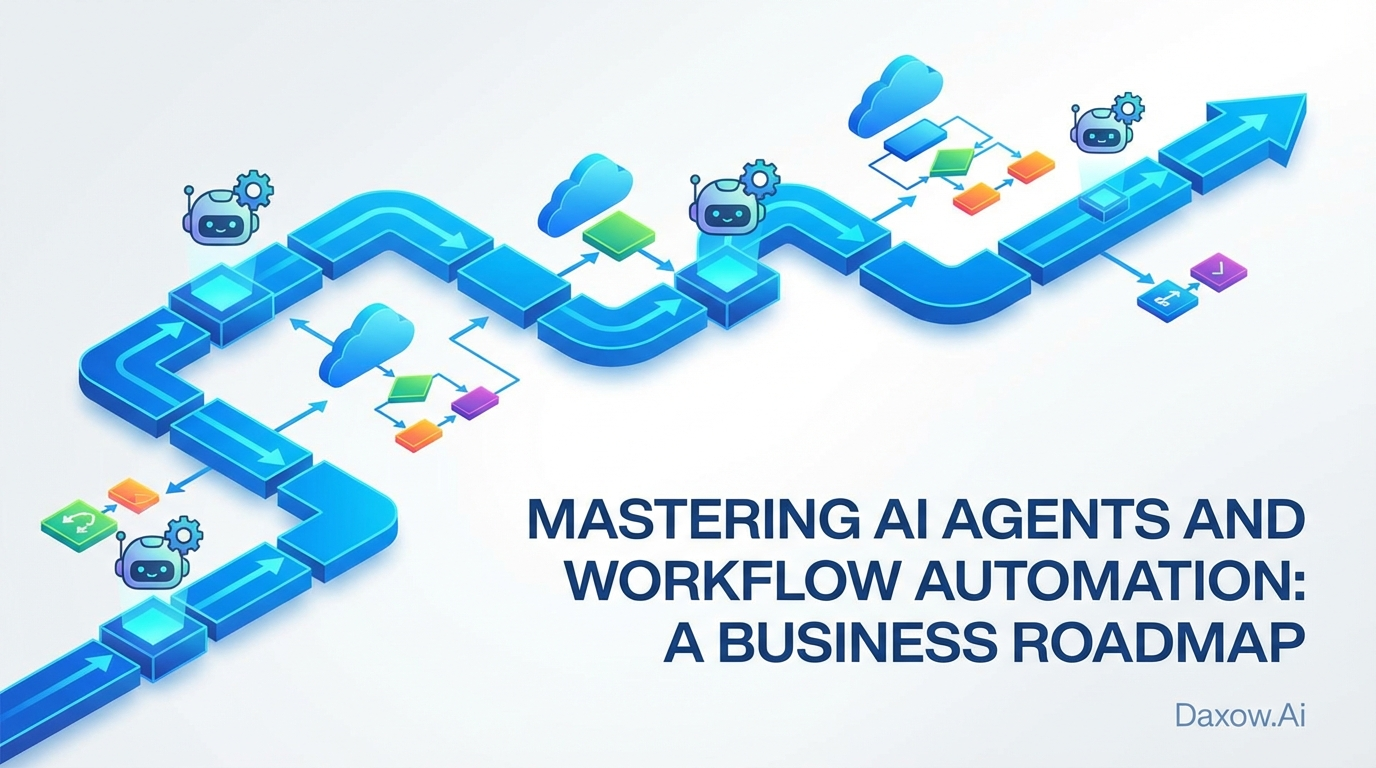
Practical roadmap to implement AI agents and workflow automation—use cases, KPIs, phased implementation, and how Daxow.ai builds and scales custom solutions.
Mastering AI Agents and Workflow Automation: A Strategic Roadmap for Business Transformation
Estimated reading time: 15 minutes
Key Takeaways
- AI agents and workflow automation unlock significant cost savings, productivity gains, and enhanced customer experiences.
- Practical use cases span industries including e-commerce, healthcare, finance, real estate, and HR.
- A phased implementation approach with clear objectives and secure integrations is essential for success.
- Continuous monitoring, iteration, and stakeholder buy-in ensure sustained ROI and scalability.
- Daxow.ai partners with businesses to design, build, and scale custom AI automation solutions.
Table of Contents
- Mastering AI Agents and Workflow Automation — Strategic Meaning for Business Leaders
- Practical Use Cases for Mastering AI Agents and Workflow Automation
- Implementation Steps and Best Practices for Mastering AI Agents and Workflow Automation
- Measuring ROI and Scaling Your Automation Program
- How Daxow.ai Helps Organizations Master AI Agents and Workflow Automation
- Common Objections and How to Address Them
- Frequently Asked Questions
- Conclusion and Call to Action
Mastering AI Agents and Workflow Automation — Strategic Meaning for Business Leaders
AI agents and workflow automation combine intelligent software entities with process orchestration to automate complex, decision-intensive work. Unlike rigid rule-based automation, AI agents adapt, learn, and act across multiple systems. For executives and operational leaders, this capability translates into measurable business value:
- Reclaim human capacity: Repetitive tasks like data entry and basic customer inquiries consume a significant portion of employee time. Automating these tasks frees staff for higher-value work.
- Reduce operational costs: Organizations implementing AI automation typically see cost reductions in the 20–50% range for targeted processes.
- Increase speed and accuracy: Processes can be 30–70% faster, with error rates falling below 1% in highly automated workflows.
- Enhance resilience and scalability: AI agents enable scaling without a proportional increase in headcount, crucial during talent shortages or market variability.
These outcomes make AI automation a pathway to better customer experiences, faster decision-making, and strategic agility.
What AI Agents Do Differently
AI agents combine ML models, natural language understanding, and integrations to:
- Understand context across conversations and records.
- Orchestrate multi-step processes (e.g., invoice validation → vendor query → ledger update).
- Execute real tasks across tools (CRMs, ERPs, ticketing systems).
- Learn from outcomes and improve through feedback loops.
Practical Use Cases for Mastering AI Agents and Workflow Automation
E-commerce — Order-to-Cash and Customer Experience
Use case:
An AI agent manages order validation, inventory checks, personalized post-purchase messaging, returns processing, and fraud detection.
Practical workflow:
- Customer places an order → agent verifies payment and stock.
- Agent updates inventory and triggers fulfillment.
- Post-purchase, the agent sends tailored recommendations and monitors for return triggers.
- If anomalies appear (fraud patterns, shipping exceptions), the agent escalates to human review.
Business value:
- Reduced cart abandonment and faster fulfilment.
- Lower manual dispute handling and improved NPS.
KPIs:
Order processing time, return rate, chargeback rate, customer satisfaction score.
Healthcare — Patient Onboarding and Administrative Relief
Use case:
Agents automate appointment scheduling, pre-visit paperwork, triage through chat, and billing reconciliation.
Practical workflow:
- Patient requests appointment → agent matches available slots and collects pre-visit intake.
- NLP triage flags urgent symptoms for clinical review.
- Billing agent matches claims to encounters and flags inconsistencies.
Business value:
- Reduced administrative burden, faster patient throughput, fewer billing errors.
KPIs:
Time-to-appointment, patient no-show rate, billing error rate, clinician time saved.
Finance — Compliance, Risk, and Transaction Monitoring
Use case:
Agents run KYC checks, transaction monitoring, loan pre-approval, and reconciliation.
Practical workflow:
- New application enters system → agent aggregates identity data and checks compliance lists.
- Transactions flagged by anomaly models are routed for investigation.
- Automated audit trails and reports are generated for compliance teams.
Business value:
- Faster approvals, reduced compliance overhead, and improved fraud detection.
KPIs:
Time-to-approval, false positive rate on alerts, compliance breach incidents.
Real Estate — Lead Qualification and Transaction Support
Use case:
Agents qualify incoming leads, schedule virtual tours, prepare contract drafts, and coordinate closings.
Practical workflow:
- Lead interacts with chatbot → agent qualifies based on budget, timing, preferences.
- Qualified leads receive automated property matches and tour scheduling.
- Transaction agent assembles documents, collects e-signatures, and tracks milestones.
Business value:
- Shorter sales cycles, higher lead-to-close conversion, improved client satisfaction.
KPIs:
Lead qualification rate, time from lead to showing, days-on-market.
HR — Recruitment and Onboarding
Use case:
Agents screen resumes, conduct preliminary interviews, schedule interviews, and personalize onboarding paths.
Practical workflow:
- Resume parser extracts skills and experience → agent pre-screens by match score.
- NLP-driven chat conducts initial screening and schedules interviews.
- Onboarding agent sequences required training and checks compliance milestones.
Business value:
- Faster hiring cycles, improved candidate experience, reduced time-to-productivity.
KPIs:
Time-to-hire, offer acceptance rate, onboarding completion rate.
Implementation Steps and Best Practices for Mastering AI Agents and Workflow Automation
1. Define Clear Objectives and Prioritize Processes
- Identify repetitive, high-volume processes with measurable KPIs that map to ROI.
- Set clear goals: cost reduction, throughput increase, or customer satisfaction improvements.
Daxow.ai role:
Conducts process audits to identify top-priority automation candidates and expected ROI.
2. Assess Data, Tools, and Security Requirements
- Evaluate data quality, availability, and compliance constraints.
- Choose platforms that integrate with your CRM, ERP, ticketing, and other core systems.
- Design secure data pipelines and governance.
Daxow.ai role:
Designs data architecture, ensures secure integrations, and helps select scalable AI infrastructure.
3. Build a Cross-Functional Team
- Include stakeholders from IT, operations, legal, and business units.
- Train users and define human-AI handoffs.
Daxow.ai role:
Provides project management, change management, and stakeholder alignment to prevent shadow automation.
4. Prototype, Test, and Deploy in Phases
- Start with a pilot that delivers a quick win (3–6 months).
- Use A/B testing and tight monitoring to validate impact.
- Gradually expand scope and complexity.
Daxow.ai role:
Develops pilots with custom AI agents, integrates them into live workflows, and optimizes before scale.
5. Monitor, Measure, and Iterate
- Track cost savings, throughput, error rates, and user satisfaction.
- Retrain models regularly and incorporate feedback loops.
Daxow.ai role:
Establishes monitoring dashboards, maintenance plans, and continuous improvement cycles.
Best practices summary:
- Start small to build stakeholder buy-in.
- Ensure human-AI governance for safe, auditable decisions.
- Plan integrations and data pipelines upfront to avoid rework.
- Involve IT early and communicate goals organization-wide.
Measuring ROI and Scaling Your Automation Program
Quantifying impact is essential for sustained investment.
- Quick wins: Target processes that provide immediate cost savings (e.g., invoice processing, lead qualification). Typical pilots deliver measurable returns within 3–6 months.
- Metrics to track:
- Cost reduction percentage for the process.
- Time saved per transaction or case.
- Error rate and rework reduction.
- Customer metrics (NPS, response time).
- Scaling strategy:
- Use pilot results to build a prioritized backlog of automations.
- Reuse modules (e.g., a document extraction component) across processes.
- Maintain governance and continuous model retraining.
Expected outcomes:
- 20–50% process cost reduction.
- 30–70% faster throughput on automated workflows.
- Drop in manual error rates below 1% for mature implementations.
How Daxow.ai Helps Organizations Master AI Agents and Workflow Automation
Daxow.ai is an AI automation agency founded in Estonia in 2024 with a pragmatic, end-to-end approach to business automation. We partner with companies to move from process discovery to production-grade AI systems.
Our services include:
- Process analysis and strategy: We map workflows, estimate ROI, and prioritize automation opportunities.
- Custom AI agents: We design agents that execute real tasks — from customer triage bots to autonomous transaction handlers.
- Workflow automation: We orchestrate end-to-end processes across systems, eliminating manual handoffs and reducing cycle times.
- Chatbots and support automation: We build conversational agents that resolve issues, escalate appropriately, and improve CSAT.
- Lead qualification and sales automation: We implement intelligent lead routing, scoring, and nurture flows that accelerate sales pipelines.
- Data extraction and document automation: We extract structured data from unstructured documents and feed it into back-office systems.
- Integrations with business tools and CRMs: We connect AI capabilities to your existing stacks for seamless operations.
How we work:
- Discovery: We run a process analysis to identify high-impact opportunities and present a prioritized roadmap.
- Build: We develop custom agents and integrations tailored to your tools and compliance needs.
- Deploy: We pilot, measure, and refine in live environments.
- Operate: We provide ongoing monitoring, model retraining, and optimization to maximize ROI.
Business outcomes Daxow.ai delivers:
- Reduced manual tasks and operational costs.
- Improved productivity and throughput.
- Better customer experiences through faster, more accurate responses.
- Stronger ROI from prioritized, measurable pilots that scale.
Discover more about our services and how we can drive your automation transformation.
Common Objections and How to Address Them
- “We lack clean data.” — Start with small, structured datasets and iterative cleaning; Daxow.ai builds robust data pipelines and validation flows.
- “This will eliminate jobs.” — Focus on redeploying staff to higher-value roles; automation reduces drudgery and improves employee engagement.
- “Security and compliance concerns.” — We design secure integrations, audit trails, and governance frameworks aligned with your requirements.
- “Integration complexity.” — We specialize in CRM, ERP, and third-party integrations and deliver phased integration roadmaps.
Frequently Asked Questions
What is the main difference between AI agents and traditional automation?
AI agents use machine learning and natural language understanding to adapt and learn from workflows, while traditional automation relies on pre-defined, rigid rules.
How does Daxow.ai ensure data security?
We design secure data pipelines, incorporate compliance frameworks, and apply governance best practices to protect your sensitive information throughout the automation lifecycle.
How quickly can businesses expect to see ROI from AI automation?
Typical pilots deliver measurable returns within 3 to 6 months, with significant cost and efficiency gains as automation scales.
Are AI agents compatible with existing CRM and ERP systems?
Yes. Daxow.ai specializes in integrating AI agents seamlessly with popular CRM, ERP, ticketing, and other business systems.
Conclusion and Call to Action
Mastering AI Agents and Workflow Automation delivers measurable operational efficiency, improved customer experience, and strategic agility. The path is practical: prioritize high-impact processes, pilot thoughtfully, and scale with governance. Daxow.ai partners with organizations to design and deploy custom AI systems that reduce manual work, boost productivity, and drive measurable ROI.
Request a process analysis for your company or book a free consultation with Daxow.ai to identify your highest-value automation opportunities and start building a custom AI system that executes real tasks. Contact us today to begin your automation transformation.