
AI Agents for End-to-End Workflow Automation: Practical Guide
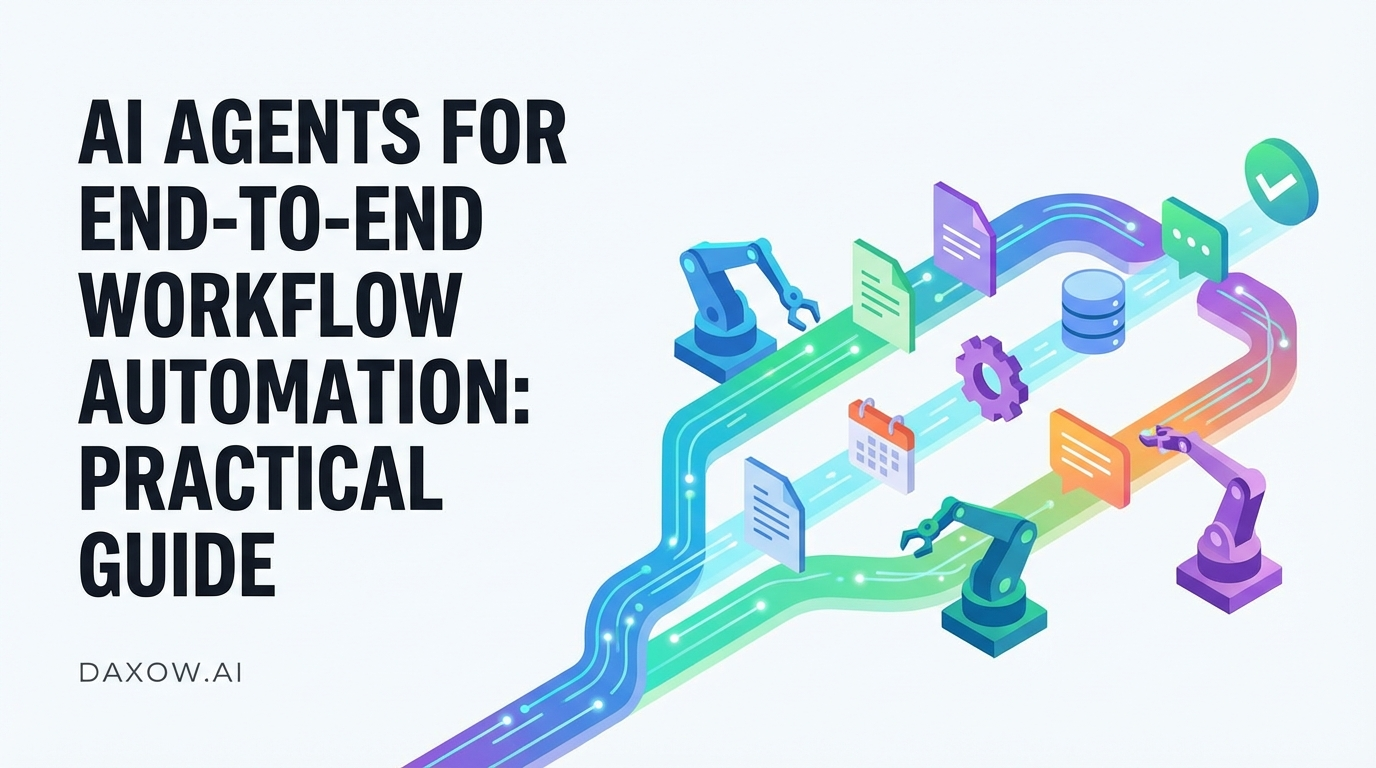
Practical playbook to deploy AI agents that automate end-to-end workflows, reduce manual tasks, and boost productivity with use cases, KPIs, and rollout steps.
AI Agents for End-to-End Workflow Automation: A Practical Guide to Reducing Manual Tasks and Boosting Productivity
Estimated reading time: 15 minutes
Key Takeaways
- AI agents enable automation of multi-step workflows combining AI and orchestration for measurable ROI.
- Implementations focusing on high-volume, repetitive processes yield the fastest business impact.
- Cross-industry use cases span e-commerce, finance, healthcare, real estate, HR, and customer support.
- Success depends on governance, human-in-the-loop frameworks, and continuous improvement.
- Daxow.ai offers end-to-end design, build, integration, and scaling services for AI workflow automation.
Table of Contents
- AI Agents for End-to-End Workflow Automation — Why Now?
- How AI Agents Deliver Business Value
- Use Cases — Practical Examples Across Industries
- Implementation Framework — From Discovery to Scale
- Measuring Success — KPIs and ROI
- Risk Management and Best Practices
- How Daxow.ai Helps — From Strategy to Live AI Agents
- Realistic Example — Automating Invoice-to-Pay with an AI Agent
- Adoption Checklist for Decision-Makers
- Frequently Asked Questions
AI Agents for End-to-End Workflow Automation — Why Now?
Market momentum and business drivers
- Automation expectations are rising. Organizations face higher customer expectations, tighter margins, and a talent shortage that makes manual, repetitive tasks a liability.
- AI + orchestration unlocks end-to-end value. Combining AI capabilities (NLP, RPA, document understanding) with workflow orchestration enables automation beyond isolated tasks — handling multi-step processes that previously required human coordination.
- Top business outcomes sought: lower operational costs, faster response times, improved compliance, higher employee productivity, and better customer satisfaction.
Key research insights (industry synthesis)
- Enterprises adopting AI automation consistently report significant reductions in manual effort across routine processes.
- Implementations focused on targeted workflow automation (e.g., lead qualification, invoice processing, support triage) produce the fastest measurable ROI.
- AI agents — autonomous or semi-autonomous systems that execute defined tasks and make decisions — are the most effective way to scale complex process automation.
How AI Agents Deliver Business Value
What an AI agent does in a workflow
- Sense: Ingest data from emails, forms, CRMs, chat, documents, sensors.
- Decide: Apply rules, ML models, and retrieval-augmented reasoning to determine the next action.
- Act: Write back to systems, trigger other tools, notify humans, or execute transactions.
- Learn: Capture outcome data and improve over time via feedback loops.
Core value drivers
- Reduce manual tasks by automating repetitive decision and data-entry work.
- Boost productivity by freeing staff for high-value activities (strategy, complex problem-solving).
- Improve speed and consistency by enforcing standardized workflows and policies.
- Enhance customer experience via faster response times and 24/7 automated support.
- Lower operational costs by shifting routine work from humans to automated agents.
Use Cases — Practical Examples Across Industries
E‑commerce
- Order triage and exception handling: AI agents ingest order data, verify payment and inventory, and escalate discrepancies. Outcome: fewer delayed shipments and lower manual follow-ups.
- Personalized fulfillment orchestration: Agents route orders to optimal warehouses and create returns workflows automatically. Outcome: reduced shipping costs and fewer returns disputes.
- Sales automation: Lead qualification agents score and enrich leads, then create prioritized tasks in the CRM for sales reps. Outcome: better conversion rates and fewer wasted outreach cycles.
Finance and Accounting
- Invoice processing and PO matching: AI agents extract invoice fields, match to purchase orders, flag mismatches, and route approvals. Outcome: faster payment cycles and reduced late fees.
- Expense policy enforcement: Agents classify expenses, detect anomalies, and trigger audits or manager approvals. Outcome: improved compliance and reduced fraud risk.
- Reconciliation automation: Agents reconcile accounts by matching transactions and creating exception tickets. Outcome: fewer manual reconciliations and faster close cycles.
Healthcare
- Patient intake automation: AI agents extract information from forms, validate insurance, schedule appointments, and pre-populate EHRs. Outcome: shorter wait times and fewer input errors.
- Clinical documentation support: Agents summarize visit notes and generate coding suggestions for billing. Outcome: increased clinician productivity and better reimbursement capture.
- Prior authorization and claims triage: Agents check requirements, prepare submissions, and track approvals. Outcome: fewer denied claims and faster revenue recognition.
Real Estate and Property Management
- Lead qualification and viewing scheduling: Agents qualify prospects based on criteria, schedule showings, and send follow-ups. Outcome: higher tour-to-lease conversion.
- Document automation: Lease generation, renewals, and e-signature workflows fully automated. Outcome: reduced administrative overhead and faster move-ins.
- Maintenance ticket automation: Agents categorize maintenance requests, route to vendors, and follow up until closure. Outcome: improved tenant satisfaction and reduced resolution times.
HR and Admin
- Candidate screening: Agents parse resumes, score candidates against job requirements, and schedule interviews. Outcome: shorter hiring cycles and better fit hires.
- Employee onboarding: Agents provision accounts, queue training, and ensure policy acknowledgements. Outcome: consistent onboarding and faster time-to-productivity.
- Compliance reporting: Agents aggregate required documentation and prepare audit-ready reports. Outcome: reduced compliance risk and lower manual effort.
Customer Support and Sales Automation
- Customer support automation: Conversational AI agents handle common inquiries, retrieve account data, and resolve tickets or escalate as needed. Outcome: lower response times and reduced live agent load.
- Sales follow-up workflows: Agents create personalized outreach sequences, log activity to the CRM, and escalate high-intent leads to reps. Outcome: improved pipeline velocity and better quota attainment.
Implementation Framework — From Discovery to Scale
1. Process discovery and prioritization
- Map current workflows and quantify manual effort, cycle time, error rates, and cost.
- Prioritize processes with clear automation ROI potential (high volume, repetitive, rules-based, data-rich).
- Deliverable: Ranked automation backlog and success criteria.
2. Design and prototyping
- Define agent responsibilities, decision rules, data inputs/outputs, and exception paths.
- Build a minimum viable agent to validate assumptions using representative data.
- Deliverable: Working prototype and test metrics.
3. Integration and data connectivity
- Connect AI agents to CRMs, ERPs, ticketing systems, document stores, and APIs.
- Ensure secure authentication, logging, and audit trails.
- Deliverable: Production-grade integrations and data flow diagrams.
4. Governance and human-in-the-loop
- Define escalation thresholds and human review points for exceptions.
- Implement monitoring dashboards and model performance metrics.
- Deliverable: Governance framework and operational playbook.
5. Deployment and continuous improvement
- Roll out in stages: pilot → phased expansion → full-scale automation.
- Collect outcome data, retrain models, and refine rules.
- Deliverable: Scaled automation with defined KPIs and iteration plan.
Measuring Success — KPIs and ROI
Primary KPIs
- Reduction in manual tasks (hours saved per week/month).
- Time to resolution (support or process cycle time).
- Error rate and compliance incidents.
- Cost per transaction or per case.
- Employee productivity (tasks handled per FTE).
- Customer satisfaction (CSAT / NPS for interactions handled by agents).
Calculating ROI
- Baseline cost = current manual hours × fully loaded labor rate.
- Savings = automated hours × labor rate + error/cost reduction + revenue uplift (e.g., faster sales cycles).
- Factor in implementation cost, licensing, and recurring maintenance.
- Typical payback: targeted automations often pay for themselves within months to a year when prioritized correctly.
Risk Management and Best Practices
Common risks
- Over-automation of complex judgment tasks leading to poor outcomes.
- Data silos and integration complexity slowing implementation.
- Lack of ownership and change management friction.
- Regulatory and privacy compliance issues.
Mitigations and best practices
- Start with clear scope and measurable outcomes.
- Keep humans in the loop until models and agents prove reliable.
- Ensure robust data governance and secure integrations.
- Build observability: logging, audit trails, and dashboards to detect drift.
- Invest in training and change management so teams adopt and trust agent outputs.
How Daxow.ai Helps — From Strategy to Live AI Agents
End-to-end AI automation services
- Discovery & process analysis: We map workflows, quantify manual tasks, and identify high-impact automation opportunities.
- Custom AI agents: We design and build agents tailored to your business logic — from conversational agents that handle customer support to autonomous workflow agents that coordinate multi-system processes.
- Workflow automation: We orchestrate tasks across tools and CRMs, turning point solutions into end-to-end automated processes.
- Integrations & data connectivity: We connect to your existing tech stack securely — CRM, ERP, ticketing, document stores — to ensure agents act on reliable data.
- Monitoring & optimization: We deploy observability and continuous learning frameworks so agents improve over time and maintain compliance.
Example Daxow.ai engagement model
- Phase 1: Process analysis and ROI case (2–4 weeks).
- Phase 2: Prototype agent and pilot (4–8 weeks).
- Phase 3: Production integration and rollout (8–16 weeks).
- Phase 4: Scale and continuous improvement (ongoing).
Realistic Example — Automating Invoice-to-Pay with an AI Agent
Problem
Manual invoice processing required data entry, PO matching, and approval routing across finance and procurement teams, causing delays and late payments.
AI agent solution
- Agent ingests emailed invoices and extracts structured data via intelligent document processing.
- It matches invoices to POs in the ERP and validates amounts, vendors, and accounting codes.
- For matches, the agent creates payment batches and records them; for exceptions, it opens a ticket and assigns it to a reviewer with context and suggested resolutions.
- The agent notifies stakeholders and logs every action into the audit trail.
Results (typical)
- Manual processing time reduced by 60–80%.
- Invoice exceptions resolved faster due to pre-populated context and suggested fixes.
- Improved cash management by eliminating late fees and leveraging early payment discounts.
Adoption Checklist for Decision-Makers
- Identify 3–5 highest-volume manual workflows.
- Assign process owners and success metrics.
- Gather representative data (documents, chats, emails).
- Choose integrations that matter: CRM, ERP, ticketing, and document management.
- Start with a pilot and commit to iteration.
- Ensure executive sponsorship and cross-functional collaboration.
AI Agents for End-to-End Workflow Automation represent a practical, high-impact path to reduce manual tasks, improve productivity, and transform customer and employee experiences. When implemented strategically, AI automation delivers measurable cost reductions, faster cycle times, and consistent operations.
If your organization is ready to evaluate which processes to automate first, or to build custom AI agents tailored to your systems and goals, Daxow.ai can help. Book a free consultation or request a process analysis for your company to discover high-impact automation opportunities and a roadmap to rapid ROI. Contact us to build a custom AI system and start reducing manual work today.
Frequently Asked Questions
What are AI agents in workflow automation?
AI agents are autonomous or semi-autonomous systems that perform defined tasks within workflows by sensing data, deciding on actions using AI models, acting on systems, and learning from outcomes.
Which industries benefit most from AI agents?
Industries like e-commerce, finance, healthcare, real estate, HR, and customer support benefit greatly by automating repetitive processes and scaling productivity.
How does Daxow.ai support AI automation initiatives?
Daxow.ai offers end-to-end services including process discovery, custom AI agent development, integrations, workflow automation, monitoring, and continuous improvement to ensure reliable and scalable automation solutions.
What are common risks in AI workflow automation?
Common risks include over-automation of complex tasks, data silos, integration challenges, lack of ownership, and compliance issues, which require careful governance and human-in-the-loop strategies to mitigate.