
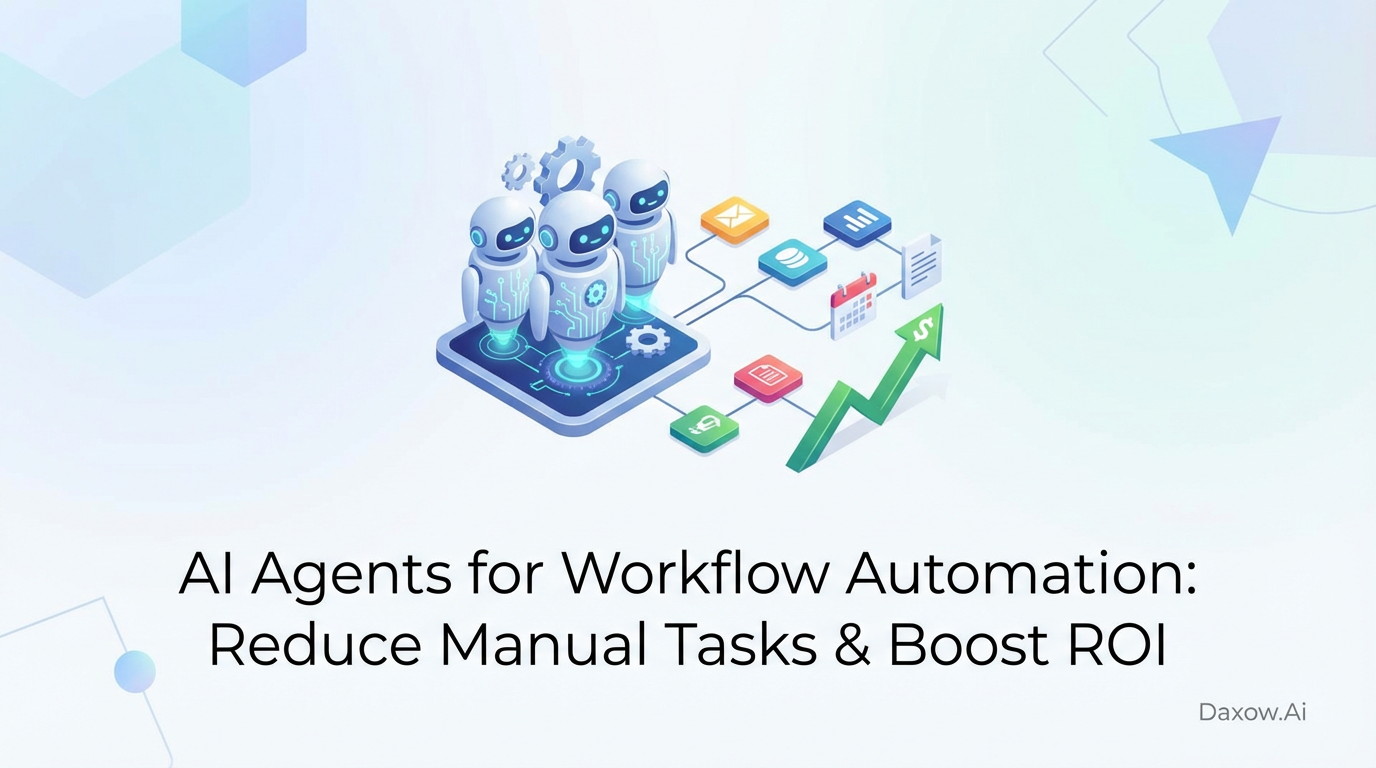
AI Agents for Workflow Automation: Reduce Manual Tasks & Boost ROI
Learn how AI agents automate workflows to cut manual tasks, improve accuracy, and boost ROI. Use cases, KPIs, implementation roadmap, and Daxow.ai solutions.
AI Agents for Workflow Automation: How to Reduce Manual Tasks and Boost Productivity
Estimated reading time: 15 minutes
Key Takeaways
- AI agents enable intelligent, end-to-end workflow automation by integrating natural language understanding, decision logic, and multi-system interactions.
- Deploying AI agents reduces manual tasks, accelerates cycle times, lowers operational costs, and improves customer experience.
- Successful implementation requires a clear roadmap including process discovery, solution design, data preparation, pilot testing, and scaling.
- Industry-specific use cases demonstrate AI agents’ value in e-commerce, finance, healthcare, real estate, sales, marketing, HR, and administration.
- Partnering with Daxow.ai ensures custom AI agent development with secure system integrations, measurable ROI, and ongoing support.
Table of Contents
- AI Agents for Workflow Automation — What leaders need to know
- The business value of AI Agents for Workflow Automation
- Use cases: AI Agents for Workflow Automation across industries
- How to implement AI Agents for Workflow Automation — a step-by-step roadmap
- Technical considerations: integrations, security, and compliance
- Common pitfalls and best practices
- Practical implementation examples (short playbooks)
- Why partner with Daxow.ai for AI Agents and workflow automation
- Next steps — Start your AI automation journey
- Frequently Asked Questions
AI Agents for Workflow Automation — What leaders need to know
What is an AI agent in the context of business automation?
An AI agent is a software entity that performs tasks on behalf of users by combining natural language understanding, decision logic, integrations, and automation capabilities. Unlike simple rule-based bots, AI agents can:
- Understand unstructured inputs (emails, documents, chat).
- Make context-aware decisions based on business rules and data.
- Interact with multiple systems (CRM, ERP, ticketing, databases).
- Execute end-to-end workflows without constant human intervention.
Key benefit: AI agents enable true workflow automation by converting human intent into automated action, thereby reducing manual tasks and improving speed and accuracy.
How AI agents differ from traditional automation
Traditional automation often relies on macros, RPA, or single-system scripts. AI agents extend these capabilities by:
- Handling ambiguity using machine learning and natural language processing.
- Orchestrating decision paths that adapt to changing inputs.
- Learning from outcomes to improve performance over time.
- Integrating conversational interfaces for customer-facing and internal workflows.
The business value of AI Agents for Workflow Automation
Productivity and cost impact
Implementing AI agents leads to measurable improvements:
- Reduced manual tasks: Automating repetitive activities (data entry, invoice reconciliation, lead triage) frees staff for higher-value work.
- Faster cycle times: Processes that took days can complete in minutes through automated decision-making and system actions.
- Lower operational costs: Reduced manual labor and error correction lowers cost per transaction.
- Improved customer experience: Faster responses and fewer errors increase satisfaction and retention.
Measuring ROI
To build a business case, track these metrics:
- Time saved per task and per employee (hours/week).
- Reduction in error rates and rework costs.
- Transaction throughput (tickets processed, orders fulfilled).
- Revenue impact from faster lead qualification and sales automation.
- Net labor cost savings vs. implementation and maintenance costs.
Estimate ROI with a 12–24 month horizon. Example: Automating a billing reconciliation workflow that consumes 200 employee-hours/month can save 2,400 hours annually. At $30/hour fully loaded, that’s $72,000 in annual savings—often sufficient to justify initial development within 6–12 months when combined with improved cash flow and lower dispute rates.
Key KPIs to monitor
- Automation coverage (% of process automated)
- First-contact resolution (for customer support automation)
- Lead-to-opportunity conversion rate (for sales automation)
- Average handling time (AHT) reduction
- System uptime and SLA adherence
Use cases: AI Agents for Workflow Automation across industries
E-commerce — Order operations and customer support
Use case: An AI agent monitors incoming orders, verifies payment, flags inventory issues, communicates with suppliers, and updates customers via chat or email.
Benefits:
- Faster order fulfillment
- Reduced chargebacks
- Automated returns processing and refunds
How Daxow helps:
- Build AI-driven order orchestration agents that integrate with e-commerce platforms, fulfillment partners, and CRM.
- Implement customer support automation that escalates complex issues to humans and resolves common queries automatically.
Finance — Accounts payable and compliance automation
Use case: AI agents extract data from invoices using document automation, match invoices to purchase orders, route exceptions, and initiate payments.
Benefits:
- Lower invoice processing costs
- Fewer payment delays and penalties
- Improved auditability and compliance
How Daxow helps:
- Deploy data extraction pipelines and connect AI agents to ERP systems.
- Create exception-handling workflows and dashboards for finance teams to monitor and approve edge cases.
Healthcare — Patient intake and claims processing
Use case: AI agents handle patient intake forms, verify insurance coverage, schedule appointments, and pre-authorize claims.
Benefits:
- Reduced administrative burden on clinical staff
- Faster claims turnaround and fewer denials
- Better patient experience through timely communication
How Daxow helps:
- Implement HIPAA-aware AI agents that integrate with EHRs, billing systems, and patient portals.
- Automate data extraction from forms and handle complex decision logic for authorizations.
Real estate — Lease administration and tenant communications
Use case: AI agents process lease documents, extract key dates and clauses, trigger renewal workflows, and respond to tenant inquiries.
Benefits:
- Reduced legal and administrative overhead
- Improved lease compliance and revenue retention
How Daxow helps:
- Build document automation systems that feed extracted data into property management systems.
- Create tenant-facing chatbots that escalate maintenance requests and coordinate contractors.
Sales and marketing — Lead qualification and follow-up
Use case: AI agents ingest inbound leads, enrich profiles with public and CRM data, qualify leads based on scoring rules, and schedule meetings.
Benefits:
- Higher-quality leads passed to sales
- Faster follow-up increases conversion rates
- Reduced manual lead triage workload
How Daxow helps:
- Design lead qualification agents that integrate with marketing automation, CRM, and calendar systems.
- Implement multi-channel outreach automation aligned to sales playbooks.
HR and admin — Candidate screening and onboarding
Use case: AI agents screen resumes, score candidates, coordinate interviews, and automate onboarding tasks (documents, access provisioning, training enrollment).
Benefits:
- Shorter time-to-hire
- Reduced administrative work for HR teams
- Faster new-hire productivity
How Daxow helps:
- Build candidate screening pipelines and integrations with ATS systems.
- Automate access provisioning and compliance checks through secure connectors.
How to implement AI Agents for Workflow Automation — a step-by-step roadmap
1. Process discovery and prioritization
Start with a systematic review of your workflows:
- Map current processes and identify pain points.
- Measure time, frequency, and error rates for manual tasks.
- Prioritize opportunities with high volume, clear rules, or high cost.
Daxow role: We conduct process audits and workshops to identify the highest-value automation candidates and create a prioritized roadmap.
2. Solution design and architecture
Design the AI agent architecture:
- Define intent and decision models.
- Specify integration endpoints (CRMs, ERPs, databases).
- Design human-in-the-loop exceptions and approvals.
- Plan for observability and logging.
Daxow role: We design scalable architectures that balance AI models, orchestration engines, and secure integrations to deliver predictable business outcomes.
3. Data preparation and model selection
Prepare structured and unstructured data for AI:
- Clean and label documents for extraction models.
- Configure connectors for live data access.
- Select pre-trained models or custom models depending on domain specificity.
Daxow role: We implement data pipelines, train document extraction and NLU models, and validate performance against operational SLAs.
4. Build, integrate, and test
Develop the agents and integrate with business systems:
- Build scripts, APIs, and UI components.
- Create fallback and escalation paths.
- Run end-to-end tests using real-world scenarios.
Daxow role: We deliver production-ready agents with robust testing, secure credentials management, and integration with your tech stack.
5. Pilot and measure
Launch a controlled pilot:
- Monitor KPIs closely.
- Capture user feedback and exception cases.
- Iterate quickly to refine decision rules and model thresholds.
Daxow role: We run pilots, provide dashboards for live monitoring, and perform iterative tuning to reach target KPIs.
6. Scale and govern
Once validated, scale automation:
- Expand coverage across teams and geographies.
- Implement governance, version control, and compliance monitoring.
- Establish SLAs for uptime and response times.
Daxow role: We provide ongoing support, managed services, and governance frameworks to ensure reliability and continuous improvement.
Technical considerations: integrations, security, and compliance
System integrations and data connectivity
AI agents realize value only when connected to core systems. Typical integrations include:
- CRMs (for customer and lead data)
- ERPs (for finance and inventory)
- Ticketing systems (for support workflows)
- Document repositories and email systems
Best practice: Use API-first connectors and event-driven architectures to ensure reliability and traceability.
Security and compliance
Protecting data is non-negotiable:
- Encrypt data at rest and in transit.
- Implement role-based access control and audit logging.
- Apply data minimization and anonymization where possible.
- Align to industry regulations (GDPR, HIPAA, SOC2) based on sector.
Daxow role: We apply security-by-design principles and help implement compliance controls appropriate for your industry.
Observability and performance management
Monitor agent performance with:
- Real-time dashboards for throughput and error rates.
- Alerting for exceptions and SLA breaches.
- Periodic model performance reviews and re-training schedules.
Daxow role: We deliver monitoring solutions and operational handbooks to keep AI agents effective and accountable.
Common pitfalls and best practices
Pitfalls to avoid
- Automating poorly defined processes: automation amplifies inefficiency if underlying processes are not optimized.
- Ignoring data quality: weak data yields unreliable agent decisions.
- Insufficient exception handling: lack of human-in-the-loop pathways creates risk and user frustration.
- Overlooking change management: staff resistance and lack of training impede adoption.
Best practices
- Start with high-impact, low-risk use cases to prove value quickly.
- Combine rule-based automation with AI where appropriate.
- Maintain transparent audit trails and explainability for decisions.
- Invest in training and change management to align teams with new workflows.
- Continuously measure and iterate—automation is an ongoing program, not a one-time project.
Practical implementation examples (short playbooks)
Playbook A — Customer support automation in 90 days
- Week 1–2: Map top 10 support intents and measure AHT.
- Week 3–4: Train intent classifiers and response templates.
- Week 5–8: Integrate with ticketing system and implement escalation rules.
- Week 9–12: Pilot with 20% of traffic, monitor FCR and CSAT, refine.
Outcome: 50–70% reduction in manual handling for common queries and improved CSAT.
Playbook B — Sales automation for lead qualification
- Phase 1: Define lead scoring and qualification rules.
- Phase 2: Build integrations between marketing automation, CRM, and calendar.
- Phase 3: Deploy agent to enrich and score leads, schedule SDR meetings for qualified leads.
Outcome: Faster lead response and 15–30% uplift in conversion from MQL to SQL.
Why partner with Daxow.ai for AI Agents and workflow automation
Daxow.ai brings a combination of practical delivery and strategic insight:
- End-to-end services: From process discovery and solution design to deployment, monitoring, and managed services.
- Custom AI systems: We design AI agents tailored to your workflows, not generic chatbots.
- System integrations: We connect agents to CRMs, ERPs, ticketing, and document systems to enable real task execution.
- Measurable ROI: We focus on delivering cost reductions, productivity gains, and improved customer experience.
- Security and compliance: We embed data protection and compliance controls from day one.
Next steps — Start your AI automation journey
Implementing AI agents for workflow automation is a strategic investment that delivers measurable business value when executed correctly. If you want to reduce manual tasks, boost productivity, and scale business automation across sales, support, finance, HR, or operations, Daxow.ai can help.
Contact us to:
- Book a free consultation
- Request a process analysis for your company
- Get a proposal to build a custom AI system
Take the next step toward intelligent automation and unlock the productivity your business deserves.
Frequently Asked Questions
What distinguishes AI agents from traditional automation tools?
AI agents combine natural language understanding, adaptive decision-making, and multi-system integration to handle ambiguous and complex workflows, unlike traditional tools which often rely on predefined rules or single-system scripts.
How can AI agents improve ROI in my organization?
By automating repetitive and error-prone tasks, AI agents reduce labor costs, accelerate cycle times, and improve accuracy leading to higher customer satisfaction and increased revenue opportunities.
What industries benefit most from AI workflow agents?
Industries such as e-commerce, finance, healthcare, real estate, sales and marketing, and HR benefit significantly through tailored AI agents addressing their specific workflow challenges.
Is human oversight required when using AI agents?
Yes, especially in exceptions or sensitive cases, human-in-the-loop design ensures control, trust, and continuous learning to improve AI decisions over time.