
AI Agents for Workflow Automation: Reduce Manual Tasks
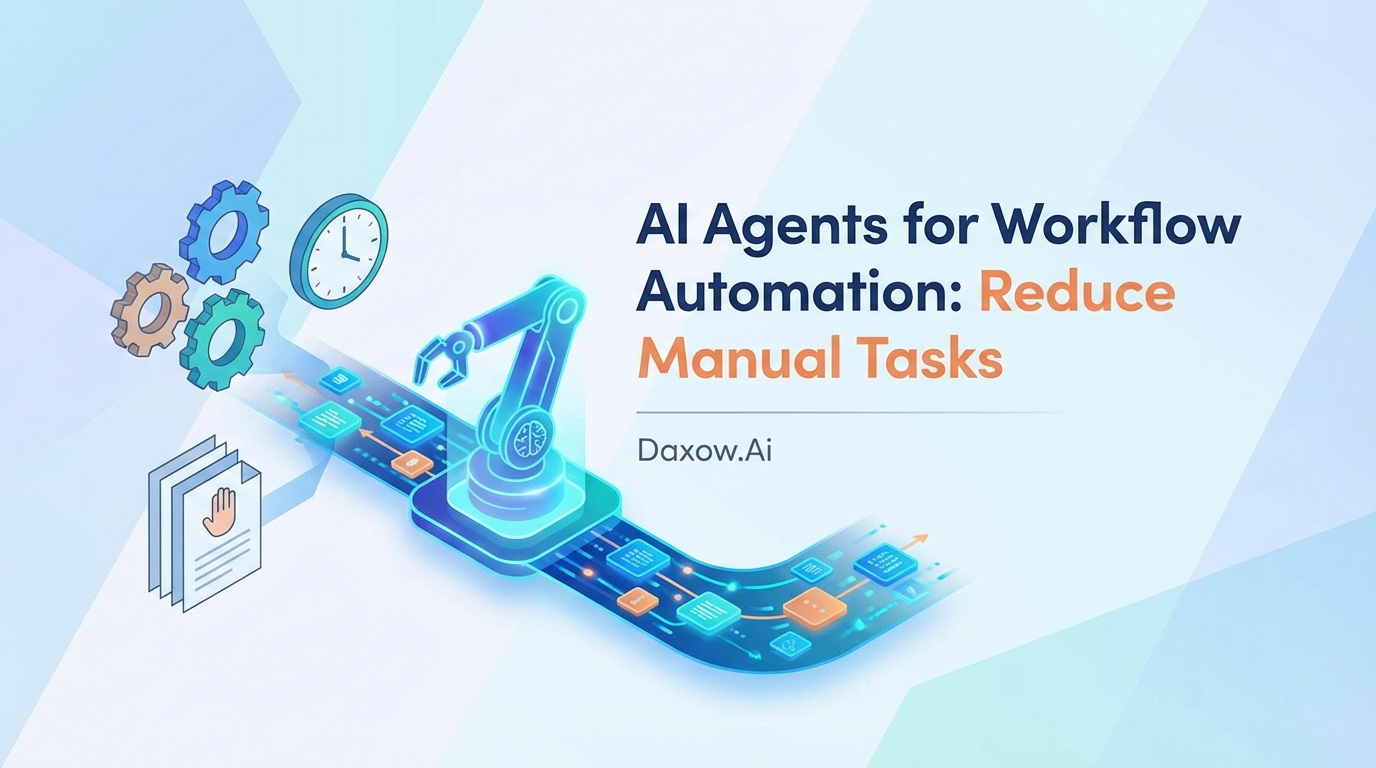
How AI agents automate workflows to cut manual tasks, boost productivity, and deliver ROI. Includes use cases, implementation roadmap, and Daxow.ai services.
AI Agents for Workflow Automation: How to Reduce Manual Tasks and Boost Productivity
Estimated reading time: 15 minutes
Key Takeaways
- AI agents embedded in workflow automation reduce manual tasks and unlock new productivity.
- Key benefits include cost savings, consistency, compliance, scalability, and improved customer experience.
- Practical use cases span customer support, sales, finance, HR, healthcare, and e-commerce.
- Successful implementation requires process redesign, pilot testing, secure integrations, and governance.
- Daxow.ai provides custom AI agent solutions delivering measurable ROI across industries.
Table of Contents
- Introduction
- What the Trend Means for Business
- AI Agents for Workflow Automation — Key Benefits
- Practical Use Cases — How AI Agents Drive Business Automation
- Research & Analysis — What Industry Findings Mean for Your Strategy
- Implementation Roadmap — From Process Discovery to Live AI Agents
- Technology Stack and System Integrations
- Measuring ROI — KPIs and Expectations
- Common Pitfalls and How to Avoid Them
- How Daxow.ai Helps — From Strategy to Production
- Roadmap to Get Started — A Practical First 90 Days
- Conclusion and Next Steps
- Frequently Asked Questions
Introduction
AI Agents for Workflow Automation are rapidly shifting from experimental pilots to mission-critical systems across industries. Decision-makers are recognizing that combining AI agents with workflow automation delivers measurable productivity gains, lowers operational costs, and improves customer experience. This article explains why AI agents matter now, breaks down actionable implementation steps, provides industry-specific use cases, and shows how Daxow.ai builds custom AI systems that automate end-to-end processes and deliver tangible ROI.
What the Trend Means for Business
- AI agents are autonomous or semi-autonomous software components that perform tasks, make decisions, and trigger actions across systems.
- When embedded into workflow automation, AI agents handle routine, repetitive, and decision-driven work that historically required human intervention.
- The business value is twofold: reduce manual tasks and unlock new productivity, enabling teams to focus on higher-value activities like strategy, relationship-building, and product innovation.
AI Agents for Workflow Automation — Key Benefits
Productivity and cost savings
- Automate repetitive work: AI agents can process invoices, route customer inquiries, qualify leads, and update CRM records automatically.
- Lower operational costs: By reducing manual processing and error rates, organizations can reallocate staff and reduce overhead.
- Faster throughput: Automation reduces cycle times — from minutes to seconds for many tasks — improving SLAs and customer satisfaction.
Consistency, compliance, and quality
- Consistent decision logic: AI agents apply standardized rules and models across all transactions, reducing variability.
- Auditability and compliance: Automated logs and traceable decision paths make regulatory reporting and internal audits easier.
- Improved data quality: Automated data extraction and validation reduce manual entry errors, improving downstream analytics.
Scalability and resilience
- Scale without linear headcount growth: As volume rises, AI agents scale horizontally, handling spikes without proportional hiring.
- 24/7 operations: Agents work continuously, supporting global customers and time-sensitive workflows.
Practical Use Cases — How AI Agents Drive Business Automation
Customer support automation
Use case: AI agent triages incoming customer messages across chat, email, and social channels.
What it does: Classifies intent, extracts key details (order IDs, account numbers), resolves simple queries, and escalates complex cases to human agents with a pre-populated context.
Business impact: Reduced response times, higher first-contact resolution rates, lower support costs, and improved NPS.
Sales automation and lead qualification
Use case: AI agent qualifies inbound leads and schedules discovery calls.
What it does: Scores leads based on behavioral signals, CRM data, and firmographics; sends personalized outreach; books meetings when thresholds are met.
Business impact: Higher conversion rates, shorter sales cycles, and improved SDR productivity.
Invoice processing and finance automation
Use case: AI agent automates accounts payable processing.
What it does: Extracts invoice data from PDFs and emails, validates against purchase orders, identifies exceptions, routes approvals, and posts entries to accounting systems.
Business impact: Faster invoice cycles, fewer late-payment penalties, and reduced manual reconciliation.
HR & onboarding automation
Use case: AI agent handles new-hire paperwork and first-week onboarding tasks.
What it does: Sends personalized onboarding checklists, captures signed documents, sets up accounts in HRIS and IT systems, and schedules orientation sessions.
Business impact: Reduced HR workload, faster time-to-productivity for employees, and better new-hire experience.
Healthcare intake and triage
Use case: AI agent triages patient intake forms and schedules appointments.
What it does: Extracts symptoms and medical history, prioritizes high-risk cases, and integrates with EHR systems to update records.
Business impact: Improved throughput, better resource allocation, and higher patient satisfaction.
E-commerce order processing
Use case: AI agent manages order exceptions and returns.
What it does: Verifies addresses, authorizes refunds based on policies, and triggers logistics workflows.
Business impact: Lower return processing times, improved inventory visibility, and reduced customer friction.
Research & Analysis — What Industry Findings Mean for Your Strategy
Industry analysis consistently shows that businesses adopting AI automation and workflow automation achieve faster operations, lower error rates, and higher customer satisfaction. Key strategic takeaways from research trends:
- Start with high-volume, high-friction processes — these deliver the fastest payback.
- Combine AI with process re-design — automation is most effective when processes are simplified first.
- Focus on measurable metrics like cycle time, error rate, cost per transaction, and customer satisfaction.
- Invest in integrations and data quality — AI agents are only as effective as the data and systems they connect to.
- Plan for governance and explainability — maintain human oversight and clear audit trails for automated decisions.
Implementation Roadmap — From Process Discovery to Live AI Agents
Phase 1 — Process discovery and prioritization
- Conduct workshops to map workflows and identify pain points.
- Use criteria to prioritize: volume, manual effort, error impact, regulatory risk, and potential cost savings.
- Deliverable: prioritized backlog of automation opportunities.
Phase 2 — Design and proof of value
- Select a pilot process and define success metrics (KPIs).
- Build lightweight prototypes or “AI sandboxes” to validate model performance and integration feasibility.
- Deliverable: pilot with baseline vs. post-automation metrics.
Phase 3 — Build and integrate (workflow automation & integrations)
- Develop AI agents that include:
- Data extraction and transformation capabilities.
- Decision logic and fallback rules.
- Connectors to CRMs, ERPs, ticketing systems, and communication channels.
- Implement secure APIs and middleware for reliable integrations.
- Deliverable: production-ready automation with end-to-end process flows.
Phase 4 — Monitoring, governance, and continuous improvement
- Deploy monitoring dashboards for throughput, errors, model drift, and user feedback.
- Establish governance: approval workflows, human-in-the-loop checkpoints, and audit logs.
- Iterate models and processes based on performance data.
- Deliverable: sustained improvement plan and scaling roadmap.
Technology Stack and System Integrations
A modern AI automation stack typically contains:
- Orchestration layer: workflow automation platform that coordinates agents and system actions.
- AI/ML layer: models for NLP, document understanding, classification, and recommendation.
- Integration layer: APIs and connectors to CRMs, ERPs, support tools, and data warehouses.
- Monitoring and logging: observability tools for performance and compliance.
- Security and governance: identity and access controls, encryption, and audit trails.
Daxow.ai builds solutions that blend these components into a unified system. We focus on secure integrations with enterprise tools and on delivering AI agents that both execute tasks and provide explainable outcomes.
Measuring ROI — KPIs and Expectations
To evaluate success, track both operational and strategic KPIs:
Operational KPIs:
- Cycle time reduction (e.g., invoice processing time).
- Volume of transactions automated.
- Error rate reduction.
- Cost per transaction.
Customer-facing KPIs:
- First response time.
- First contact resolution.
- Customer satisfaction (CSAT, NPS).
Business KPIs:
- Revenue impact from faster lead-to-opportunity conversion.
- Headcount redeployed to higher-value roles.
- Compliance incidents or audit findings reduced.
Expectation setting:
- Short-term wins: many pilots show measurable improvement within 8–12 weeks.
- Medium-term scaling: full process automation and integration across departments typically require 3–9 months.
- Long-term impact: strategic value compounds as data improves models and automation scales across multiple processes.
Common Pitfalls and How to Avoid Them
- Over-automation without process redesign: Automating broken processes amplifies inefficiency. Re-engineer before automating.
- Poor data quality: Garbage in, garbage out. Invest in data cleansing and validation.
- Lack of integration planning: Siloed automations create fragmented experiences. Plan for enterprise integrations from the start.
- Ignoring change management: Staff adoption matters. Provide training, clear governance, and human-in-the-loop options.
- Neglecting monitoring and governance: Without oversight, models degrade and compliance exposure grows.
How Daxow.ai Helps — From Strategy to Production
Daxow.ai offers an end-to-end approach tailored to enterprise needs:
- Process analysis and discovery: We map your workflows and quantify opportunities to reduce manual tasks.
- Custom AI agent design: We build agents that understand context, take actions, and integrate with your systems.
- Workflow automation and orchestration: We assemble robust workflows that coordinate AI agents, human steps, and system actions.
- Integrations and data connectivity: We connect CRMs, ERPs, support platforms, and document repositories securely.
- Compliance and governance: We design audit trails, explainable decision paths, and human oversight mechanisms.
- Ongoing optimization: We monitor performance, retrain models, and scale automations across departments to maximize ROI.
Daxow.ai’s methodology ensures that automation projects deliver measurable business outcomes — lower operational costs, faster processing times, and better customer experiences.
Example engagement outcomes
- Finance team: Reduced invoice processing time by automating extraction, validation, and posting — freeing staff for strategic vendor negotiations.
- Support team: Implemented chat and email triage agents that resolved routine requests and reduced average handle time.
- Sales team: Deployed lead qualification agents that increased conversion rates by prioritizing high-intent leads.
Roadmap to Get Started — A Practical First 90 Days
- Day 0–15: Discovery — Kickoff workshops, stakeholder interviews, and data access planning.
- Day 15–45: Pilot design — Select pilot process, define KPIs, and build a prototype.
- Day 45–90: Pilot deployment and measurement — Integrate, test, and run pilot; measure results and refine.
- After 90 days: Scale — Build a scaling roadmap based on measured ROI and operational readiness.
Conclusion and Next Steps
AI Agents for Workflow Automation are no longer optional for organizations that want to compete on speed, cost, and customer experience. By targeting high-volume, high-friction processes and pairing AI with careful process redesign and integrations, businesses can dramatically reduce manual tasks, increase productivity, and achieve measurable ROI.
If you’re ready to explore how AI agents can transform workflows in your organization, Daxow.ai can help with a structured, end-to-end approach: from discovery and pilot to integration and scale.
- Book a free consultation with Daxow.ai today.
- Request a process analysis for your company to identify top automation opportunities.
- Contact us to build a custom AI system that reduces manual work, boosts productivity, and improves customer experience.
Frequently Asked Questions
What are AI agents in workflow automation?
AI agents are autonomous or semi-autonomous software components that perform specific tasks, make decisions, and trigger actions automatically within business workflows.
How do AI agents reduce manual tasks?
They automate repetitive, routine, and decision-driven tasks that previously required human intervention, freeing staff to focus on strategic, creative, and high-value activities.
What industries benefit most from AI workflow automation?
Industries such as finance, healthcare, sales, customer support, HR, and e-commerce have shown significant productivity gains and cost reductions by implementing AI-driven workflow automation.
How does Daxow.ai support AI automation projects?
Daxow.ai delivers end-to-end AI workflow automation solutions, including process discovery, AI agent design, integration, governance, and ongoing optimization to ensure measurable ROI.