
How AI Agents Transform Workflow Automation
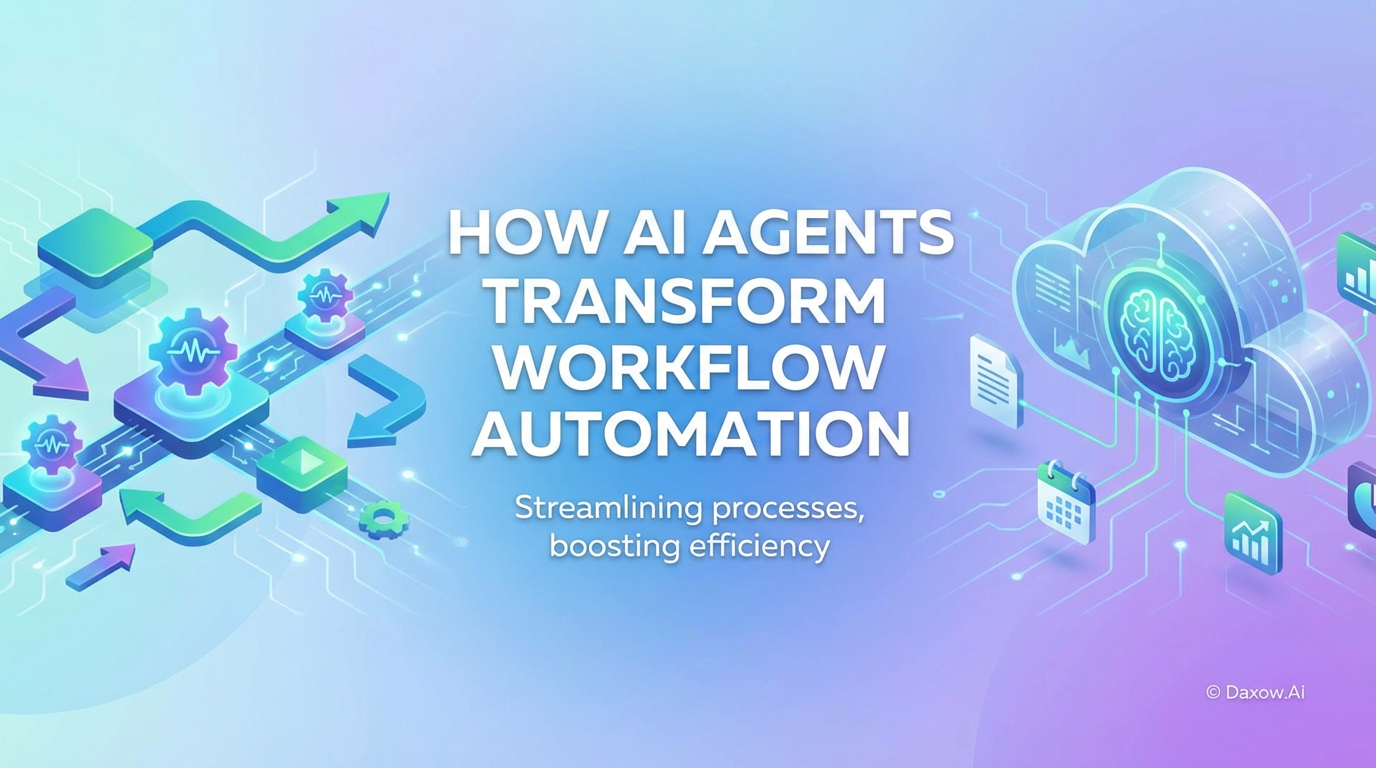
Learn how AI agents turn manual processes into intelligent, scalable workflows with real use cases, ROI metrics, and a practical Daxow.ai implementation roadmap.
How AI Agents are Transforming Workflow Automation
Estimated reading time: 15 minutes
Key Takeaways
- AI agents shift repetitive manual tasks to intelligent autonomous systems enabling higher productivity and scalability.
- Transformations span industries including e-commerce, healthcare, finance, real estate, HR, and customer support.
- A phased implementation roadmap ensures data quality, tool choice, secure integration, agent training, and continuous improvement.
- Measuring ROI requires clear KPIs and monitoring model performance to sustain business impact.
- Partnering with Daxow.ai facilitates custom AI workflow automation with end-to-end expertise and domain-specific solutions.
Table of Contents
- How AI Agents are Transforming Workflow Automation
- What Are AI Agents and How Do They Differ From Traditional Automation?
- Why Now?
- Industry Use Cases: Practical Examples of AI Automation with AI Agents
- Implementation Roadmap: From Process Audit to Production
- Data, Integration, and Governance: Practical Considerations
- Measuring ROI and Business Value
- Common Challenges and How to Mitigate Them
- Why Partner with Daxow.ai
- Getting Started: Practical Next Steps for Decision-Makers
- Frequently Asked Questions
How AI Agents are Transforming Workflow Automation
AI automation blends artificial intelligence with workflow automation to handle repetitive, data-heavy, and decision-based tasks at scale. Within this landscape, AI agents—autonomous systems powered by large language models, APIs, and business logic—are transforming workflow automation from scripted RPA into adaptive systems that reason, learn, and execute multi-step tasks across tools and teams.
What this means for your business:
- Reduce manual tasks: Shift routine data entry, document processing, and status updates to autonomous agents.
- Increase productivity: Expect 20–50% productivity gains from automated workflows, with faster processing and fewer errors.
- Improve customer experience: 24/7 customer support automation and faster response times lead to higher satisfaction and retention.
- Scale operations: Agents maintain consistent performance as transaction volumes rise—without proportional headcount increases.
What Are AI Agents and How Do They Differ From Traditional Automation?
AI agents combine NLP, structured data access, and orchestrated actions across systems. Unlike basic RPA bots that follow rigid scripts, AI agents:
- Understand intent and context.
- Retrieve knowledge from internal repositories.
- Make conditional decisions and escalate when needed.
- Execute multi-step workflows that interact with CRMs, ERPs, and communication channels.
This capability enables hyperautomation: intelligent end-to-end processes such as automatically approving invoices, updating CRM records, notifying stakeholders, and filing audit trails without human handoffs.
Why Now?
- Business environments demand speed, accuracy, and continuity—especially in the face of labor shortages and rising costs.
- Improvements in language models, integration APIs, and model deployment practices make AI agents practical and secure for production use.
- Data-driven organizations are turning automation into a competitive advantage—delivering faster decision cycles and superior experiences.
Industry Use Cases: Practical Examples of AI Automation with AI Agents
E-commerce: Order-to-cash and personalization
- Problem: High volume of order exceptions, delayed fulfillment, and generic recommendations that reduce conversion.
- Solution: AI agents monitor order pipelines, reconcile payments with invoices, trigger fulfillment exceptions, and push personalized product suggestions to shoppers based on real-time signals.
- Outcome: Reduced fulfillment errors, faster order resolution, higher conversion rates, and fewer manual touchpoints in the order-to-cash cycle.
Healthcare: Patient intake, triage, and administrative automation
- Problem: Manual patient intake and scheduling create bottlenecks and risk compliance errors.
- Solution: AI agents capture patient data from forms, verify insurance eligibility, handle appointment scheduling, and route urgent cases to clinicians using predefined triage rules.
- Outcome: Improved patient response times, lower administrative overhead, and stronger adherence to privacy and regulatory standards.
Finance: Fraud detection, invoice processing, and compliance
- Problem: Fraud patterns are complex; invoice processing is labor-intensive and audit preparation is time-consuming.
- Solution: AI agents analyze transaction patterns to flag anomalies, extract invoice data from documents, reconcile accounts, and auto-generate compliance reports.
- Outcome: Faster fraud detection, reduction in audit preparation time (up to 70% in similar deployments), and streamlined accounts payable workflows.
Real Estate: Listings, client screening, and document automation
- Problem: Manual listing creation and lease documentation slow transactions and risk errors.
- Solution: AI agents summarize property details from multiple sources, generate market analyses, populate lease templates, and support client onboarding conversations.
- Outcome: Shorter deal cycles, more accurate documentation, and improved lead qualification.
HR: Talent acquisition and employee lifecycle automation
- Problem: High volume of resumes and inconsistent screening processes bottleneck hiring.
- Solution: AI agents screen candidates against role criteria, draft job descriptions, schedule interviews, and surface candidates with high fit probability.
- Outcome: Faster time-to-hire, higher recruiter productivity, and consistent candidate experience.
Customer Support and Sales Automation
- Customer Support Automation: AI agents handle level-1 tickets, respond to FAQs, escalate complex issues, and populate CRM tickets with context—reducing resolution times and enabling human agents to focus on high-value cases.
- Sales Automation: Agents qualify leads through conversational flows, update opportunity stages, and prepare outreach sequences—improving conversion efficiency and enabling sales teams to prioritize high-value prospects.
Implementation Roadmap: From Process Audit to Production
Phase 1 — Define goals and audit processes
- Identify high-impact, repetitive tasks (e.g., invoice processing, support triage).
- Map process flows and set measurable KPIs: cost per transaction, processing time, NPS.
- Daxow involvement: We run process mapping workshops and quantify baseline metrics to prioritize quick wins.
Phase 2 — Data audit and pipelines
- Standardize data formats and ensure quality—avoid "garbage in, garbage out."
- Implement secure data pipelines and access controls to meet privacy and compliance requirements.
- Daxow involvement: We build data connectors and ETL workflows to centralize inputs for AI agents.
Phase 3 — Tool selection and architecture
- Choose scalable platforms with robust APIs, security, and model management features.
- Determine where to use pre-built models, fine-tuned models, or custom components.
- Daxow involvement: We design an integration architecture (APIs, webhooks, connectors) tailored to your stack and growth needs.
Phase 4 — Build and train AI agents
- Define agent goals, decision trees, knowledge bases, and guardrails.
- Train models on in-domain data and craft prompts/flows that maintain context and handle exceptions.
- Daxow involvement: We design, train, and validate AI agents, ensuring they execute real tasks like updating CRMs, generating documents, and interacting with customers.
Phase 5 — Test, deploy, monitor, iterate
- Deploy in a phased manner starting with non-critical processes.
- Monitor performance metrics, model drift, and user feedback.
- Retrain and refine agents based on real-world data.
- Daxow involvement: We provide production monitoring, retraining schedules, and support SLAs to maintain performance and compliance.
Data, Integration, and Governance: Practical Considerations
- Data quality: Standardize inputs and maintain versioned datasets to support consistent model outputs.
- Integrations: Use secure APIs and middleware to connect CRMs, ERPs, and communication platforms—enabling agents to perform end-to-end actions.
- Security and compliance: Implement role-based access, logging, and audit trails. Ensure personal data processing aligns with local regulations.
- Ethics and guardrails: Define escalation policies and boundaries for agent actions to prevent harmful or incorrect automation.
Measuring ROI and Business Value
AI automation delivers rapid and measurable ROI when focused on high-volume, low-complexity bottlenecks first. Typical outcomes observed across deployments include:
- 20–50% productivity gains in automated workflows.
- 30–50% reduction in costs on routine processing tasks.
- Up to 70% faster audit or reconciliation processes in finance scenarios.
- Improved customer satisfaction through faster, more accurate responses and 24/7 support availability.
How to measure:
- Baseline KPIs before deployment: cycle time, error rates, cost per transaction, customer satisfaction.
- Track delta improvements post-deployment and report ROI in financial terms and operational KPIs.
- Use phased pilots to validate assumptions and scale based on measured impact.
Daxow has guided clients to sustained returns by prioritizing high-value processes first and measuring success against clear baselines.
Common Challenges and How to Mitigate Them
- Data silos: Standardize formats and build centralized pipelines to ensure consistent access.
- Resistance to change: Engage stakeholders early, provide role-based training, and demonstrate quick wins.
- Scalability issues: Choose enterprise-grade tools and design for modularity and observability.
- Model drift: Implement monitoring, logging, and scheduled retraining to keep agents aligned with business realities.
Best practices:
- Start small to deliver momentum and prove value.
- Involve IT and security teams early for integrations and governance.
- Focus on data quality and clear KPIs to avoid ambiguous outcomes.
Why Partner with Daxow.ai
Daxow.ai is an AI automation agency founded in Estonia in 2024 focused on turning processes into measurable business outcomes. We combine domain expertise, integration engineering, and AI agent design to deliver end-to-end automation.
How Daxow helps:
- Custom AI solutions: Tailored agents that execute real-world tasks—updating CRMs, automating invoices, qualifying leads, and handling support tickets.
- End-to-end process automation: From process discovery to production monitoring and retraining.
- System integrations and data connectivity: Connectors and pipelines that ensure agents have secure, reliable access to the data they need.
- Reduce operational costs and improve ROI: Prioritized ROI-driven approach—deliver quick wins and scale with governance.
- Domain-specific workflows: Experience across technology, e-commerce, real estate, finance, healthcare, HR, and customer support.
What a typical engagement looks like:
- Discovery workshop and process audit.
- Pilot for a single high-impact workflow.
- Full-scale rollout with monitoring, governance, and continuous improvement.
Getting Started: Practical Next Steps for Decision-Makers
- Conduct a process audit to identify top 3 automation candidates.
- Define measurable KPIs tied to cost, speed, and customer experience.
- Run a short pilot (4–8 weeks) to validate impact and collect training data.
- Plan integrations with your core systems and designate an internal champion.
- Establish monitoring and retraining cadence before full-scale deployment.
Daxow’s team can accelerate each step, supplying project management, engineering, and AI expertise to reduce your time-to-value.
Conclusion and Call to Action
How AI Agents are Transforming Workflow Automation is not a theoretical trend—it is a practical route to reduce manual tasks, boost productivity, and realize business automation across functions. If you want to move from concept to production with a partner who builds secure, integrated AI systems that deliver measurable ROI, take the next step.
Book a free consultation with Daxow.ai or request a process analysis for your company to identify the first workflows we can automate together. Contact us to build a custom AI system that reduces operational costs, improves customer experience, and scales with your business.
Frequently Asked Questions
What distinguishes AI agents from traditional RPA bots?
AI agents leverage natural language processing, contextual understanding, and multi-step decision making, while traditional RPA bots follow fixed scripts without adapting to changing contexts or complex workflows.
How can businesses ensure the security of AI automation?
Security is maintained through role-based access controls, audit logs, compliance with data privacy regulations, secure API integrations, and continuous monitoring and governance enforced by both technology and process controls.
What are the initial steps in implementing AI agents?
Start with defining clear automation goals, auditing existing processes to identify candidates, setting KPIs, and building a data foundation. Partnering with experts like Daxow.ai can help streamline this phased journey.
How does Daxow.ai support ongoing improvements post-deployment?
Daxow.ai provides production monitoring, retraining schedules, and support service level agreements to adapt AI agents to evolving business needs, addressing model drift and incorporating user feedback to ensure sustained ROI.