
AI Agents vs Automation: A Strategic Guide for Businesses
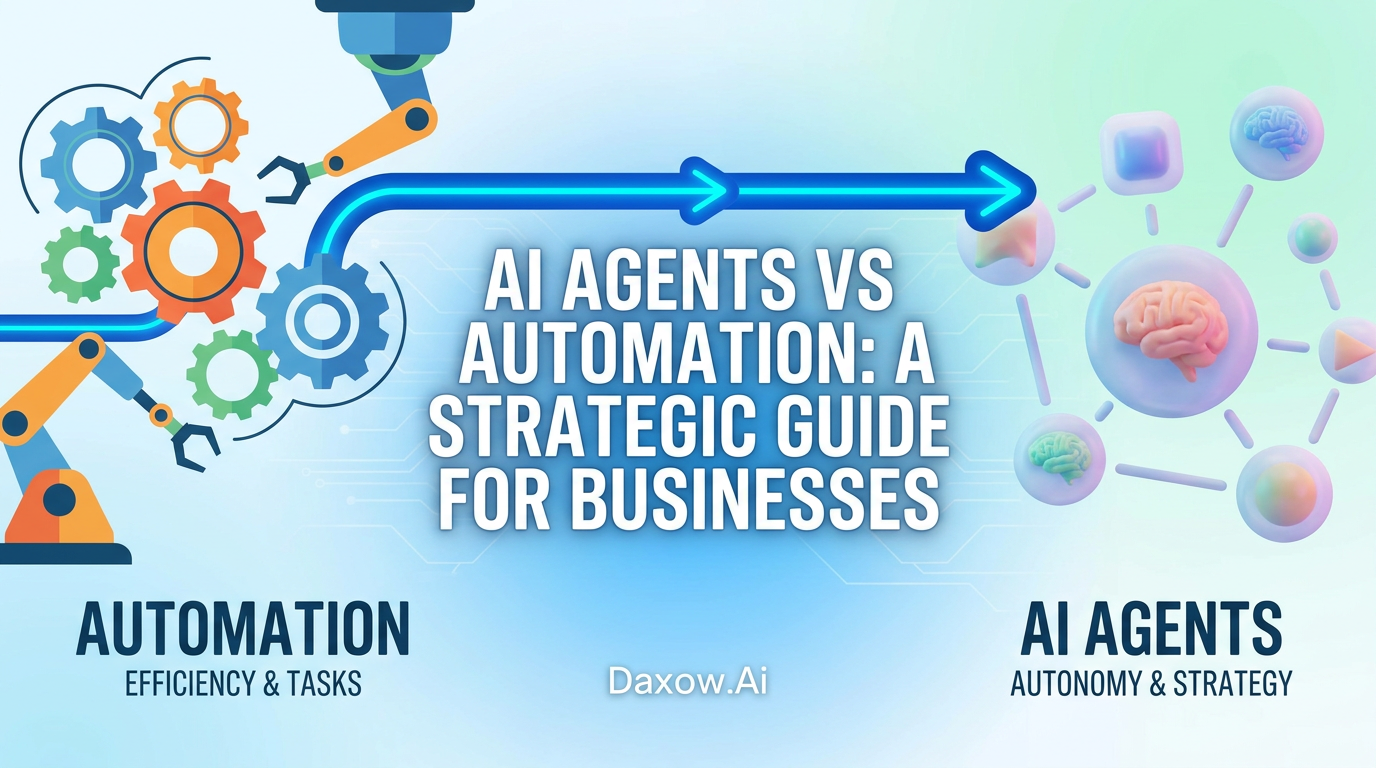
Practical guide to choosing workflow automation vs AI agents, with use cases, roadmap, governance, and ROI to drive business transformation.
AI Agents vs. Automation: A Strategic Guide for Modern Businesses
Estimated reading time: 14 minutes
Key Takeaways
- Combining AI agents with workflow automation optimizes productivity and reduces manual work.
- Choosing the right autonomy level balances risk and ROI effectively.
- Use workflow automation for deterministic tasks and AI agents for unstructured, multi-step processes.
- A phased approach enables smooth adoption and scalable implementation across industries.
- Governance and human oversight are essential for managing risks with agentic systems.
Table of Contents
- AI Agents vs. Automation: What It Means for Your Business
- Where Automation Is Best — and Where AI Agents Add Unique Value
- Practical Use Cases Across Industries
- Implementation Roadmap — From Process Mapping to Production
- Measuring ROI — What Leaders Should Expect
- Risk Management and Governance for Agentic Systems
- Decision Framework — How to Choose Between AI Agents and Automation
- How Daxow.ai Delivers Value — From Strategy to Execution
- Moving Forward — Start Small, Deliver Big
- Frequently Asked Questions
AI Agents vs. Automation: What It Means for Your Business
Definitions and the Autonomy Spectrum
- Traditional automation (RPA, integration platforms) follows explicit rules and excels at high-volume, predictable tasks.
- AI agents are goal-driven systems that understand language, orchestrate tools, and adapt decisions across multi-step processes.
- The autonomy spectrum ranges from static automation to AI-enhanced workflows to partially and highly autonomous agents.
Key point: Most organisations should adopt AI-enhanced automation and partially autonomous agents first — they deliver the biggest gains while keeping risk manageable.
Why this distinction matters
Choosing between AI agents and workflow automation affects operating models, governance, and cost structure. The right mix:
- Reduces manual work and error rates.
- Improves response times and customer experience.
- Enables employees to focus on strategic work, lifting productivity.
Daxow.ai helps businesses map this spectrum, recommending the simplest solution that reliably solves the business problem and progressively introducing agentic capabilities where they unlock new value.
Where Automation Is Best — and Where AI Agents Add Unique Value
When to use workflow automation (best fit)
- Tasks are deterministic and stable.
- High-throughput, low-variance processes (e.g., invoice routing under fixed thresholds).
- Integrations with CRMs, ERPs, and ticketing systems are straightforward.
Use cases:
- Customer notification flows for order status.
- Form-to-CRM pipelines that create or update records.
- Scheduled data syncs between systems.
When to deploy AI agents (best fit)
- Inputs are unstructured (emails, PDFs, images) or require natural language judgment.
- Processes require multi-step reasoning, tool selection, or dynamic decision-making.
- The outcome benefits from personalization or context-aware escalation.
Use cases:
- Conversational agents that handle complex customer support scenarios and autonomously initiate refunds within policy.
- Lead qualification agents that converse across channels, book meetings, and update pipelines.
- Compliance agents that synthesize documents, flag anomalies, and draft narratives for human review.
Key point: Automation and AI agents are complementary. Automation provides speed and consistency; agents provide understanding and orchestration.
Practical Use Cases Across Industries
E-commerce — Customer Support & Cart Recovery
- Workflow automation: auto-responders for order confirmations and simple returns.
- AI agents: omnichannel conversational assistants that read order histories, apply policies, initiate refunds, and escalate only when necessary.
Impact: reduced support cost, faster resolutions, higher conversion via personalized cart recovery messages.
Healthcare — Intake, Triage, and Prior Authorization
- Workflow automation: EHR form integrations and basic triage rules.
- AI agents: pre-visit conversational assistants that structure symptom descriptions, suggest care pathways, and prepare clinician-ready summaries. Prior authorization agents draft requests, compile supporting evidence, and track responses.
Impact: reduced clinician documentation time, faster triage, improved approval rates for authorizations.
Finance — KYC, Onboarding, and Client Insights
- Workflow automation: ID verification flows and rule-based risk checks.
- AI agents: agents that correlate documents, emails, and transaction patterns to flag anomalies, draft SAR/STR narratives, and generate personalized investment insights.
Impact: faster onboarding, stronger risk detection, higher-quality client engagement.
Real Estate — Lead Qualification & Listing Preparation
- Workflow automation: CRM entries from forms and static drip sequences.
- AI agents: multi-channel lead conversationalists that qualify intent, schedule viewings, and generate tailored listing descriptions from documents and photos.
Impact: fewer low-quality leads, more showings, faster listings with professional copy.
Human Resources — Sourcing & Employee Support
- Workflow automation: job distribution and keyword resume parsing.
- AI agents: candidate sourcing agents that summarize qualifications, manage outreach, and schedule interviews. Employee support agents answer policy questions, initiate PTO workflows, and escalate sensitive issues.
Impact: reduced time-to-fill, better candidate matches, lower HR ticket volume.
Implementation Roadmap — From Process Mapping to Production
Step 1 — Identify a high-value, narrow use case
Start with processes that:
- Consume significant manual hours.
- Have measurable KPIs (time, cost, conversion).
- Contain accessible data.
Example pilot targets: sales lead qualification, returns processing, or a clinic’s intake process.
Step 2 — Map the workflow and distinguish task types
Document inputs, decision points, tools, and exceptions. Separate:
- Mechanical tasks (data entry, file transfers) — ideal for workflow automation.
- Cognitive tasks (interpretation, negotiation, synthesis) — ideal for AI agents.
Step 3 — Choose the right autonomy level
For each step, decide whether it should be:
- Fully automated (low-risk, repetitive).
- AI-assisted with human-in-the-loop (drafts and recommendations).
- Agent-managed with strict guardrails (e.g., refunds up to $X).
Start constrained, expand autonomy as confidence grows.
Step 4 — Design technical architecture
Core components:
- Workflow orchestration platform for triggers and integrations.
- LLM/AI provider for language understanding and generation.
- Agent orchestration layer for memory, tool use, and multi-step reasoning.
- Connectors for CRMs, ERPs, ticketing, calendar, and data warehouses.
- Observability layer for logs, decisions, and audit trails.
Daxow.ai’s approach: build a reliable workflow backbone, add an AI intelligence layer for unstructured data, and deploy agents where dynamic orchestration is required.
Step 5 — Governance, testing, and monitoring
- Define access controls and environment separation.
- Implement policy guardrails for financial and privacy constraints.
- Require human review thresholds for regulated or high-risk actions.
- Run synthetic tests and shadow-mode pilots before fully autonomous operation.
Step 6 — Pilot, measure, iterate, scale
- Pilot with a single team or region.
- Track clear metrics: time saved, reduction in manual touches, accuracy, CSAT, and revenue impact.
- Iterate prompts, workflow logic, and guardrails.
- Scale once stability and ROI are proven.
Measuring ROI — What Leaders Should Expect
Quantitative benefits
- 30–70% reduction in handling time for optimized workflows.
- Lower headcount growth relative to volume increases.
- Faster speed-to-market for offerings that require document processing or personalization.
Qualitative benefits
- Better customer experiences through faster, personalized responses.
- Higher employee satisfaction as routine tasks are automated.
- Improved compliance and auditability with consistent logging.
Key point: ROI is not just cost reduction. It includes revenue uplift from better conversion, retention, and product velocity.
Risk Management and Governance for Agentic Systems
Build guardrails from day one
- Define explicit action limits (financial, legal).
- Log decisions and provide human-readable rationales where possible.
- Ensure data access follows least-privilege principles.
Human-in-the-loop where it matters
- Maintain approval steps for regulated communications or high-value decisions.
- Use agents to prepare drafts and evidence summaries, then route to experts for sign-off.
Continuous validation
- Monitor model drift, error patterns, and edge cases.
- Update prompts, training data, and rules based on observed failures.
Daxow.ai embeds governance into every deployment, ensuring agents and automation operate within corporate policies and regulatory requirements.
Decision Framework — How to Choose Between AI Agents and Automation
- Is the task well-defined and stable? → Prefer workflow automation.
- Does the task require interpreting unstructured data? → Add AI components.
- Is the process dynamic with multiple conditional paths and tool interactions? → Consider AI agents.
- Would autonomy materially speed outcomes with acceptable risk? → Deploy partially autonomous agents with guardrails.
- Is the task high-risk or heavily regulated? → Keep human oversight and constrained autonomy.
Practical guidance
Apply a staged approach:
- Automate clear rules first to capture quick wins.
- Add AI enhancements for unstructured data tasks.
- Introduce agents to orchestrate across tools when it drastically reduces manual coordination.
How Daxow.ai Delivers Value — From Strategy to Execution
Discovery and process analysis
Daxow.ai starts by mapping current workflows, identifying manual bottlenecks, and quantifying KPIs. We recommend focused pilots with measurable outcomes.
Custom solution design and integration
We design hybrid solutions that combine workflow automation, AI modules, and agent orchestration. Our engineers build connectors to CRMs, ERPs, ticketing systems, and data stores to ensure data integrity and real-time operations.
Build, govern, and scale
Daxow deploys production-grade systems with built-in governance, audit logs, and human-in-the-loop checkpoints. We run pilots, measure improvements, and scale successful automations and agents across teams.
Continuous optimization
Once live, we monitor performance, refine models and prompts, and expand capabilities — ensuring sustained productivity gains and reduced manual tasks.
Moving Forward — Start Small, Deliver Big
Action plan for decision-makers:
- Pick one high-impact process.
- Map it end to end and separate mechanical from cognitive tasks.
- Deliver a pilot that combines workflow automation with an AI agent where it adds clear value.
- Measure hard metrics, tighten governance, and iterate rapidly.
Daxow.ai partners with companies across industries to design and deploy these systems end-to-end — from process analysis to custom AI agents that execute real tasks and integrate with your tech stack.
Conclusion
AI Agents vs. Automation: A Strategic Guide for Modern Businesses is not a theoretical debate — it is a roadmap for operational transformation. By matching autonomy to business needs and combining workflow automation with AI agents where appropriate, organisations can dramatically reduce manual work, improve productivity, and unlock new revenue and service possibilities.
Book a free consultation with Daxow.ai to request a process analysis for your company and explore how tailored AI automation and AI agents can drive measurable ROI. Contact us to build a custom AI system that reduces manual tasks, automates critical workflows, and elevates customer and employee experience.
Frequently Asked Questions
What is the main difference between AI agents and workflow automation?
Workflow automation follows explicit rules for repetitive tasks, while AI agents understand language, adapt decisions, and orchestrate complex multi-step processes.
How can businesses decide which autonomy level to choose?
Businesses should start with low-risk, rule-based automation and progressively add AI agent capabilities where they unlock clear value, balancing risk and ROI.
Which industries benefit most from AI agents?
Industries like healthcare, finance, real estate, e-commerce, and HR gain significant benefits due to their need for unstructured data interpretation, multi-step reasoning, and personalized processes.
How does Daxow.ai ensure governance in AI deployments?
Daxow.ai implements strict policy guardrails, human-in-the-loop review stages, audit logging, and continuous monitoring to mitigate risks and maintain compliance.