
AI Agents for Customer Support Automation — Reduce Manual Tasks
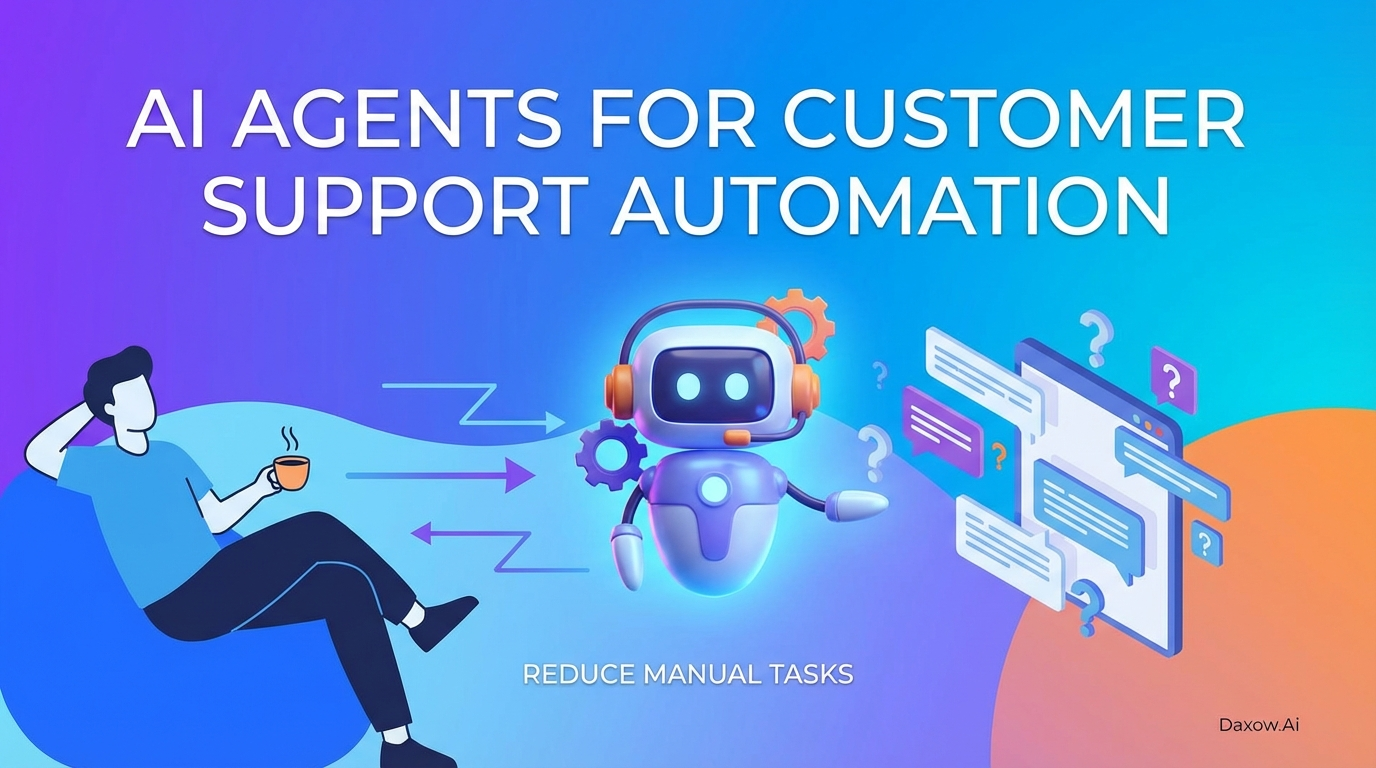
How AI agents automate customer support to cut manual tasks, boost productivity, and deliver measurable ROI across industries. Book a Daxow.ai consultation.
AI Agents for Customer Support Automation: How to Reduce Manual Tasks and Boost Productivity
Estimated reading time: 12 minutes
Key Takeaways
- AI agents automate routine support tasks, reducing manual workload by up to 50% and improving customer satisfaction.
- Research shows AI-driven automation lowers handling times, costs, and increases first-contact resolution rates.
- Integration with backend systems and workflow orchestration are essential for effective AI automation deployment.
- Industry use cases span e-commerce, finance, healthcare, real estate, SaaS, and HR demonstrating diverse benefits.
- Daxow.ai provides custom AI system design focusing on measurable ROI, security, and scalable integration.
- Successful implementation requires prioritizing high-value processes, human-in-the-loop fallback, KPI measurement, and governance.
Table of Contents
- AI Agents for Customer Support Automation — Overview
- Research Insights — Business Impact of AI Automation
- How AI Agents and Workflow Automation Work
- Practical Use Cases Across Industries
- Designing Custom AI Systems — Daxow.ai Approach
- Implementation Framework and Best Practices
- Measuring ROI and Reducing Operational Costs
- Common Challenges and How to Overcome Them
- Real-world Implementation Roadmap
- Frequently Asked Questions
AI Agents for Customer Support Automation — Overview
AI agents combine natural language understanding, task automation, and integrations with back-end systems to handle routine and repeatable support tasks. They can triage requests, answer common questions, extract and update customer data, escalate complex cases to human agents, and run follow-up actions like refunds, bookings, or account updates. When integrated into a broader workflow automation strategy, AI agents become the operational backbone that reduces manual tasks and increases productivity across support, sales, and operations.
Research Insights — Business Impact of AI Automation
Recent industry research and vendor reports consistently show meaningful business outcomes from AI automation. Key findings relevant to customer support automation include:
- Reduced handling time: Companies report a notable decrease in average handling time for routine queries when AI agents manage first-line interactions.
- Fewer manual tasks: Automation can eliminate repetitive data entry and status updates, typically reducing manual workload by 20–50% in targeted processes.
- Improved response times and availability: 24/7 AI-driven responses lead to faster first response times and higher case throughput.
- Cost savings and ROI: Organizations achieving automation at scale often realize lower per-ticket costs and faster ROI through reduced staffing needs for repetitive tasks.
- Higher agent productivity and satisfaction: With AI handling routine work, human agents focus on complex issues, increasing resolution quality and job satisfaction.
These insights point to a consistent opportunity: deploy AI agents where queries are repetitive, data-driven, or rule-based, then connect them to workflow automation to complete end-to-end tasks.
How AI Agents and Workflow Automation Work
Core components
- Intent recognition: Understanding what the customer wants using natural language processing.
- Entity extraction: Pulling structured data (account numbers, invoice IDs, dates) from unstructured text.
- Business rules and decisioning: Mapping intents and entities to automated actions.
- Integrations and APIs: Connecting to CRMs, ticketing systems, billing, and ERP systems to read and write data.
- Orchestration layer: Choreographing multi-step processes and fallback to human agents when confidence is low.
Typical automation flow
- Customer sends message via chat, email, or web form.
- AI agent classifies intent and extracts entities.
- Agent executes rules: answers, updates records, or triggers workflows.
- If needed, agent escalates to human support with context and suggested actions.
- AI logs outcomes and learns from resolved cases to improve accuracy.
Practical Use Cases Across Industries
E-commerce — Order inquiries and returns
- Use case: Automated order tracking, return authorizations, and refund processing.
- How it works: An AI agent verifies order numbers, checks shipping status via API, provides ETA, and triggers return labels or refunds when policy criteria are met.
- Business value: Reduced manual ticket handling by up to 40%, faster refunds, improved NPS, and fewer escalations to human agents.
- Daxow role: Build AI agents that integrate with e-commerce platforms and payment processors to fully automate returns and status updates.
Finance and Banking — Account inquiries and KYC
- Use case: Balance checks, transaction explanations, and KYC document verification.
- How it works: Agents authenticate customers, retrieve account data, summarize transactions, and automatically request missing KYC documents with guided uploads and OCR extraction.
- Business value: Lower compliance bottlenecks, faster onboarding, and reduced manual verification workload.
- Daxow role: Design secure integrations and document automation pipelines that meet regulatory requirements.
Healthcare — Appointment scheduling and patient triage
- Use case: Symptom triage, appointment booking, and pre-visit intake.
- How it works: AI triages urgency, schedules appointments in provider calendars, pre-populates intake forms, and sends reminders.
- Business value: Improved operational efficiency, reduced no-shows, and less administrative burden on clinical staff.
- Daxow role: Implement HIPAA-aware workflows and integrate EMRs to automate patient administration tasks.
Real Estate — Lead qualification and property inquiries
- Use case: Qualify leads, schedule viewings, and auto-generate property recommendation lists.
- How it works: AI collects budget, location, timeline, and preferences; routes qualified leads to agents; and schedules showings automatically.
- Business value: Faster lead response times, higher conversion rates, and reduced manual lead nurturing.
- Daxow role: Build AI agents that integrate with CRMs to update lead statuses and automate follow-ups.
SaaS / B2B Support — Incident classification and resolution
- Use case: Troubleshooting common product issues, delivering knowledge-base articles, and creating support tickets with contextual diagnostics.
- How it works: AI captures logs, suggests remediation steps, runs automated diagnostics where allowed, and escalates persistent problems to L2 engineers.
- Business value: Fewer escalations, higher first-contact resolution, and lower mean time to resolution (MTTR).
- Daxow role: Connect product telemetry to AI agents to automate initial diagnostics and remediation.
HR and Admin — Employee onboarding and payroll queries
- Use case: New hire onboarding checklist automation and routine payroll question handling.
- How it works: AI agents guide new employees through tasks, collect documents, and answer payroll FAQs, triggering HR workflows for approvals.
- Business value: Reduced HR administrative time and faster onboarding completion.
- Daxow role: Create secure internal AI agents that integrate with HRIS systems and payroll providers.
Designing Custom AI Systems — Daxow.ai Approach
Discovery and process mapping
- Map current workflows, identify high-volume repetitive tasks, and quantify manual time and cost.
- Identify quick wins where automation will deliver immediate value.
Data assessment and integration planning
- Evaluate available data sources (CRM, ticketing, product logs, knowledge base).
- Design secure, scalable integrations and data pipelines.
Prototype and iterate
- Build a minimum viable AI agent for a single workflow.
- Measure accuracy, response quality, and operational impact.
- Iterate quickly using real interactions and human-in-the-loop training.
Full automation and orchestration
- Deploy AI agents into production with orchestration to manage multi-step processes.
- Implement robust escalation paths, monitoring, and audit logs.
Continuous improvement and governance
- Monitor performance metrics, retrain models, and update business rules.
- Maintain governance for data privacy, compliance, and explainability.
Throughout this process, Daxow.ai focuses on delivering measurable ROI, reducing manual tasks, and ensuring systems integrate with existing CRMs, ticketing platforms, and business applications. Learn more on our services page.
Implementation Framework and Best Practices
Prioritize by value and complexity
- Start with processes that are high-frequency, standardized, and data-rich.
- Avoid long, complex flows as an initial project; target modular automations.
Human-in-the-loop for risk mitigation
- Use fallback to human agents when confidence is low.
- Track corrections to continuously improve the agent.
Measure the right KPIs
- Automation rate (percentage of tickets fully handled by AI).
- Manual tasks reduced (hours saved per month).
- First response time and resolution time.
- Customer satisfaction (CSAT or NPS) and cost per ticket.
Security and compliance
- Ensure data access follows least-privilege principles.
- Implement logging, consent, and data retention policies.
Change management
- Train staff to work with AI agents and update job roles to higher-value tasks.
- Communicate clear benefits and measure impact to maintain buy-in.
Measuring ROI and Reducing Operational Costs
Example ROI model (simplified)
- Baseline: 10,000 monthly support tickets; average handling cost $6 per ticket; total monthly cost $60,000.
- Automation: AI handles 40% of tickets end-to-end.
- Savings: 4,000 tickets * $6 = $24,000 monthly savings.
- Additional benefits: Improved CSAT, lower churn, and increased revenue from faster sales support.
Even modest automation rates rapidly pay back implementation costs. Daxow.ai focuses on building solutions where the business case is clear and measurable. Visit our ROI calculator to estimate your impact.
Common Challenges and How to Overcome Them
- Data quality and fragmentation: Consolidate and clean data before automation.
- Integration complexity: Use API-first connectors and modular architecture.
- Model drift and maintenance: Plan for ongoing retraining and monitoring.
- Over-automation risk: Maintain human oversight for ambiguous or high-risk scenarios.
Daxow.ai helps mitigate these challenges by delivering integration expertise, robust data engineering, and governance frameworks.
Real-world Implementation Roadmap
- Assessment workshop: Identify processes and KPIs.
- Pilot build (4–8 weeks): Prototype one AI agent integrated with a single system.
- Pilot evaluation: Measure impact and refine models and workflows.
- Scale: Expand automation to adjacent processes and integrate additional systems.
- Operate: Ongoing monitoring, retraining, and business optimization.
Daxow.ai supports every stage — from discovery and prototyping to scaling and long-term operations. Learn more on our implementation page.
Frequently Asked Questions
What types of customer support tasks can AI agents automate?
AI agents can automate routine inquiries such as order tracking, account status, refund processing, appointment scheduling, lead qualification, incident classification, and onboarding activities. They excel at repetitive, data-driven, or rule-based tasks.
How do AI agents work with human support staff?
AI agents handle first-line support and routine actions, then escalate complex or ambiguous cases to human agents. This human-in-the-loop approach ensures quality and risk mitigation while improving agent productivity.
What are the key benefits of customer support automation using AI?
Benefits include reduced manual workload, faster response times, improved customer satisfaction, cost savings, higher agent efficiency, and measurable ROI.
How does Daxow.ai ensure security and compliance?
Daxow.ai designs AI systems with privacy, regulatory compliance, and data security in mind, implementing least-privilege access, encryption, logging, and governance processes suitable for each industry.