
AI Agents in Customer Service — Implementation & ROI
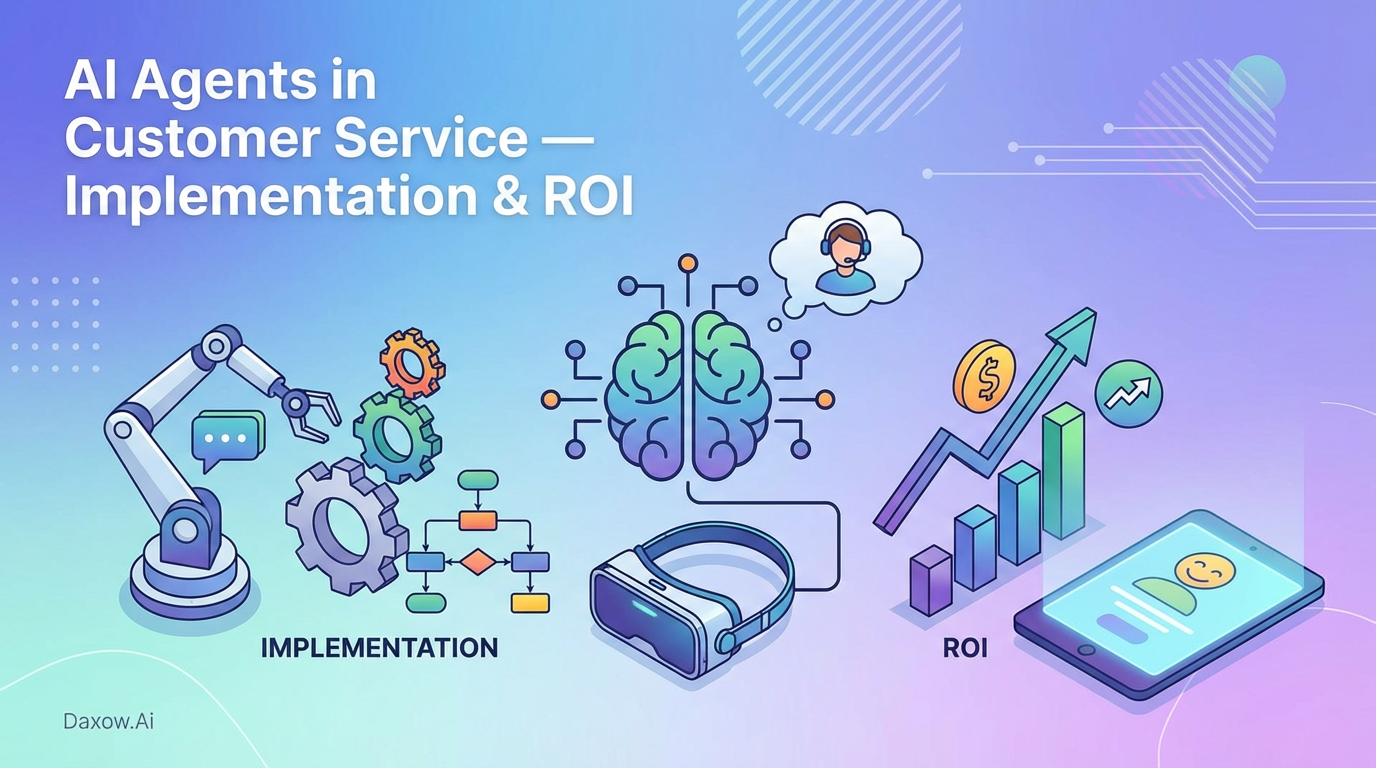
How AI agents transform customer service: use cases, architecture, KPIs, and a practical deployment roadmap.
AI agents in customer service: How AI automation transforms support, sales, and workflows
Estimated reading time: 12 minutes
Key Takeaways
- AI agents reduce manual tasks and increase productivity by automating customer support workflows.
- Implementing AI improves customer experience with faster responses and 24/7 availability.
- Strategic deployment includes discovery, design, integration, testing, and ongoing monitoring.
- Use cases span e-commerce, healthcare, finance, real estate, HR, and internal IT support.
- Daxow.ai provides end-to-end AI agent solutions tailored to industry needs and business goals.
Table of Contents
- AI agents in customer service — Why the shift to AI automation matters
- Designing AI agents in customer service — Architecture and capabilities
- Use cases across industries — Practical examples of AI agents in customer service
- Implementation roadmap — From process analysis to production
- Measuring ROI and KPIs for AI agents in customer service
- Risks, governance, and best practices
- How Daxow.ai helps build and operate AI agents in customer service
- Frequently Asked Questions
AI agents in customer service — Why the shift to AI automation matters
Business drivers
- Reduce manual tasks: Routine ticket routing, status checks, and data entry consume significant agent time. AI agents automate these workflows.
- Improve productivity: AI-enabled assistants augment agents with context, suggested responses, and automated actions that speed resolution.
- Scale support without linear headcount growth: Automating common requests enables teams to handle volume spikes and expand support coverage.
- Increase conversion and retention: AI agents that qualify leads and follow up automatically boost sales automation and customer lifetime value.
- Enhance customer experience: Faster first response times, consistent answers, and 24/7 support raise satisfaction and NPS.
Measurable outcomes executives care about
- First Response Time (FRT) reduction by 30–70% through automated triage and responses.
- Deflection rates improving by 20–50% when self-service and intelligent bots resolve common queries.
- Agent productivity gains of 25–60% from automation of repetitive tasks and contextual agent assist.
- Cost per contact decreases through lower human intervention for routine issues.
- Lead-to-opportunity conversion uplift using automated qualification and follow-up.
Designing AI agents in customer service — Architecture and capabilities
Core capabilities of effective AI agents
- Natural language understanding and generation to interpret and respond to customers across channels.
- Workflow automation to execute tasks: update CRM records, trigger refunds, schedule callbacks.
- Data extraction and document automation to parse invoices, contracts, and support attachments.
- Integrations with business tools and CRMs (e.g., Salesforce, HubSpot, Zendesk) for end-to-end action.
- Business-rule engines and escalation logic to hand off to humans when needed.
- Observability, logging, and monitoring for compliance and continuous improvement.
Recommended technical architecture
- Front-end channel adapters: chat, email, SMS, social, voice.
- Conversational layer built on LLMs and intents/slots for deterministic tasks.
- Orchestration layer: workflow engine that sequences API calls, waits for confirmations, and manages retries.
- Integration layer: secure connectors to CRM, ERP, billing, and ticketing systems.
- Data layer: centralized knowledge base, conversation logs, and extracted document data.
- Monitoring layer: metrics dashboards, error tracing, and human override interfaces.
Use cases across industries — Practical examples of AI agents in customer service
E-commerce — Automated order support and proactive recovery
Use case:
- AI agent handles order status inquiries, initiates returns, and issues refunds based on policy.
Implementation:
- Integrate with order management and payment gateways.
- Build workflows that authenticate customers, fetch order data, calculate refund eligibility, and trigger refunds.
Business impact:
- Reduce manual tasks for support agents by 60%.
- Improve customer satisfaction with faster refunds and transparent communications.
Example: After implementing an AI agent, an online retailer reduced average order inquiry handle time from 8 minutes to under 2 minutes, while increasing refund processing speed by 4x.
Healthcare — Appointment scheduling and patient triage
Use case:
- AI agent performs symptom triage, schedules appointments, and routes urgent cases to clinicians.
Implementation:
- Connect to EHR scheduling APIs, maintain privacy controls and consent workflows, and include human-in-the-loop escalation.
Business impact:
- Increase productivity of administrative staff and reduce missed appointments.
- Streamline intake by extracting patient-reported data into structured forms.
Compliance note: Ensure data encryption, access controls, and adherence to healthcare regulations.
Example: A clinic automated pre-visit data collection with an AI agent, reducing administrative overhead and improving clinician preparedness.
Finance — Document automation and compliance queries
Use case:
- AI agent extracts data from KYC documents, reconciles transactions, and answers customer queries about statements.
Implementation:
- Use document extraction models to parse PDFs and integrate with core banking systems.
- Implement audit trails and multi-factor authentication for sensitive actions.
Business impact:
- Reduce manual tasks in compliance processes, decreasing review time and error rates.
- Faster onboarding through automated document verification.
Example: A fintech firm cut onboarding time by 70% by automating ID verification and initial KYC checks with AI agents.
Real estate — Lead qualification and property matching
Use case:
- AI agents engage website visitors, qualify leads based on budget and preferences, and schedule viewings.
Implementation:
- Connect AI agent to CRM, calendar systems, and property databases.
- Automate follow-ups, send tailored property lists, and notify agents for high-value leads.
Business impact:
- Increase sales automation efficiency and conversion rates by focusing agents on qualified leads.
Example: A brokerage used AI agents to pre-qualify leads, resulting in a 30% increase in appointments booked per week.
HR and internal operations — Employee onboarding and IT support
Use case:
- AI agent automates IT ticket triage, password resets, and new-hire onboarding workflows.
Implementation:
- Integrate with HRIS, identity management systems, and ticketing platforms.
- Build templated workflows for equipment provisioning and training scheduling.
Business impact:
- Improve productivity of HR and IT teams by removing routine onboarding tasks.
- Reduce time-to-productivity for new hires.
Example: An enterprise reduced manual onboarding steps by 80% and shortened provisioning lead time from days to hours.
Implementation roadmap — From process analysis to production
Phase 1 — Discovery and process mapping
- Map current workflows and identify high-volume, high-effort processes suitable for automation.
- Quantify baseline metrics: handle time, volume, cost per contact.
- Prioritize opportunities by ROI and complexity.
Phase 2 — Design and prototype
- Design conversational flows and automation workflows.
- Prototype AI agents for a subset of use cases with clear success criteria.
- Include privacy, security, and compliance requirements from the start.
Phase 3 — Build and integrate
- Implement connectors to CRMs, ticketing systems, payment gateways, and databases.
- Develop orchestration logic that ensures reliable end-to-end execution.
- Implement human handoff and escalation rules.
Phase 4 — Test, validate, and iterate
- Run closed beta with real traffic and monitor performance.
- Use human reviewers to validate AI outputs for tasks like document extraction and complex decisioning.
- Iterate on prompts, rules, and training data.
Phase 5 — Rollout and operate
- Gradually extend coverage and channels.
- Establish monitoring for KPIs, error rates, and model drift.
- Implement continuous training loops and update policies.
Measuring ROI and KPIs for AI agents in customer service
Key metrics to track
- Deflection rate: percentage of inquiries resolved without human agents.
- Average handle time (AHT) and first contact resolution (FCR).
- Customer Satisfaction (CSAT) and Net Promoter Score (NPS).
- Cost per contact and total support cost savings.
- Lead conversion rate and revenue impact from sales automation.
- Time-to-resolution for compliance or document processing tasks.
How to estimate ROI
- Calculate labor cost saved: (hours automated × fully loaded hourly rate).
- Add operational savings from reduced errors and improved throughput.
- Attribute revenue uplift from improved lead handling and faster responses.
- Consider one-time development and integration costs versus ongoing savings to determine payback period.
Risks, governance, and best practices
Risk areas
- Data privacy and regulatory compliance.
- Incorrect or biased responses leading to customer harm.
- Over-automation without adequate human oversight.
- Integration failures causing inconsistent system states.
Mitigations and governance
- Human-in-the-loop for ambiguous or high-risk decisions.
- Role-based access controls and encryption for sensitive data.
- Audit trails and explainability for decisions affecting customers.
- Ongoing monitoring and retraining to reduce drift.
How Daxow.ai helps build and operate AI agents in customer service
End-to-end process automation and custom AI systems
Daxow.ai partners with businesses to analyze current workflows, identify automation opportunities, and design tailored AI agents that execute real tasks. Our approach covers everything from discovery to long-term operations:
- Discovery & process analysis: We map your workflows, quantify baseline metrics, and prioritize automation opportunities that deliver immediate ROI.
- Custom AI design: We build AI agents combining conversational intelligence, workflow automation, and document extraction tuned to your domain.
- Systems integration: We connect AI agents to CRMs, help desks, billing systems, and ERPs to enable reliable end-to-end automation.
- Compliance & security: We implement governance, logging, and privacy controls aligned with industry regulations.
- Managed operations: We provide monitoring, retraining, and continuous optimization to keep AI agents performing reliably.
Examples of Daxow.ai engagements
- Automating order support for an e-commerce client: reducing average response time and refund processing costs.
- Building a lead qualification agent for a real estate firm: increasing booked viewings and agent productivity.
- Deploying document automation for a financial services provider: accelerating KYC and compliance reviews.
Why choose Daxow.ai
- Domain-driven implementations: We tailor AI agents to your industry context and business rules.
- Focus on measurable outcomes: Projects are scoped around clear KPIs and ROI.
- End-to-end delivery: From connectors and orchestration to monitoring and compliance.
- Scalable systems: AI agents built to integrate into existing toolchains and scale with growth.
Frequently Asked Questions
What are AI agents in customer service?
AI agents are automated systems that use conversational intelligence and workflow automation to handle customer inquiries, support requests, and sales processes, reducing manual effort and improving response quality.
How do AI agents improve customer experience?
They provide faster response times, consistent and accurate answers, 24/7 availability, and personalized support, resulting in higher satisfaction and loyalty.
What industries benefit most from AI agents?
E-commerce, healthcare, finance, real estate, HR, and IT support are among the key sectors where AI agents have demonstrated significant impact.
What is the best approach to implement AI agents?
A phased roadmap starting with process discovery, followed by design, development, integration, testing, and ongoing operations ensures sustainable results and measurable ROI.
How does Daxow.ai support AI agent deployment?
Daxow.ai offers end-to-end services including workflow analysis, custom AI design, integration with existing systems, security compliance, and managed operations to maximize AI agent effectiveness.