
AI Agents for Business: Value, Use Cases & Implementation
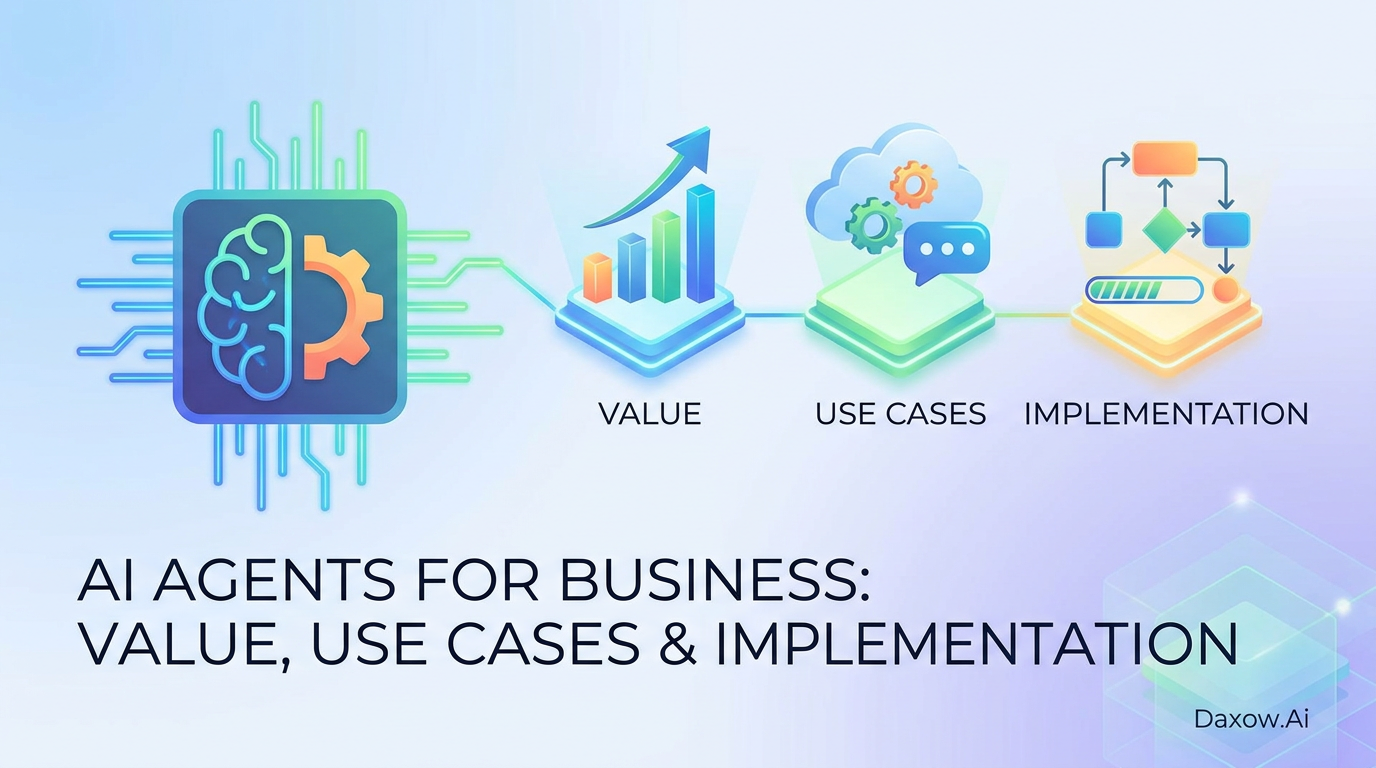
How AI agents drive business automation: definitions, use cases, ROI metrics, and a practical roadmap for implementing outcome-driven digital workers with Daxow.ai.
AI Agents for Business: What They Mean, Where They Deliver Value, and How to Implement Them
Estimated reading time: 15 minutes
Key Takeaways
- AI agents are goal-driven digital workers that manage outcomes by interpreting inputs, reasoning contextually, and acting across systems.
- They excel in high-volume, complex workflows to reduce manual effort, improve productivity, and enhance customer experience.
- Successful implementation requires clear outcome goals, end-to-end workflow mapping, integration, governance, and iterative refinement.
- Daxow.ai partners with businesses to design, build, scale, and govern AI agents for measurable ROI and productivity gains.
- Start with high-impact pilots, define KPIs upfront, prioritize system integrations, and build governance early for sustainable success.
Table of Contents
- AI Agents for Business: What They Mean, Where They Deliver Value, and How to Implement Them
- Why AI agents matter for business automation and productivity
- Practical use cases and industry examples
- How to implement AI agents successfully — a practical roadmap
- Combining AI agents with workflow automation for maximum ROI
- Measuring ROI — what to track and how to report it
- Common pitfalls and how to avoid them
- How Daxow.ai partners with you to deliver AI automation and AI agents
- Final recommendations — where to start this quarter
- Frequently Asked Questions
AI Agents for Business: What They Mean, Where They Deliver Value, and How to Implement Them
Definition and business distinction
An AI agent is a goal-driven digital worker that can interpret inputs, make context-aware decisions, and execute actions across systems. Unlike classical automation that follows fixed rules, AI agents combine language understanding, reasoning, and integrations to manage outcomes. This makes them especially valuable where work is high-volume, cross-system, partially unstructured, and prone to exceptions.
The core capabilities that create business value
- Interpret unstructured inputs (emails, documents, chat).
- Reason about next steps using business context and policies.
- Take action across multiple systems (CRM, ERP, ticketing).
- Escalate or hand off to humans when necessary.
- Learn from feedback to improve over time.
Why AI agents matter for business automation and productivity
From task automation to outcome ownership
Traditional workflow automation is excellent for deterministic tasks: moving data, triggering alerts, or enforcing simple rules. AI agents shift the model to outcome ownership: they pursue a business goal (e.g., resolve a customer issue, approve an invoice, qualify a lead), adapt when conditions change, and orchestrate the steps required to reach that goal.
Business impacts at a glance
- Reduce manual tasks and repetitive decision load for employees.
- Increase productivity by enabling teams to handle higher volumes without linear headcount increases.
- Improve customer experience through faster, consistent responses (customer support automation).
- Lower operational costs by reducing cycle times and error rates.
- Scale processes while maintaining compliance and quality.
Practical use cases and industry examples
E-commerce — Reduce support backlog and increase conversions
Use case: Order delays and returns
- Inputs: Customer emails, order data, inventory status.
- Agent actions: Read customer message, check order system, identify delay cause, generate personalized response with next steps, trigger refund or expedited shipment workflows when appropriate, update CRM.
- Measurable outcomes: Reduce average handling time by 60%, lower ticket backlog, improved first-contact resolution, and higher post-resolution NPS.
- Daxow.ai role: Integrate order management, CRM, and fulfillment systems; build agent templates for common scenarios; monitor and refine response accuracy.
Healthcare — Reduce administrative friction without replacing clinicians
Use case: Patient intake and pre-authorization
- Inputs: Patient forms, insurance documents, scheduling requests.
- Agent actions: Classify incoming documents, validate insurance eligibility, pre-fill EHR fields, schedule appointments, remind patients, escalate unclear cases to staff.
- Measurable outcomes: Fewer missed appointments, faster intake completion, reduced administrative hours per patient.
- Daxow.ai role: Connect EHR, scheduling, and document repositories with secure governance; implement privacy controls and audit logs.
Finance — Speed up invoice processing and improve controls
Use case: Invoice validation and exception routing
- Inputs: Invoices, purchase orders, contracts.
- Agent actions: Extract invoice fields, match to POs, flag anomalies (duplicates, price mismatches), auto-approve low-risk invoices, route exceptions to approvers with contextual notes.
- Measurable outcomes: Cut invoice processing time from days to hours, reduce manual reconciliation, improve compliance.
- Daxow.ai role: Deploy document extraction models, integrate with ERP, design approval thresholds and audit trails.
Real estate — Improve lead qualification and follow-up
Use case: Lead intake and viewing scheduling
- Inputs: Website inquiries, emails, SMS leads.
- Agent actions: Classify lead intent, qualify prospect based on criteria, route warm leads to agents, schedule viewings automatically, send reminders.
- Measurable outcomes: Faster lead response (under 5 minutes), higher conversion rates, reduced manual follow-up by staff.
- Daxow.ai role: Build lead-scoring agent, connect CRM and calendar systems, automate reminders and feedback collection.
HR — Streamline candidate screening and onboarding
Use case: Candidate pre-screening and onboarding checklist
- Inputs: Resumes, application forms, policy documents.
- Agent actions: Screen resumes for role fit, shortlist candidates, coordinate interview schedules, guide new hires through onboarding tasks and policy acknowledgments.
- Measurable outcomes: Shorter hiring cycles, consistent onboarding completion, reduced HR ticket volume.
- Daxow.ai role: Integrate applicant tracking, calendar, and HRIS; implement privacy-safe data flows.
How to implement AI agents successfully — a practical roadmap
1. Identify high-value workflows
Start with processes that are:
- High volume and repetitive
- Time-sensitive or revenue-impacting
- Cross-system and error-prone
- Amenable to measurable KPIs (cycle time, error rate)
2. Define clear business outcomes and metrics
Set targets such as:
- Reduce average handling time by X%
- Increase throughput by Y%
- Achieve Z% automation of routine cases
Without measurable goals, initiatives stall.
3. Map workflows end-to-end
Document every input, decision point, exception path, and system touchpoint. A thorough map uncovers hidden manual steps and integration requirements.
4. Choose the right autonomy level
Use a staged approach:
- Assistive: agent suggests drafts or next actions.
- Semi-autonomous: agent executes with human approval.
- Autonomous: agent executes within well-defined boundaries.
Start with assistive and semi-autonomous modes for high-risk workflows.
5. Integrate with core systems
Value materializes when agents can act in the systems your teams use:
- CRM, ERP, HRIS, EHR, ticketing, and document management systems.
Integrations convert a chatbot into an operational AI agent.
6. Build governance and traceability
Essential controls:
- Role-based access and permissions
- Audit logs of agent decisions and actions
- Escalation rules and human-in-the-loop checkpoints
- Data retention and privacy controls
Good governance reduces operational risk as autonomy grows.
7. Pilot, measure, refine, and scale
A focused pilot validates accuracy, adoption, and ROI. Use iterative cycles to refine prompts, decision logic, and integrations before broader rollout.
Combining AI agents with workflow automation for maximum ROI
A layered architecture
- Layer 1 — Workflow automation: handle predictable integrations and data movements.
- Layer 2 — AI agents: interpret inputs, make decisions, orchestrate workflows.
- Layer 3 — Human oversight: manage exceptions, approvals, and sensitive decisions.
Example orchestration
- Automation collects data from forms and systems.
- An AI agent interprets intent and decides the next actions.
- Automation executes the low-risk steps.
- Humans intervene on escalations flagged by the agent.
This approach delivers fast wins while minimizing risk and maximizing throughput.
Measuring ROI — what to track and how to report it
Core metrics to monitor
- Time saved per task and total labor hours recovered.
- Rate of successful autonomous resolutions (percent fully automated).
- Error and exception rates before and after deployment.
- Cycle time reductions (e.g., invoice processing time).
- Customer satisfaction (CSAT, NPS) and employee satisfaction.
- Cost savings versus implementation and operating costs.
Example ROI calculation (illustrative)
- Team handles 10,000 tickets annually; average handling time 20 minutes.
- AI agent reduces handling time by 40% and automates 30% of tickets fully.
- Labor hours saved = (10,000 * 20min * 0.40) / 60 = 1,333 hours saved.
- Multiply hours saved by average loaded hourly rate to estimate savings, subtract solution costs to estimate net ROI.
Daxow.ai helps build these measurement frameworks and creates dashboards to track them continuously.
Common pitfalls and how to avoid them
Pitfall: Automating the wrong processes
Avoid automating low-impact or highly-variable work. Focus on tasks with clear, repeatable value.
Pitfall: Weak integrations
An agent without access to systems is a conversation, not an operational asset. Prioritize integrations during design.
Pitfall: Poor governance
As agents gain autonomy, missing guardrails increase legal, compliance, and operational risk. Implement permissions, audits, and escalation paths early.
Pitfall: No owner or measurement plan
Every agent needs a business owner, KPIs, and an iterative improvement plan.
How Daxow.ai partners with you to deliver AI automation and AI agents
Our end-to-end approach
Daxow.ai delivers a full lifecycle service that turns process discovery into operational AI:
- Discovery and process analysis
- We map workflows and quantify potential gains.
- We identify integration points and data constraints.
- Design and feasibility
- We define agent scope, autonomy level, and success metrics.
- We design governance, security, and audit controls.
- Build and integration
- We develop AI agents, connect core systems (CRM, ERP, HRIS), and implement workflow automation.
- We use secure connectors and maintain strict data handling standards.
- Pilot and refine
- We run controlled pilots, measure outcomes, and iterate.
- We tune models and prompts for accuracy and compliance.
- Scale and operate
- We deploy agents at scale, monitor performance, and provide ongoing optimization and support.
- We implement dashboards and reporting to demonstrate ROI.
Why work with Daxow.ai
- Custom solutions: We design agents tailored to your processes and systems.
- End-to-end implementation: From integration to governance to scaling, we deliver production-ready automation.
- Outcome focus: We prioritize measurable productivity gains and reduced manual tasks.
- Cross-industry experience: We have proven patterns for customer support automation, sales automation, finance automation, HR automation, and operations.
Final recommendations — where to start this quarter
- Start with a high-impact pilot: Choose a single workflow (e.g., invoice processing, lead qualification, or a high-volume support queue).
- Define KPIs before you build: Make success measurable from day one.
- Prioritize integrations: Ensure agents can act in your systems.
- Implement governance early: Permissioning, audits, and human-in-the-loop controls are non-negotiable.
- Iterate and scale: Use pilot learnings to expand agents into adjacent processes.
AI agents are not a novelty — they are a new operating model for business automation. By combining smart AI agents with workflow automation, companies can significantly reduce manual tasks, improve productivity, and deliver better customer and employee experiences while controlling risk. Daxow.ai partners with organizations to design, build, and scale these systems end-to-end, integrating with your tools, enforcing governance, and proving ROI.
Book a free consultation with Daxow.ai to request a process analysis for your company and begin designing a custom AI system that reduces manual work and delivers measurable business automation and productivity gains. Contact us to build AI agents that execute real tasks and transform your operations.
Frequently Asked Questions
What distinguishes AI agents from traditional automation?
AI agents go beyond fixed rule-based automation by interpreting unstructured inputs, reasoning contextually, acting across multiple systems, and adapting to changing conditions to manage outcomes holistically.
How can AI agents improve customer support?
AI agents reduce response times, personalize interactions, automate routine inquiries, escalate exceptions efficiently, and help maintain high-quality consistent customer experiences.
What are common challenges in implementing AI agents?
Challenges include selecting the right processes, integrating with core systems, establishing strong governance, defining measurable outcomes, and iteratively tuning the agent based on feedback.
Why partner with Daxow.ai for AI agent implementation?
Daxow.ai offers end-to-end services from discovery and design to build, pilot, and scale with strong governance and outcome focus, backed by cross-industry experience and proven AI automation patterns.