
AI Agents for Business Automation: Strategy, Use Cases & ROI
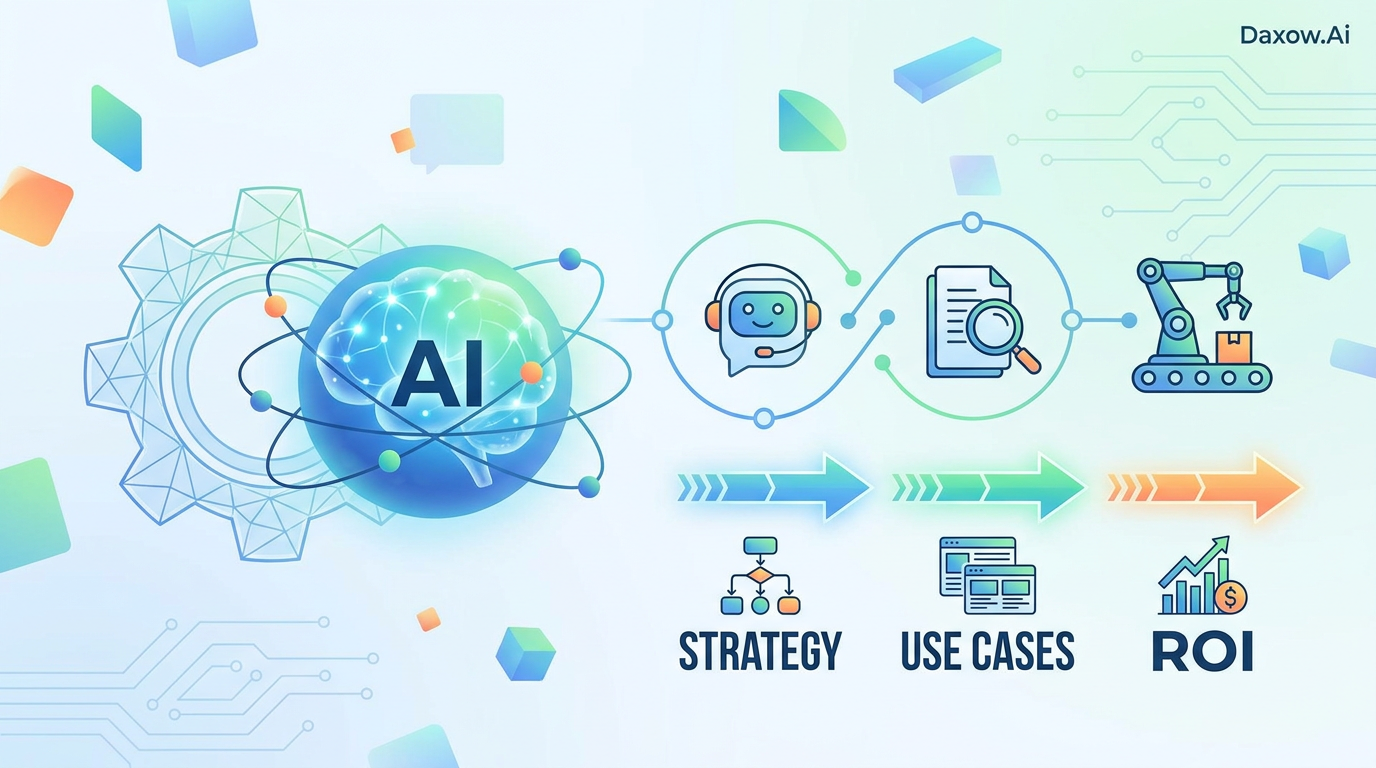
Practical guide to deploying AI agents for business automation—use cases, phased implementation, governance, and measuring ROI with Daxow.ai.
AI Agents for Business Automation: Strategy, Use Cases, Implementation, and ROI
Estimated reading time: 15 minutes
Key Takeaways
- AI agents automate and orchestrate multi-step workflows to improve productivity and reduce manual tasks.
- Industry-specific AI agent use cases deliver measurable ROI in e-commerce, healthcare, finance, real estate, and HR.
- Successful implementation involves selecting high-impact use cases, designing secure architectures, and continuous monitoring.
- AI agents generate value through cost savings, revenue growth, and risk mitigation.
- Daxow.ai provides tailored AI automation solutions focused on measurable business outcomes and secure integrations.
Table of Contents
- AI Agents for Business Automation: Strategy, Use Cases, Implementation, and ROI
- Practical Use Cases Across Key Industries
- How AI Agents and Automation Help in Practice
- Implementation Steps and Best Practices
- ROI and Business Value
- Strategic Recommendations for Decision-Makers
- How Daxow.ai Helps You Build and Scale AI Agents
- Frequently Asked Questions
AI Agents for Business Automation: Strategy, Use Cases, Implementation, and ROI
AI Agents for Business Automation: Strategy, Use Cases, Implementation, and ROI is rapidly moving from pilot projects to core operational capability. For decision-makers, the opportunity is simple: deploy systems that reduce manual tasks, orchestrate end-to-end workflows, and scale knowledge without linear headcount growth. This article explains what AI agents are, where they deliver the fastest ROI, how to implement them safely, and how Daxow.ai helps businesses turn strategy into measurable outcomes through custom AI automation.
AI agents are autonomous software systems that perceive, reason, act, and learn. They extend traditional automation by orchestrating multi-step processes across multiple systems and channels. When applied thoughtfully, AI agents drive measurable gains in productivity, reduce manual error, and enable new forms of business automation such as proactive customer outreach, intelligent lead qualification, and automated compliance enforcement.
What AI Agents Mean for Businesses
- Perceive: ingest emails, chats, documents, and data streams.
- Reason: interpret context, apply policies, and select next steps.
- Act: update CRMs, issue refunds, schedule meetings, or trigger downstream workflows.
- Learn: improve from feedback, outcomes, and new data.
For leaders, AI agents should be framed as a strategic digital workforce that can embed your SOPs and policies directly into operations, enabling scale without proportional hiring.
Practical Use Cases Across Key Industries
E‑Commerce
-
Customer Support & Order Management Agents
- Automate order status lookups, return label creation, and refund initiation.
- Integrations: e‑commerce platform, shipping carriers, payment gateways.
- Outcome: 40–70% ticket deflection, faster resolution, higher CSAT.
-
Personalization & Recommendation Agents
- Deliver personalized product suggestions across email, SMS, and on‑site.
- Outcome: higher conversion and increased average order value.
-
Operations & Inventory Agents
- Forecast demand, trigger purchase orders, and monitor supplier SLAs.
- Outcome: fewer stockouts, optimized inventory, reduced carrying costs.
Healthcare
-
Patient Triage & Virtual Front Desk
- Intake symptoms, match triage protocols, and book appropriate care.
- Outcome: reduced call-center load, faster routing, improved patient experience.
-
Care Coordination Agents
- Automate reminders, lab scheduling, and follow-up coordination.
- Outcome: improved adherence and lower no-show rates.
-
Back-Office & Coding Agents
- Suggest medical codes, pre-check claims, and summarize denials.
- Outcome: faster revenue cycle and fewer billing errors.
Finance (Banking, FinTech, Insurance)
-
Customer Onboarding Agents
- Guide KYC, document checks, and digital product selection.
- Outcome: higher onboarding completion, lower support costs.
-
Risk & Compliance Assistants
- Summarize alerts, propose risk ratings, and generate draft reports.
- Outcome: faster investigations and more consistent compliance documentation.
-
Finance Ops Agents
- Aggregate ERP and BI data, generate variance analyses, and answer ad-hoc CFO queries.
- Outcome: reduced manual reporting and faster decision cycles.
Real Estate
-
Lead Qualification & Nurturing Agents
- Capture preferences, pre-qualify, and book showings.
- Outcome: faster follow-up, better lead-to-appointment conversion.
-
Property Information & Document Agents
- Answer HOA, zoning, and rental yield questions; draft emails and comparatives.
- Outcome: lower admin overhead and consistent client experience.
-
Asset Management Agents
- Monitor occupancy, maintenance tickets, and recommend rent adjustments.
- Outcome: proactive portfolio management and reduced downtime.
HR & People Operations
-
HR Helpdesk Agents
- Answer PTO, benefits, and policy questions from employees.
- Outcome: major reduction in repetitive HR queries and faster employee responses.
-
Recruiting Agents
- Screen resumes, conduct async Q&A, and schedule interviews.
- Outcome: shorter time-to-screen and higher recruiter productivity.
-
Development & Performance Agents
- Recommend learning paths and prepare performance narratives.
- Outcome: better-managed development cycles and less manager admin time.
How AI Agents and Automation Help in Practice
Orchestrate Multi-Step Workflows
An agent replaces fragmented manual steps with a single automated flow:
- Example: customer support agent reads a message, fetches order data, applies refund policy, issues refund, updates CRM, and documents the action.
Enforce Policies and Compliance
Agents embed approval thresholds and regulatory checks:
- Result: consistent decisions at scale and auditable trails for every action.
Turn Unstructured Data into Action
Agents extract meaning from emails, contracts, and transcripts and convert it into structured tasks:
- Result: fewer manual data-entry errors and faster downstream processing.
Learn and Improve Continuously
Production feedback loops—logs, user corrections, and outcome tracking—help agents reduce failure rates and expand scope over time.
Implementation Steps and Best Practices
Step 1 — Select High-Impact, High-Clarity Use Cases
- Prioritize workflows that are high-volume, rule-based, and measurable.
- Quick wins: common support intents, order tracking, PTO queries, and lead follow-up.
Step 2 — Map the Workflow and Define Outcomes
- Document inputs, knowledge sources, systems, and success criteria.
- Build a simple process diagram so business and engineering align.
Step 3 — Design Technical Architecture & Integrations
- Agent orchestration layer that supports tool-calling and memory.
- Secure integrations with CRM, ERP, HRIS, ticketing, and communication channels.
- Centralized knowledge layer for policies and SOPs.
- Security controls: least privilege access, data residency, and audit logs.
Step 4 — Define Behavior and Guardrails
- Specify role, scope, approval limits, and escalation rules.
- Set tone, fallback behaviors, and error-handling policies.
Step 5 — Prepare Data and Test Extensively
- Use historical tickets, emails, and SOPs to train and validate agents.
- Run “red team” tests for adversarial inputs and compliance breaches.
- Involve business users in acceptance testing.
Step 6 — Pilot with Human-in-the-Loop
- Start small with shadow mode, then move to partial autonomy.
- Use feedback channels and clear communication to employees.
Step 7 — Monitor, Govern, and Iterate
- Track containment rate, resolution time, CSAT, escalation rate, and policy exceptions.
- Maintain a cadence for reviews, prompt versioning, and governance.
ROI and Business Value
Cost Savings and Productivity Gains
- Automate repetitive tickets, data entry, and routine checks.
- Metrics: FTE hours saved, percent of queries handled end-to-end, and reallocation of staff to higher-value work.
Revenue Growth and Conversion
- Faster lead response, personalized recommendations, and proactive retention.
- Metrics: conversion rate uplift, increased AOV, and improved retention or renewal rates.
Risk Reduction and Quality Improvements
- Consistent policy enforcement and auditable decisions.
- Metrics: fewer compliance incidents, lower error and rework rates, and faster audits.
Strategic Recommendations for Decision-Makers
- Start with bounded, high-ROI workflows to prove value quickly.
- Design for Human + AI collaboration; phased autonomy builds trust.
- Make knowledge a priority: centralized, maintained SOPs amplify agent effectiveness.
- Establish governance early: ownership, KPIs, and approval processes prevent drift.
- Choose platform-first architecture to scale across teams and use cases.
- Iterate quickly, safely: pilots, fast feedback, and controlled rollouts.
How Daxow.ai Helps You Build and Scale AI Agents
Daxow.ai is an end-to-end partner for organizations that want to implement practical AI automation. Our approach focuses on business outcomes, security, and measurable ROI.
- Discovery & Process Analysis
- We map current workflows, measure baseline metrics, and identify the top 3 high-ROI AI agent opportunities tailored to your operations.
- Custom Agent Design & Orchestration
- We build agent logic, guardrails, and personas that reflect your policies and brand voice.
- Capabilities: multi-step workflow automation, tool-calling, memory, and semantic retrieval from your knowledge base.
- Secure Integrations & Data Connectivity
- We connect agents to CRMs, ERPs, HRIS, ticketing systems, and communication channels with secure, least-privilege integrations.
- Pilot Deployment & Human-in-the-Loop
- We run controlled pilots (shadow mode → partial autonomy) with active user feedback loops and UAT with your subject matter experts.
- Monitoring, Governance, and Continuous Improvement
- We implement dashboards, alerting, versioning, and a governance model so agents continue to deliver predictable outcomes.
- Measurable ROI and Scaling
- We quantify savings, productivity improvements, and revenue impact so you can scale agents across departments with confidence.
Across projects, our goal is to replace repetitive manual work with reliable AI automation while preserving human oversight where it matters most.
Conclusion and Next Steps
AI agents are no longer a speculative technology — they are a practical lever for improving efficiency, customer experience, and compliance. By focusing on clear use cases, disciplined implementation, and continuous governance, organizations can achieve rapid, measurable gains in productivity and cost reduction.
Book a free consultation with Daxow.ai to request a process analysis for your company and identify the top AI automation opportunities tailored to your business. Contact us to build a custom AI system that reduces manual tasks, improves customer support automation, and drives sales automation while delivering measurable ROI.
Frequently Asked Questions
What are AI agents in business automation?
AI agents are autonomous software systems that perceive, reason, act, and learn to automate multi-step workflows across multiple systems and channels.
How do AI agents generate ROI?
AI agents deliver ROI by reducing manual tasks, increasing productivity, improving customer experience, enabling revenue growth, and mitigating compliance risks.
What industries benefit most from AI agents?
Industries such as e-commerce, healthcare, finance, real estate, and HR experience measurable benefits from AI agents through tailored use cases.
How does Daxow.ai support AI agent implementation?
Daxow.ai partners with organizations to design, build, pilot, monitor, and scale AI agents with secure integrations and a focus on measurable business outcomes.