
AI Agents for Business: Unlocking Autonomous Automation & ROI
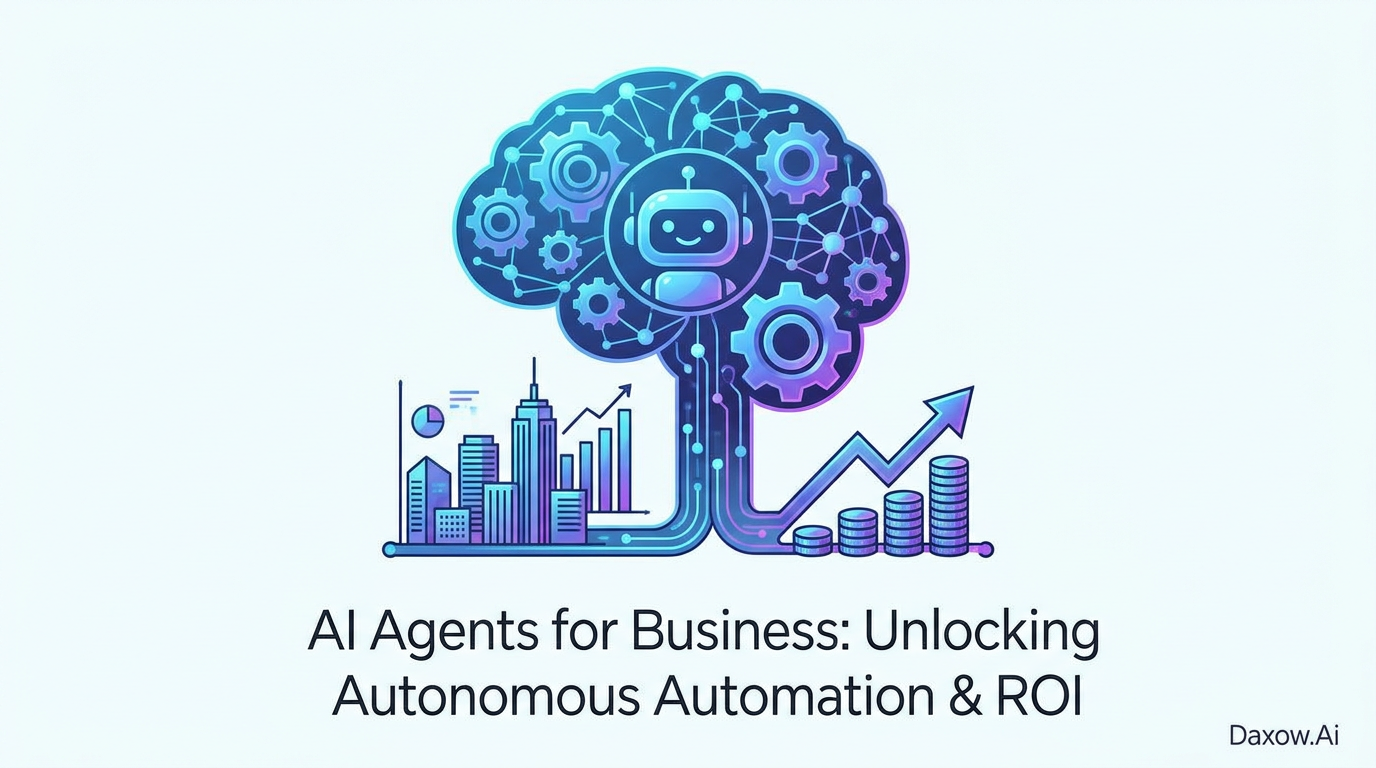
Practical guide to AI agents that automate workflows, cut costs, and boost productivity (45–70%). Use cases, roadmap, governance, and Daxow.ai services.
AI Agents for Business: Unlocking Autonomous Automation and Scalable ROI
Estimated reading time: 15 minutes
Key Takeaways
- AI agents combine perception, reasoning, and execution to outperform traditional automation with up to 70% productivity gains.
- They automate 50–80% of routine tasks, reducing operational costs and improving customer experiences.
- Use cases span e-commerce, healthcare, finance, real estate, and HR with measurable business impact.
- A structured implementation roadmap ensures risk mitigation and maximizes scalable ROI.
- Daxow.ai partners with businesses to design, build, and deploy custom AI agent solutions integrated with existing tools.
Table of Contents
- AI Agents for Business: Unlocking Autonomous Automation and Scalable ROI
- Why AI Agents Matter for Business Automation
- Practical Use Cases Across Industries
- How AI Agents and Workflow Automation Drive Transformation
- Implementation Roadmap: From Audit to Scaled AI Automation
- Measuring ROI and Mitigating Risk
- Best Practices and Pitfalls to Avoid
- How Daxow.ai Builds AI Agents That Deliver Business Value
- Frequently Asked Questions
AI Agents for Business: Unlocking Autonomous Automation and Scalable ROI
AI Agents for Business: Unlocking Autonomous Automation and Scalable ROI is no longer a speculative headline — it is a practical roadmap for companies that want to eliminate repetitive work, accelerate decision-making, and scale operations without proportional headcount increases. AI agents are autonomous software entities that perceive inputs, plan multi-step workflows, execute actions through APIs and integrated tools, and adapt over time. For business leaders, adopting AI agents and workflow automation translates directly into measurable productivity gains, lower operational costs, and enhanced customer experiences.
This article explains what AI agents do, why they outperform legacy automation, concrete use cases across industries, an implementation roadmap, ROI expectations, and how Daxow.ai partners with organizations to design, build, and deploy custom AI automation solutions that reduce manual tasks and deliver scalable value.
What makes AI agents different and strategically important for business automation?
- AI agents combine perception (text, speech, structured data), reasoning (decomposing goals, selecting steps), and execution (calling APIs, updating CRMs, sending messages).
- Unlike simple chatbots, they act as digital employees that can handle exceptions, coordinate with other systems, and operate continuously.
- The result: 45–70% productivity gains, 30–50% operational cost reductions, and the ability to automate 50–80% of routine tasks in targeted workflows when implemented correctly.
Why this matters now:
- Organizations are facing saturated talent markets and rising customer expectations. AI agents let teams focus on high-value, strategic work while the agents handle repetitive, rule-based but exception-prone tasks.
- Integration with existing systems (Salesforce, Zendesk, Slack, ERPs) avoids disruptive process overhauls and preserves historical data while unlocking automation.
Why AI Agents Matter for Business Automation
From reactive tools to proactive digital workers
- Traditional automation executes fixed rules; AI agents reason, adapt, and escalate when needed.
- They enable 24/7 operations, proactive anomaly detection, and contextual follow-ups that reduce manual handoffs.
Business-level benefits
- Productivity: Agents handle research, data entry, triage, and reporting, increasing throughput without proportional staff increases.
- Cost savings: By automating high-volume tasks, organizations can cut operational expenditures and reallocate human resources.
- Customer experience: Faster resolutions, personalized interactions, and proactive communications improve retention and conversion.
- Compliance and risk: Agents can enforce policy checks and produce auditable logs, helping with regulatory adherence.
Practical Use Cases Across Industries
AI agents excel in workflows that are rule-based but require contextual judgment. Below are practical, actionable examples showing how agents deliver measurable business automation and how Daxow.ai helps implement them.
E-commerce — Inventory, personalization, and post-purchase support
- Use cases: Inventory and demand forecasting: Agents analyze sales trends, supplier lead times, and promotions to trigger procurement or initiate supplier negotiations. Customer support automation: Route tickets, query order histories, and present personalized product recommendations within the CRM.
- Business impact: Reduce stockouts and overstock, lower carrying costs, and increase conversion through timely recommendations.
- How Daxow.ai helps: Build agents that integrate ERP, Shopify/Magento, and supplier APIs. Deploy workflow automation to tie demand signals to procurement actions and fulfillment tasks.
Healthcare — Patient triage and administrative automation
- Use cases: Patient triage and appointment scheduling: Agents assess symptoms, check provider availability, and book appointments while logging encounters to EHRs. Claims and compliance checks: Automate claim validation and alert clinicians about potential regulatory issues.
- Business impact: Reduce administrative burden by up to 60%, shorten patient wait times, and reduce claim denials.
- How Daxow.ai helps: Design HIPAA-compliant agents with secure EHR integrations and industry-specific governance.
Finance — Fraud detection and client onboarding
- Use cases: Real-time transaction monitoring: Agents flag anomalies, generate reports, and trigger investigations with audit trails. Automated client onboarding: KYC checks, document verification, and risk scoring integrated with core banking systems.
- Business impact: Faster onboarding, improved fraud detection, and lower compliance overhead.
- How Daxow.ai helps: Implement secure data extraction and verification pipelines, integrate with identity services, and tune agents to firm-specific risk policies.
Real Estate — Lead qualification and market intelligence
- Use cases: Lead qualification and scheduling: Agents qualify inquiries by matching preferences, scoring intent, and booking viewings via calendar APIs. Market analysis: Aggregate listings, compare comps, and prepare briefing reports for agents.
- Business impact: Higher-quality leads, accelerated deal cycles, and reduced administrative time for brokers.
- How Daxow.ai helps: Create sales automation agents that integrate MLS feeds, CRM records, and calendar systems to convert more leads into appointments.
HR — Onboarding and policy automation
- Use cases: Onboarding navigation: Agents collect documents, explain benefits, and run initial role-fit assessments. Expense and time tracking: Validate claims, route approvals, and reconcile expenses into finance systems.
- Business impact: Faster new-hire ramp, lower HR overhead, and better policy compliance.
- How Daxow.ai helps: Deploy AI agents that connect HRIS, payroll, and document storage to automate employee lifecycle tasks.
How AI Agents and Workflow Automation Drive Transformation
Core capabilities that power business automation
- Perception and reasoning: Process natural language, extract structured insights, and break down complex goals.
- Tools and execution: Call APIs, update databases, send emails, and hand off to humans when needed.
- Planning and adaptation: Route tasks, implement feedback loops, and learn from outcomes to reduce error rates.
Real-world orchestration patterns
- Event-driven triggers: Slack messages, form submissions, or CRM updates can start multi-step agent workflows.
- Multi-agent systems: Specialized agents collaborate — for example, a sales research agent compiles insights and hands off to a scheduling agent.
- Observability: Instrumentation and analytics provide KPIs that feed continuous improvement.
How Daxow.ai contributes:
- We design end-to-end automation architectures that combine AI agents with workflow automation tools and native integrations.
- Daxow.ai builds agents that execute real tasks — from CRM updates to automated procurement — and instruments them with analytics to track business outcomes.
Implementation Roadmap: From Audit to Scaled AI Automation
A structured rollout minimizes risk and accelerates ROI. Use this five-step plan, adapted from proven industry practices.
1. Audit and ideation (2–4 weeks)
- Map existing workflows and identify high-impact, repetitive processes.
- Prioritize opportunities where agents can reduce manual tasks and integrate easily with current tools.
- Deliverable: prioritized automation backlog and estimated ROI.
- How Daxow.ai helps: Conducts process discovery workshops and provides a quantified ROI model.
2. Proof of Concept (4–8 weeks)
- Build a scoped agent for one workflow using existing models and connectors.
- Define success criteria: accuracy, resolution time, cost per transaction.
- Deliverable: working PoC with measurable KPIs.
- How Daxow.ai helps: Rapid PoC development and integration with no-code/low-code platforms or custom stacks.
3. Integrate tools and infrastructure (4–12 weeks)
- Connect CRMs, ticketing systems, ERPs, calendars, and data stores securely.
- Implement authentication, encryption, and access controls.
- Deliverable: production-ready connectors and secure environment.
- How Daxow.ai helps: Builds robust integrations and handles compliance and security configurations.
4. Governance and testing (ongoing)
- Define guardrails for data access, escalation paths, and audit trails.
- Conduct functional and performance testing, and use iterative user validation.
- Deliverable: governance framework and test reports.
- How Daxow.ai helps: Establishes monitoring, alerting, and governance policies tailored to your industry.
5. Deploy, monitor, and scale (months)
- Launch with analytics, refine through feedback loops, and expand to multi-agent systems.
- Track ROI and adjust SLA and staffing as automation matures.
- How Daxow.ai helps: Provides managed deployment, monitoring dashboards, and continuous improvement sprints.
Measuring ROI and Mitigating Risk
Key metrics to track
- Resolution speed and throughput.
- Percentage of tasks fully automated versus requiring human intervention.
- Error rate and rework.
- Cost per transaction and cost savings over time.
- Customer satisfaction (NPS) and employee time reallocated to higher-value work.
Expected outcomes
- Short-term: measurable reductions in manual work and faster cycle times.
- Mid-term: 45–70% productivity gains and improved conversion rates where sales automation is applied.
- Long-term: scalable digital workforce that maintains performance under volume spikes.
Risk management and compliance
- Implement role-based access and data minimization.
- Apply industry-specific controls (e.g., HIPAA in healthcare) and ensure logs for auditability.
- Mitigate model drift by retraining on domain data and using human-in-the-loop processes during early deployment.
How Daxow.ai mitigates risk:
- We design systems with security-first architecture, apply enterprise-grade governance, and provide options for private deployments or approved cloud configurations.
Best Practices and Pitfalls to Avoid
Best practices:
- Start small, think big: Validate with a single high-impact use case before scaling.
- Translate SOPs into unambiguous prompts: Clear instruction sets reduce edge-case failures.
- Prioritize existing integrations: Fit agents into current toolchains to accelerate adoption.
- Use pre-trained models and fine-tune with domain data: This balances speed and accuracy.
- Design for observability: Measure everything to iterate quickly.
Common pitfalls:
- Rushing to replace people instead of augmenting roles.
- Building agents without clear KPIs or governance.
- Ignoring data security and compliance requirements.
- Overcomplicating initial designs — keep PoCs focused and measurable.
How Daxow.ai Builds AI Agents That Deliver Business Value
Daxow.ai provides an end-to-end approach to business automation that aligns with the practical steps outlined above.
What we do:
- Discovery and process analysis to identify where AI automation will most effectively reduce manual tasks and improve outcomes.
- Custom AI agent design that maps goals, tools, and data sources to agent behaviors.
- Secure integrations with CRMs, ERPs, support systems, calendars, and data warehouses.
- Workflow automation and orchestration that ties agents into real-world business processes.
- Monitoring, governance, and continuous optimization to ensure long-term ROI.
- Domain-specific tuning for vertical needs such as healthcare compliance, financial regulations, or real estate workflows.
Concrete example (hypothetical):
- A mid-market e-commerce company engaged Daxow.ai to automate order triage and returns processing.
- Results after three months: 50% reduction in manual support workload, 35% faster return resolutions, and an uplift in repeat purchase rate due to faster service.
- Daxow.ai integrated the agent with the company’s ERP, support platform, and shipping provider APIs and delivered a monitored dashboard tracking cost savings and customer KPIs.
AI Agents for Business: Unlocking Autonomous Automation and Scalable ROI is an operational imperative for organizations looking to reduce manual tasks, increase productivity, and transform customer and employee experiences. When implemented with a disciplined roadmap — audit, PoC, secure integration, governance, and iterative scaling — AI agents deliver measurable ROI within months and create a foundation for continuous efficiency gains across the enterprise.
If you want to explore how AI automation, workflow automation, and AI agents can transform your operations, Daxow.ai can help. Book a free consultation or request a process analysis for your company to discover targeted opportunities and a custom roadmap to build, deploy, and scale AI-driven automation. Contact us to build a custom AI system that reduces manual work, improves productivity, and delivers measurable business value.
Frequently Asked Questions
What are AI agents and how do they differ from traditional automation?
AI agents are autonomous software entities that perceive, reason, and execute multi-step workflows, adapting over time. Unlike traditional automation that follows fixed rules, AI agents handle exceptions, integrate with multiple systems, and operate continuously like digital employees.
How quickly can businesses expect to see ROI from implementing AI agents?
With a structured approach including audit, proof of concept, and iterative scaling, companies can expect measurable ROI within months through productivity gains, cost savings, and improved customer experiences.
Can AI agents be integrated with existing enterprise tools?
Yes. AI agents are designed to integrate seamlessly with existing CRMs, ERPs, customer support platforms, and collaboration tools to enhance automation without disrupting current processes.
How does Daxow.ai ensure compliance and security in AI automation?
Daxow.ai designs HIPAA-compliant and industry-specific governance frameworks, enforces role-based access, secures data pipelines, and implements audit logging and continuous monitoring to ensure security and regulatory adherence.