
AI Agents for Business Automation: Strategic Guide
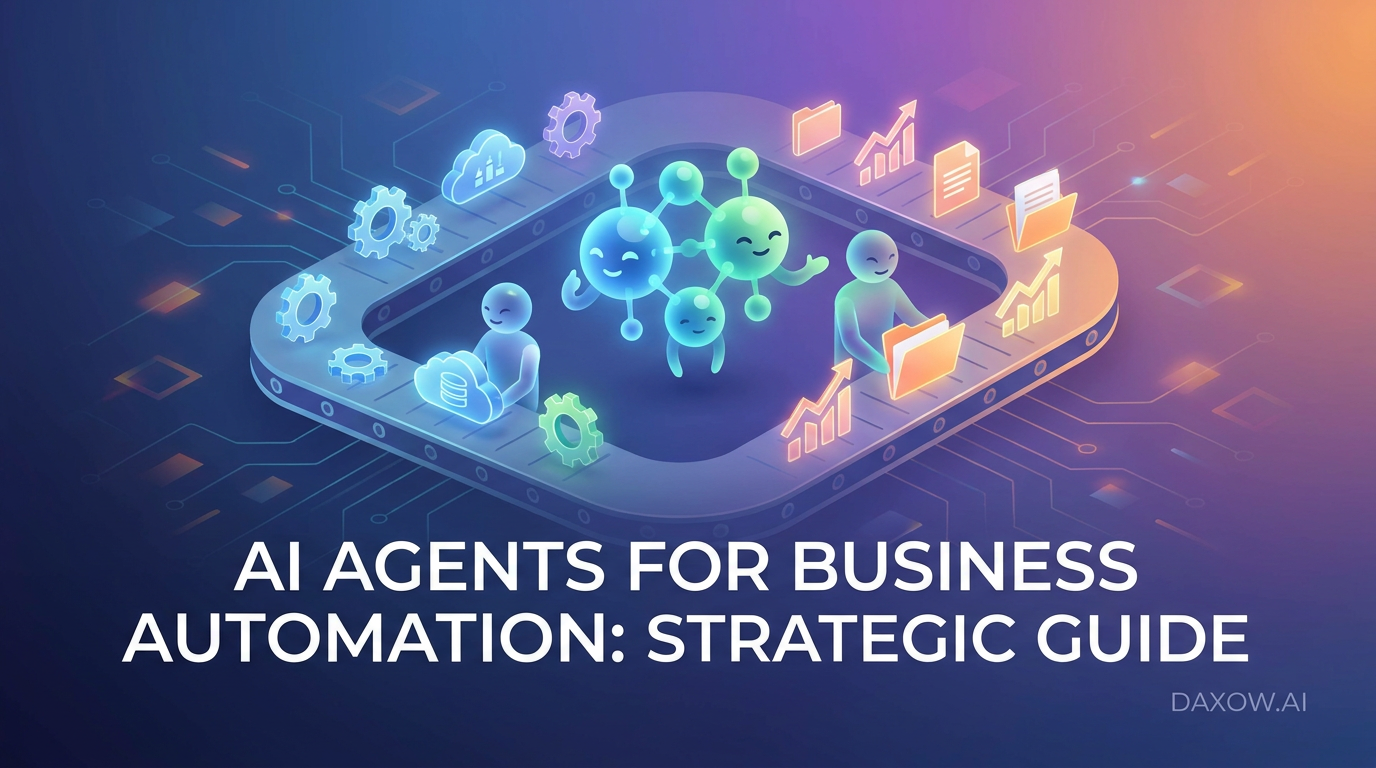
Strategic guide to deploying AI agents for business automation — use cases, ROI examples, architecture, and a practical implementation roadmap.
AI Agents for Business Automation: The Complete Strategic Guide
Estimated reading time: 15 minutes
Key Takeaways
- AI agents extend beyond chatbots to autonomously execute multi-step workflows across enterprise systems.
- They deliver measurable business value by increasing productivity, reducing manual work, and improving compliance.
- Practical use cases span industries such as e-commerce, healthcare, financial services, real estate, and HR.
- A phased implementation roadmap and governance best practices help ensure successful deployments.
- Daxow.ai provides end-to-end AI agent design, integration, and ongoing support to maximize ROI.
Table of Contents
- AI Agents for Business Automation: The Complete Strategic Guide
- What AI Agents Do and How They Differ from Traditional Automation
- Practical Use Cases Across Industries
- How AI Agents Create Measurable Business Value
- Technical Architecture: Perception → Reasoning → Action
- Implementation Roadmap & Best Practices
- Common Pitfalls and How to Avoid Them
- How Daxow.ai Helps You Deploy AI Agents and Business Automation
- Measurement Framework: What to Track
- The Road Ahead — Trends and Strategic Imperatives
- Frequently Asked Questions
AI Agents for Business Automation: The Complete Strategic Guide
AI agents are software systems that perceive context, reason about goals, plan multi-step actions, and execute tasks across systems with minimal human oversight. Unlike traditional script-based automation, AI agents combine natural language understanding, business logic, and system-level integrations to solve complex, exception-prone workflows.
Why this matters now:
- Higher productivity: Organizations report 45–70% gains on targeted processes when AI agents take over repetitive or rule-based tasks.
- Scale without headcount: Agents handle increasing volumes while maintaining quality.
- Better customer outcomes: Faster, consistent responses drive retention and revenue.
- Compliance and auditability: Agents enforce rules consistently and produce auditable trails.
What AI Agents Do and How They Differ from Traditional Automation
Core capabilities
- Perception: read emails, parse documents, query databases, and monitor systems.
- Reasoning: plan multi-step workflows and apply business rules and policies.
- Action: make API calls, update CRMs and ERPs, send communications, and create records.
- Learning: adapt from feedback and interaction data to reduce escalations and errors.
Why AI agents outperform legacy automations
- Contextual understanding handles unstructured inputs (emails, contracts).
- Adaptive decision-making manages exceptions without brittle rule lists.
- End-to-end execution performs actions across disconnected systems, not only surface-level interactions.
Practical Use Cases Across Industries
E-commerce & Retail — Customer Support Automation and Inventory Optimization
- Problem: High ticket volumes, slow responses, and manual inventory adjustments.
- Agent capabilities: Automatically triage tickets, query order systems, provide status updates, create return labels, and generate procurement requests when stock falls below thresholds.
- Business impact: Reduce manual tasks in support by up to 70%, faster order resolutions, fewer stockouts, and improved CSAT.
- Example: An online retailer automates returns and refunds, lowering average handling time from 25 minutes to 7 minutes and reducing refund-related errors by 90%.
Healthcare — Patient Operations and Compliance
- Problem: Manual appointment coordination, complex insurance verifications, and strict compliance needs.
- Agent capabilities: Schedule appointments with real-time EMR checks, prepare pre-visit summaries, automate prescription refills, and monitor compliance indicators.
- Business impact: Faster patient throughput, reduced administrative burden on clinicians, and improved adherence to regulations.
- Example: A clinic deploys agents to manage scheduling and pre-visit intake, freeing nurses for clinical tasks and reducing no-shows through proactive reminders.
Financial Services — Automated Processing and Risk Monitoring
- Problem: Manual reconciliation, slow loan decisions, and regulatory monitoring.
- Agent capabilities: Reconcile transactions, verify documents, score credit applications with explainable reasoning, and flag AML anomalies.
- Business impact: Quicker decisions, lower operational cost, fewer false positives in fraud detection, improved audit readiness.
- Example: A lending team automates document verification and underwriting pre-checks, cutting decision time from days to hours.
Real Estate — Lead Qualification and Transaction Coordination
- Problem: High lead volumes, manual follow-ups, and complex closing workflows.
- Agent capabilities: Qualify leads via conversation, match buyers to listings, schedule viewings, and coordinate closing steps with stakeholders.
- Business impact: Faster lead response rates, higher conversion, and fewer missed deadlines.
- Example: An agency uses agents to qualify inbound leads and schedule showings, improving lead-to-appointment conversion by 35%.
HR & People Operations — Recruitment and Onboarding
- Problem: Time-consuming resume screening, scheduling interviews, and provisioning systems for new hires.
- Agent capabilities: Rank candidates, coordinate interview panels, run background check workflows, and trigger automated provisioning and onboarding checklists.
- Business impact: Shorter time-to-hire, more consistent candidate experience, and reduced administrative load.
- Example: A startup reduces recruiter hours spent screening by 60% and improves offer acceptance rates through faster coordination.
How AI Agents Create Measurable Business Value
Financial and operational metrics to expect
- Labor cost reduction through automation of repetitive work.
- Faster process cycles (order processing, claims handling, loan decisions).
- Reduced error and rework costs via consistent rule enforcement.
- Revenue impact from improved customer retention, faster sales cycles, and higher conversion.
Example ROI calculation
- Support team: 500 tickets/month × 0.5 hours/ticket = 250 hours.
- Agent automation reduces effort to 70 hours = 180 hours saved.
- At $30/hour fully loaded: 180 × $30 = $5,400 monthly savings → $64,800 annually.
- Compare against implementation and maintenance cost to compute ROI.
Technical Architecture: Perception → Reasoning → Action
Perception layer
- Integrates with email, CRM, ticketing systems, document stores, and databases.
- Uses NLU to extract intents, entities, and relevant context.
Reasoning layer
- Applies business rules, composes multi-step plans, and manages contextual state.
- Implements guardrails and escalation thresholds for human-in-the-loop decisions.
Action layer
- Executes API calls, database updates, messaging, and document generation.
- Produces audit logs and supports explainability for regulated environments.
Implementation Roadmap & Best Practices
Phase 1 — Assessment & Strategy
- Identify high-volume, repetitive workflows with clear outcomes.
- Prioritize processes that are exception-prone but rule-defined.
- Conduct ROI assessments and map integrations (CRM, ERP, HRIS).
- Define security and compliance constraints (GDPR, HIPAA, SOC 2).
Phase 2 — 30-Day Proof of Concept
- Map the workflow step-by-step and document success criteria.
- Design agent instructions and escalation paths.
- Build minimal viable integrations and test with real users.
- Measure impact against predefined metrics.
Phase 3 — Governance, Security & Scale
- Define agent authority boundaries and approval workflows.
- Implement RBAC, encryption, and logging for auditability.
- Establish quality assurance: accuracy metrics, escalation review processes, and continuous retraining.
Phase 4 — Optimization & Expansion
- Monitor agent performance and identify extension opportunities.
- Standardize agent patterns and replicate across departments.
- Use analytics to uncover new automation candidates.
Common Pitfalls and How to Avoid Them
- Attempting too much at once: Start small with a single high-impact workflow.
- Poor integration planning: Ensure function-calling capabilities and bi-directional API access.
- Insufficient exception handling: Design robust escalation paths from day one.
- Lack of knowledge management: Maintain an authoritative, up-to-date knowledge base.
- No success metrics: Define KPIs before launch and track continuously.
How Daxow.ai Helps You Deploy AI Agents and Business Automation
Discovery and Process Analysis
We map your current workflows, quantify automation potential, and prioritize targets based on ROI and risk.
Deliverable: A prioritized roadmap for workflow automation and agent deployment.
Custom Agent Design and Integration
We create AI agents that connect to your CRM, ERP, ticketing, and document systems. We translate your policies into precise agent instructions and guardrails to ensure compliance.
Deliverable: Production-ready agents with robust API integrations and audit logging.
End-to-End Automation and Change Management
We handle testing, monitoring, and human-in-the-loop configuration. We implement governance, security, and continuous improvement processes.
Deliverable: Scalable automation with dashboards, alerts, and ongoing optimization.
Ongoing Support and Optimization
We measure ROI, retrain models, reduce escalations, and expand automation across functions.
Deliverable: Sustained operational gains and a roadmap for continuous expansion.
Measurement Framework: What to Track
- Process efficiency: time saved, tasks automated, reduction in manual interventions.
- Quality: error rates, compliance incidents, accuracy of outcomes.
- Customer experience: response times, satisfaction scores, retention.
- Financial: cost savings, revenue impact, ROI over time.
- Organizational: employee time reallocated to high-value work, hiring impact.
The Road Ahead — Trends and Strategic Imperatives
- Pre-packaged, industry-specific agent templates will accelerate deployment in regulated sectors.
- Proactive agents will move from reactive support to anticipating needs (e.g., proactively renewing contracts or flagging risk).
- Explainability and transparent decision logs will become standard requirements for trust and compliance.
- Continuous learning pipelines will make agents smarter and reduce human intervention over time.
Conclusion and Next Step
AI agents transform how work gets done. When designed and governed correctly, they reduce manual tasks, increase productivity, and unlock new capacity for strategic growth. Daxow.ai builds and scales tailored AI agents and workflow automation that connect to your systems, enforce policies, and deliver measurable ROI.
Book a free consultation with Daxow.ai to request a process analysis for your company and start building a custom AI system that automates your highest-impact workflows.
Frequently Asked Questions
What distinguishes AI agents from traditional automation?
AI agents leverage contextual understanding, adaptive decision-making, and end-to-end execution across systems, unlike traditional rigid, script-based processes.
Which industries benefit most from AI agents?
E-commerce, healthcare, financial services, real estate, and HR are primary industries that see significant gains through AI-driven automation.
How do I start implementing AI agents in my organization?
Begin with a thorough assessment of high-volume, repetitive workflows, assess ROI, design a phased proof of concept, and work towards governance and scale—Daxow.ai can guide you through each stage.
How does Daxow.ai support AI agent deployment?
We deliver end-to-end solutions including discovery, custom agent design, integration, change management, and ongoing optimization to ensure measurable business value.