
AI Agents for Business Automation: 2026 Enterprise Game-Changer
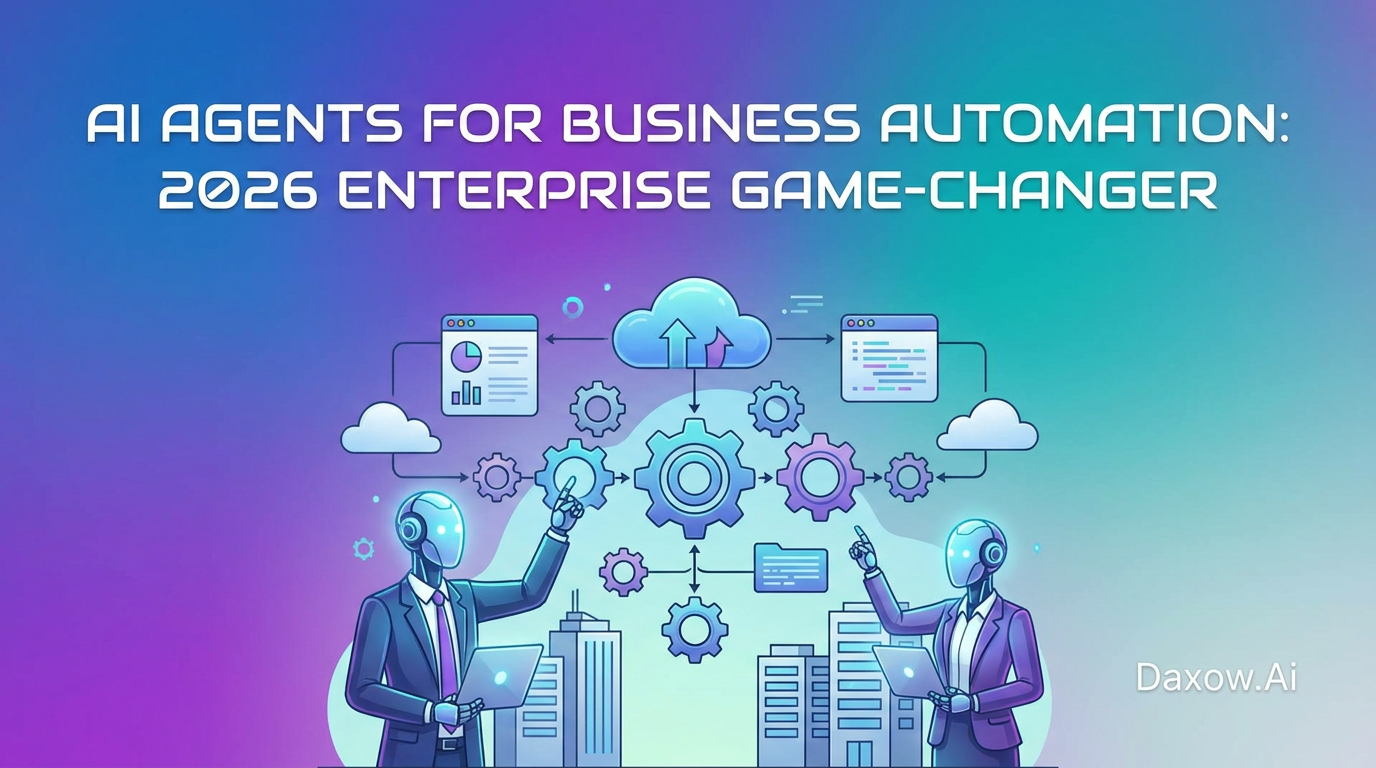
How Daxow.ai builds and scales AI agents to automate enterprise workflows, deliver measurable ROI, and ensure security, governance, and rapid time-to-value.
AI Agents for Business Automation: The 2026 Enterprise Game-Changer
Estimated reading time: 12 minutes
Key Takeaways
- AI agents transform automation by combining context perception, reasoning, and multi-step workflows across enterprise systems.
- Implementation of AI agents can yield up to 40% productivity gains, reduce operational costs, and enhance operational resilience.
- Daxow.ai delivers secure, tailored AI automation solutions integrating with CRM, ERP, and other core platforms.
- Cross-industry use cases demonstrate measurable ROI: faster resolutions, improved accuracy, reduced costs, and better customer experiences.
- A structured implementation roadmap and best practices ensure scalable, compliant deployment of AI agents in enterprises.
Table of Contents
- AI Agents for Business Automation: The 2026 Enterprise Game-Changer
- What AI Agents Do Better Than Traditional Automation
- Practical Use Cases: Industry Examples That Drive Business Automation
- How AI Agents and Workflow Automation Deliver Tangible Business Value
- Implementation Roadmap — From Pilot to Organization-Wide Automation
- Best Practices and Risk Mitigation
- Measuring ROI — What Leaders Should Expect
- How Daxow.ai Delivers End-to-End AI Automation
- Case Study Snapshot — How a Retailer Cut Costs and Boosted CX
- Getting Started — Practical First Steps for Decision-Makers
- Frequently Asked Questions
AI Agents for Business Automation: The 2026 Enterprise Game-Changer
What distinguishes AI agents from legacy automation and chatbots is their ability to perceive context, reason about goals, and execute multi-step workflows across enterprise systems. These agents combine large language models (LLMs), secure API integrations, and orchestration logic to operate as autonomous contributors to core business processes. The result is not just faster task completion but a shift from reactive task handling to proactive, goal-oriented execution.
Why this matters now
- Higher productivity: Agents free human teams from repetitive coordination and low-value work, enabling up to 40% productivity gains as organizations refocus resources on innovation.
- Lower operational costs: Automating high-volume processes reduces reliance on headcount for predictable tasks and minimizes human error.
- Operational resilience: Agents replan around disruptions—supply chain variances, sudden staffing constraints, or spikes in demand—without manual intervention.
- Strategic differentiation: Early adopters outperform peers in decision speed, personalized customer experiences, and measurable profitability improvements.
What AI Agents Do Better Than Traditional Automation
From rules to reasoning
Traditional workflow automation follows fixed rules; chatbots deliver scripted interactions. AI agents, by contrast, are goal-oriented. They:
- Extract context from CRM records, emails, tickets, and knowledge bases.
- Formulate plans to meet objectives (e.g., close a ticket, approve an invoice).
- Execute actions across systems (read/write via APIs) and replan when exceptions arise.
Integration and scale
Agents integrate deeply with enterprise software—CRM, ERP, support desks, calendars, and document stores—enabling end-to-end workflows without forcing process redesign. The architecture supports:
- Multi-agent orchestration for complex, cross-functional processes.
- Human-in-the-loop for high-risk decisions and audits.
- Audit trails and governance for compliance and traceability.
Practical Use Cases: Industry Examples That Drive Business Automation
E-commerce — Order Fulfillment and Customer Support Automation
Use case:
An AI agent triages incoming customer messages, matches intent from order data and returns policies, and executes refunds or shipping changes via ERP and payment APIs.
Business impact:
50% faster resolution times, reduced returns processing costs, and improved CSAT through personalized responses.
How Daxow helps:
We build agents that connect storefronts, fulfillment systems, and support platforms to automate refunds, update order statuses, and trigger logistics actions.
Healthcare — Patient Triage and Administrative Workflow Automation
Use case:
Agents read patient messages, consult EHR context, schedule appointments, and escalate clinical flags to staff while maintaining HIPAA-compliant logging.
Business impact:
Lower clinician administrative load, faster patient response, and improved appointment utilization.
How Daxow helps:
Daxow designs secure integrations with EHRs and clinical workflows, embedding compliance controls and human-in-the-loop thresholds for clinical safety.
Finance — Invoice Processing and Fraud Detection
Use case:
Agents extract data from invoices, validate line items against purchase orders, approve low-risk payments, and flag anomalies for review.
Business impact:
99% processing accuracy, dramatic reductions in payment cycle times, and early fraud detection.
How Daxow helps:
We implement document automation and API-driven approval flows that integrate with accounting systems for seamless reconciliations.
Real Estate — Lead Qualification and Property Operations
Use case:
An agent ingests leads from multiple channels, scores and prioritizes prospects, drafts proposals, and updates CRMs while scheduling viewings.
Business impact:
Faster lead-to-site conversion, improved agent utilization, and shorter sales cycles.
How Daxow helps:
Daxow integrates property portals, calendar systems, and CRMs to automate outreach and follow-up sequences.
HR — Onboarding, Recruiting, and Employee Services
Use case:
Agents guide new hires through onboarding steps, provision IT access, manage payroll inputs, and answer common employee queries.
Business impact:
Reduced onboarding time from days to hours and a 70% drop in HR/IT ticket volumes.
How Daxow helps:
We deliver workflow automation that connects identity providers, payroll systems, and HRIS platforms while maintaining role-based access controls.
How AI Agents and Workflow Automation Deliver Tangible Business Value
Workflow acceleration and exception handling
Agents handle multi-step processes end-to-end, drastically reducing handoffs. When exceptions occur, they reason about alternatives and either resolve issues autonomously or escalate appropriately.
Proactive intelligence and forecasting
Beyond reactive automation, agents surface leading indicators—cash flow risks, inventory shortages, or surges in customer sentiment—allowing proactive responses that preserve revenue and satisfaction.
Seamless integration with existing systems
Agents operate within current toolchains—Slack, Zendesk, Salesforce, Notion, ERP platforms—so organizations realize benefits without wholesale platform replacements. This reduces risk and speeds time-to-value.
Security, governance, and auditability
Enterprise deployments incorporate SOC 2-level controls, role-based permissions, comprehensive audit logs, and human review gates for sensitive decisions. Daxow embeds these features into every deployment to meet compliance needs.
Implementation Roadmap — From Pilot to Organization-Wide Automation
1. Define objectives and quantify baselines
- Identify high-volume, repeatable processes with clear KPIs (time spent, error rate, cost per transaction).
- Example objective: reduce average support ticket resolution by 40% within 3 months.
2. Assess data and platform readiness
- Inventory data sources, APIs, and document repositories.
- Prioritize data hygiene: consistent fields, reliable APIs, and accessible knowledge bases.
3. Select agent architecture and integrations
- Choose frameworks that support multi-agent orchestration, secure API access, and model updates.
- Favor vendor-agnostic designs to avoid lock-in.
4. Pilot small and iterate
- Launch a focused pilot (e.g., invoice approvals, first-contact support).
- Define clear success metrics and run controlled A/B testing.
5. Integrate, test, and monitor
- Simulate exceptions, enforce human review where needed, and instrument analytics to capture agent decisions.
- Use feedback to refine prompts, rules, and models.
6. Scale with governance
- Expand agent scope across departments while enforcing role-based access, data retention policies, and audit trails.
- Use change management to align teams and update SOPs.
Best Practices and Risk Mitigation
Human + AI hybrid models
- Keep humans in the loop for ambiguous or high-stakes cases.
- Define escalation criteria explicitly and log handoffs.
Data hygiene and model stewardship
- Ensure training and context data are accurate and representative.
- Maintain version control on prompts and model parameters.
Ethical AI and bias checks
- Regularly audit agent decisions for fairness and compliance.
- Provide transparent explanations for automated decisions when required.
Avoid vendor lock-in
- Use open architectures and standard APIs to preserve flexibility and future-proof investments.
Measuring ROI — What Leaders Should Expect
Estimating ROI starts with realistic baselines and conservative projections. Typical outcomes observed in 2026 deployments include:
- 30–50% productivity improvements in automated functions.
- Payback periods of 3–6 months for mid-sized firms automating support and finance.
- Measurable savings (example): a mid-sized firm saving $100K+ annually through reduced headcount and fewer errors on combined support and finance workflows.
- Long-term benefits: improved employee engagement, higher upsell rates from faster sales cycles, and better risk management through continuous monitoring.
How Daxow.ai Delivers End-to-End AI Automation
Discovery and process analysis
- We map workflows, quantify manual work, and identify high-impact automation candidates.
- Deliverable: a prioritized automation roadmap with projected savings and KPIs.
Custom agent design and integrations
- We engineer agents that integrate with your tech stack—CRM, ERP, ticketing, document stores—and execute secure read/write actions via APIs.
- Services include data extraction, document automation, lead qualification, and bespoke agent logic.
Implementation and change management
- Daxow conducts pilots, trains staff, and builds feedback loops for continuous improvement.
- We implement governance frameworks—role-based access, audit logs, and human escalation paths.
Monitoring, optimization, and support
- Continuous analytics track agent performance and business outcomes.
- Ongoing tuning of prompts, models, and orchestration logic ensures agents improve over time.
Case Study Snapshot — How a Retailer Cut Costs and Boosted CX
Scenario:
A multi-channel retailer faced long support response times and high returns processing costs.
Solution:
Daxow deployed AI agents to triage messages, process refunds, and update order statuses across ERP and CRM systems.
Outcomes:
50% reduction in ticket resolution time, 30% lower returns processing cost, and measurable uplift in customer satisfaction.
Why it worked:
Deep integrations, clear escalation pathways, and iterative improvement based on analytics.
Getting Started — Practical First Steps for Decision-Makers
- Run a workflow audit to identify repetitive, high-volume tasks suitable for automation.
- Prioritize quick wins with measurable KPIs: support triage, invoice processing, lead qualification.
- Engage a trusted partner to architect secure, scalable agents that integrate with existing systems like those featured on our services and solutions pages.
- Plan governance and change management early to maximize adoption and minimize risk.
Frequently Asked Questions
What are AI agents in business automation?
AI agents are autonomous digital workers that perceive context, reason about goals, and execute multi-step workflows across enterprise systems, improving efficiency beyond traditional automation and chatbots.
How quickly can companies expect ROI from AI agents?
Typical payback periods range from 3 to 6 months, depending on scope and scale, with measurable improvements in productivity, cost savings, and operational resilience.
How does Daxow.ai ensure security and compliance?
Daxow incorporates SOC 2-level controls, role-based permissions, audit trails, and human review gates in every deployment to meet industry compliance requirements.
Can AI agents integrate with existing enterprise systems?
Yes. AI agents are designed to seamlessly integrate with CRM, ERP, ticketing systems, calendars, and document stores without requiring complete process redesign.