
AI Agents: Game-Changer for Business Automation in 2026
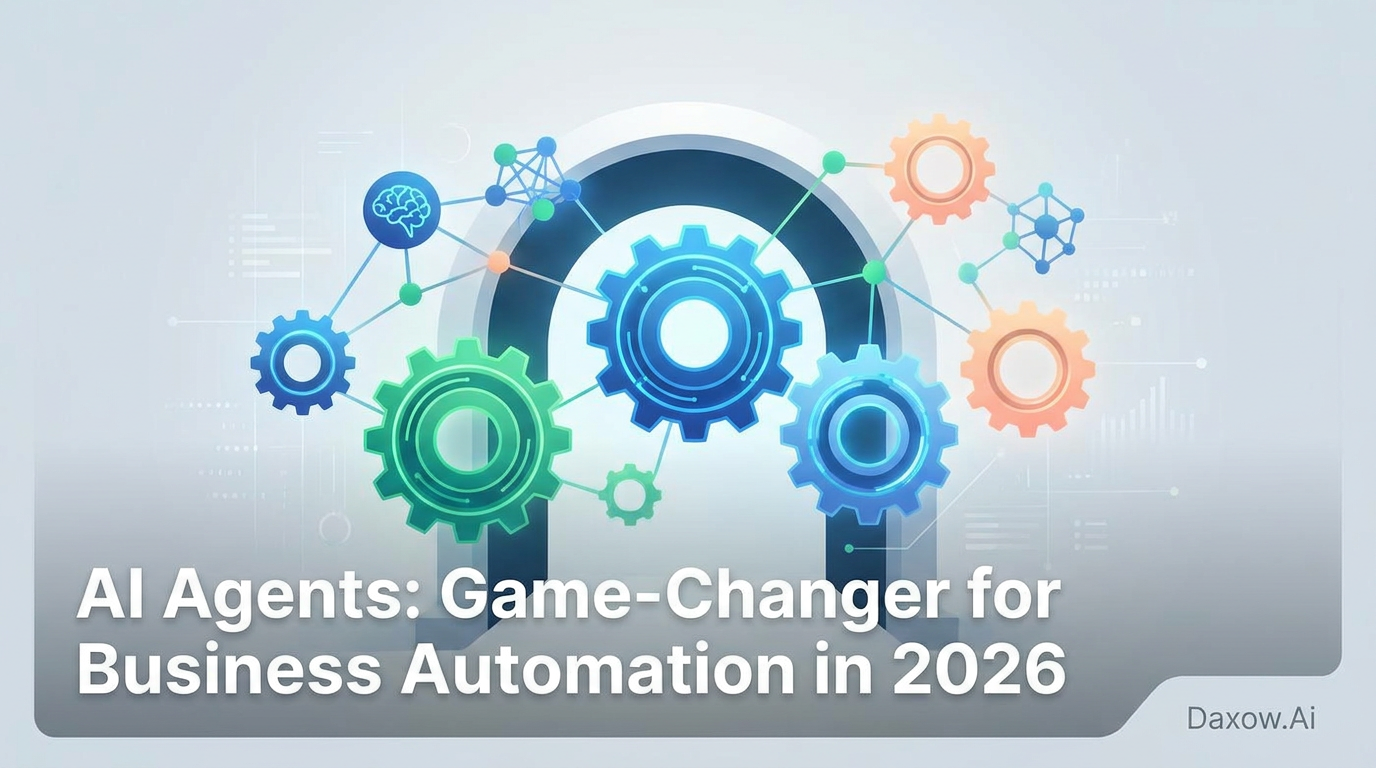
Explore how AI agents automate workflows, boost productivity, and cut costs in 2026. Use cases, implementation roadmap, and Daxow.ai services included.
AI Agents: The Game-Changer for Business Automation in 2026
Estimated reading time: 15 minutes
Key Takeaways
- AI agents autonomously handle complex workflows and learning-enabled automation with integration into existing CRMs and ERPs.
- Businesses benefit through reduced manual work, improved productivity, cost savings, and enhanced customer and employee experiences.
- Industry applications range from e-commerce and customer support to finance, healthcare, real estate, and HR.
- Successful deployment follows a structured roadmap from assessment to scalable multi-agent orchestration.
- Daxow.ai provides end-to-end solutions in agent design, integration, optimization, and governance ensuring secure and compliant deployments.
Table of Contents
- AI Agents: The Game-Changer for Business Automation in 2026 — What Decision-Makers Need to Know
- Key Business Benefits of AI Agents and Workflow Automation
- Practical Use Cases Across Industries
- Implementation Roadmap — From Pilot to Enterprise-Scale Automation
- Best Practices for Successful Deployment
- Measuring ROI — Metrics That Matter
- How Daxow.ai Helps You Deploy Agentic Automation
- Security, Ethics, and Governance
- Quick-Start Playbook for Executives
- Real Results — Example Use Cases from Client Workflows
- Frequently Asked Questions
AI Agents: The Game-Changer for Business Automation in 2026 — What Decision-Makers Need to Know
Defining AI agents in practical business terms
AI agents are autonomous software entities powered by advanced language models and task orchestration logic. Unlike traditional rule-based bots, they:
- Observe data and events across systems in real time.
- Analyze unstructured and structured information.
- Plan and execute multi-step workflows.
- Adapt to exceptions and learn from feedback.
For business leaders, that translates into automation that can handle complex customer interactions, cross-system workflows, and judgment-based decisions that previously required human intervention.
Why agents matter now
- Scale without proportional hires: Agents absorb transaction volume and repetitive tasks so headcount grows more slowly than business volume.
- Improve productivity: Teams can focus on strategic work, driving measurable gains in throughput and innovation.
- Increase resilience: Agents monitor systems and act proactively, reducing downtime and operational risks.
- Enhance customer and employee experience: Faster responses and personalized interactions improve CSAT and EX metrics.
Key Business Benefits of AI Agents and Workflow Automation
Tangible operational wins
- Reduce manual tasks: Agents automate data entry, ticket routing, and document processing, dramatically cutting routine workloads.
- Boost productivity: Expect productivity increases in the range of 20–40% for well-targeted processes.
- Lower costs and improve ROI: Automation reduces error rates and staffing pressure, producing rapid payback and long-term savings.
- Accelerate decision-making: Agents synthesize data for instant insights, enabling faster, better-qualified business decisions.
How AI agents differ from traditional automation
Traditional workflows require fixed rules and constant maintenance. AI agents:
- Handle unstructured data (emails, contracts, images).
- Make probabilistic decisions and escalate only when needed.
- Coordinate across multiple tools (CRM, ERP, ticketing systems) without fragile scripting.
- Improve performance over time through learning and analytics.
Practical Use Cases Across Industries
E-commerce — Order and inventory orchestration
Use case:
- An order-processing agent validates orders, checks inventory across warehouses, triggers fulfillment workflows, updates the CRM, and notifies customers.
Impact:
- Reduce manual tasks associated with order exceptions.
- Lower shipping delays and returns.
- Automate restocking: inventory agents monitor sales patterns and trigger supplier orders when thresholds and lead times indicate replenishment is needed.
Customer support automation — 24/7 high-quality service
Use case:
- A customer support agent performs initial triage, extracts intent and sentiment from messages, routes tickets, suggests responses to human agents, and completes routine resolutions autonomously.
Impact:
- Faster response times and lower average handle times.
- Improved CSAT through personalized and consistent interactions.
- Cost containment by shifting repetitive cases to automation and reserving skilled staff for complex issues.
Finance — Fraud detection and compliance automation
Use case:
- Agents analyze transaction flows, flag anomalies, assemble evidence packets, and execute rule-based holds while presenting summary reports to compliance teams.
Impact:
- Faster detection and containment of suspicious activity.
- Reduced compliance costs through automated reporting and audit trails.
- Enhanced accuracy through continuous learning on labeled events.
Healthcare — Administrative relief and predictive alerts
Use case:
- Agents automate appointment scheduling, pre-visit patient screening, and post-visit follow-ups; an analytics agent scans records to flag clinical risks and schedule preventive checks.
Impact:
- Reduced administrative burden on clinical staff.
- Improved patient access, adherence, and outcomes.
- Streamlined documentation and regulatory reporting.
Real estate — Lead qualification and property operations
Use case:
- Lead qualification agents evaluate inbound inquiries against property attributes and owner criteria, prioritize high-intent leads, and auto-schedule viewings.
- Property management agents handle maintenance requests, triage vendors, and automate lease renewals.
Impact:
- Higher conversion rates and faster deal cycles.
- Operational scalability for portfolios of any size.
HR — Onboarding and internal service automation
Use case:
- Onboarding agents orchestrate equipment provisioning, training enrollment, compliance checks, and knowledge delivery for new hires.
- Internal HR agents answer policy questions, process routine requests, and route approvals.
Impact:
- Faster time-to-productivity for new employees.
- Improved employee experience and lower time spent on admin by HR teams.
Implementation Roadmap — From Pilot to Enterprise-Scale Automation
Step 1 — Assess and prioritize
- Conduct a process audit to find high-volume, repetitive tasks and bottlenecks.
- Score opportunities by ROI, risk, and ease of integration.
- Target quick wins that reduce manual tasks by 20–40% early.
Step 2 — Design the agent strategy
- Define agent roles (triage, analyst, orchestrator, conversational).
- Map required integrations (CRM, ERP, ticketing, databases).
- Establish data access, privacy, and governance policies.
Step 3 — Build and pilot
- Build single-agent pilots for high-impact workflows (e.g., customer support automation).
- Train agents on proprietary company data to ensure accuracy and brand alignment.
- Use human-in-the-loop controls during pilot to validate behavior and build trust.
Step 4 — Integrate, monitor, and scale
- Integrate with enterprise systems using secure connectors and APIs.
- Implement monitoring dashboards for performance, errors, and business metrics.
- Roll out multi-agent crews to coordinate cross-functional workflows.
Step 5 — Optimize and govern
- Continuously refine prompts, models, and rules based on analytics.
- Maintain audit trails and escalation protocols.
- Implement role-based access and periodic compliance reviews.
Best Practices for Successful Deployment
- Start with clear business outcomes: Tie agent goals to KPIs like resolution time, cost per interaction, and conversion rates.
- Keep humans in the loop for high-risk decisions; allow gradual autonomy.
- Prioritize data hygiene: Accurate, centralized data maximizes agent performance.
- Design for observability: Track decisions, confidence levels, and real-world impacts.
- Enforce security and compliance: Encrypt data in transit and at rest; comply with local regulations.
- Invest in change management: Train teams, communicate benefits, and provide feedback channels.
Measuring ROI — Metrics That Matter
Track a mixture of operational and business metrics:
- Operational: average handling time, first-contact resolution, percentage of automated tasks, error rates.
- Business: cost per transaction, conversion rates, customer satisfaction (CSAT), employee satisfaction, revenue uplift.
- Long-term: cycle time reduction, headcount redeployment, and innovation velocity.
Example ROI scenario:
A mid-sized SaaS company automates 50% of inbound support queries. Support staffing needs drop by 20%, CSAT rises by 12 points, and time-to-resolution improves by 40%. The initial investment is recovered within 9–12 months.
How Daxow.ai Helps You Deploy Agentic Automation
End-to-end process analysis
Daxow.ai begins with a thorough process analysis to map workflows, identify data sources, and quantify potential time savings. We focus on opportunities to reduce manual tasks, increase productivity, and deliver fast wins that fund broader initiatives.
Custom agent design and build
We design bespoke AI agents tailored to your business goals:
- Conversational agents for customer support automation.
- Orchestrator agents that perform end-to-end workflow automation across CRMs and ERPs.
- Specialist agents for sales automation, lead qualification, and document automation.
Secure integrations and data connectivity
Daxow ensures seamless integration with your existing systems, including CRMs, ticketing platforms, databases, and third-party services. Our approach emphasizes data sovereignty, encrypted connectors, and enterprise-grade security.
Multi-agent orchestration
We architect multi-agent crews where specialized agents collaborate to execute complex business processes. This design reduces bottlenecks and enables dynamic handoffs, such as a sales agent passing qualified leads to human sales reps and a compliance agent performing background checks.
Ongoing optimization and governance
Beyond deployment, Daxow provides continuous monitoring, analytics-driven optimization, and governance frameworks to ensure agents remain accurate, compliant, and aligned with business objectives. We also offer training to embed agent-driven workflows in daily operations.
Security, Ethics, and Governance
Principles to follow
- Privacy by design: Limit data access and use anonymization where possible.
- Transparent decisioning: Log agent decisions and provide human-readable explanations for critical actions.
- Accountability: Define ownership for agent behavior, escalation paths, and remediation.
- Bias mitigation: Test agents for biased outcomes and correct training data imbalances.
Compliance checklist
- Data classification and retention policies.
- Role-based access and approval gates for sensitive actions.
- Regular audits and model validation cycles.
Quick-Start Playbook for Executives
- Week 1–2: Conduct a rapid process audit to identify top 3 automation opportunities.
- Week 3–6: Run a single-agent pilot (e.g., support triage or lead qualification).
- Month 2–4: Measure impact, refine prompts and integrations, and extend automation scope.
- Month 4–12: Implement multi-agent orchestration for cross-functional processes and scale to additional units.
Real Results — Example Use Cases from Client Workflows
- Sales automation: Agents synthesize CRM history, web behavior, and third-party signals to produce a prioritized lead list. Sales reps see pre-filled outreach scripts and personalized messaging, shortening the sales cycle.
- Document automation: Data extraction agents process invoices and contracts, auto-populating ERP fields and flagging discrepancies—reducing reconciliation time and human error.
- Support efficiency: Customer support agents automate 60% of routine cases while escalating complex issues to specialists with a complete context package, improving CSAT and reducing staffing pressure.
Frequently Asked Questions
What makes AI agents different from traditional automation tools?
AI agents are autonomous, adaptive, and capable of handling unstructured data and making probabilistic decisions. Unlike traditional tools, they learn from feedback, coordinate across multiple systems, and can escalate only when necessary.
How does Daxow.ai integrate AI agents with existing business systems?
Daxow.ai uses secure connectors and APIs to integrate AI agents with CRMs, ERPs, ticketing, and other enterprise systems ensuring seamless workflows while maintaining data sovereignty and security.
Can AI agents be customized for specific industries?
Yes, Daxow.ai specializes in designing bespoke AI agents tailored to the unique needs and compliance requirements of industries like e-commerce, finance, healthcare, real estate, and human resources.
What security and compliance measures are implemented with AI agent deployment?
Security and compliance include encrypted data transmission and storage, role-based access controls, regular audits, transparency in agent decisioning, and adherence to data classification and retention policies.
Conclusion and Call to Action
AI Agents: The Game-Changer for Business Automation in 2026 is not a future trend — it is the next step in digital transformation for organizations that need to scale, reduce manual tasks, and improve customer and employee experiences. Daxow.ai partners with businesses to assess processes, design custom AI agents, implement end-to-end workflow automation, and integrate systems securely to maximize ROI.
If you are ready to reduce manual tasks, boost productivity, and deploy AI agents that execute real business work, book a free consultation with Daxow.ai today or request a process analysis for your company. Contact us to build a custom AI system that transforms your operations and delivers measurable business impact.