
AI Agents for Business Automation: Roadmap & Use Cases
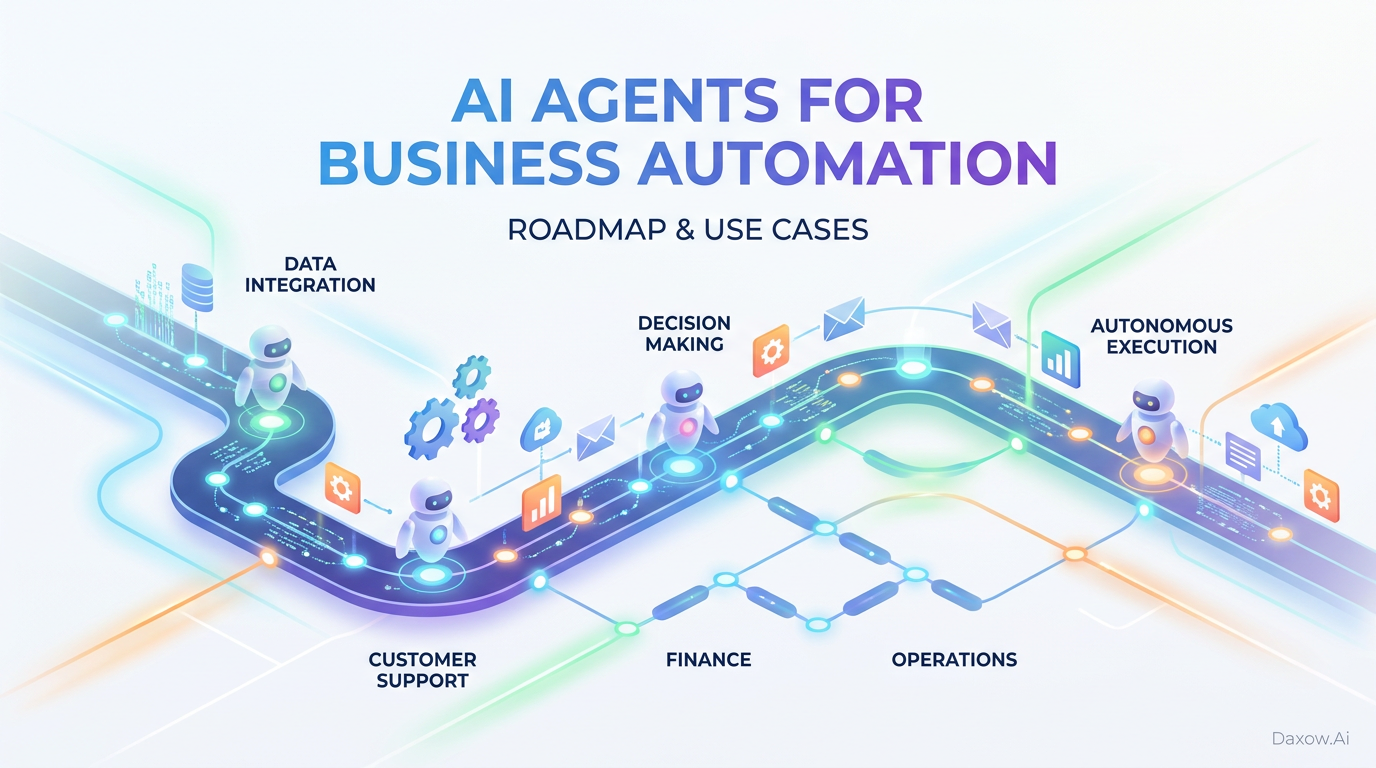
How AI agents automate workflows across industries, deliver measurable ROI, and a step-by-step roadmap for implementation — plus Daxow.ai's deployment approach.
AI Agents for Business Automation: What It Means for Modern Businesses
Estimated reading time: 15 minutes
Key Takeaways
- AI agents enable autonomous workflows that reduce manual tasks and improve productivity across systems.
- Business automation with AI impacts industries like e-commerce, healthcare, finance, real estate, and HR through tailored use cases.
- Successful AI agent implementation requires structured steps, from strategic audits to integration and governance.
- Measuring ROI relies on metrics such as cost reduction, throughput gains, error reduction, revenue growth, and experience improvement.
- Daxow.ai offers customized AI agent design, integration, proof of concept, and governance to scale automation with measurable value.
Table of Contents
- Introduction: AI Agents for Business Automation and Why It Matters
- AI Agents for Business Automation: Core Concepts and Business Impact
- Practical Use Cases Across Industries
- How AI Agents and Workflow Automation Work (Mechanics & Capabilities)
- Implementation Roadmap: From Pilot to Scale
- Measuring ROI and Business Value
- Risk Management and Best Practices
- How Daxow.ai Helps You Deploy AI Agents for Business Automation
- Conclusion and Next Steps
- Frequently Asked Questions
Introduction: AI Agents for Business Automation and Why It Matters
AI Agents for Business Automation are transforming how companies execute routine and multi-step work. This shift empowers organizations to reduce manual tasks, improve productivity, and orchestrate workflows across previously siloed systems. For decision-makers, the question is no longer whether to adopt AI automation but how to implement it strategically to capture measurable business value.
This article explains what AI agents deliver, presents industry-specific use cases, details the mechanics and implementation roadmap for workflow automation, and shows how Daxow.ai designs custom AI solutions to reduce operational costs, integrate systems, and build agentic automation that executes real tasks.
AI Agents for Business Automation: Core Concepts and Business Impact
AI agents are more than chatbots or simple scripts. They combine natural language understanding, data access, multi-step planning, and system integration to execute end-to-end processes. The result is autonomous workflows that can monitor, decide, act, and learn.
Key strategic shifts enabled by AI agents:
- From manual execution to autonomous workflows. Tasks like refunds, scheduling, and data updates are executed by agents, not by humans copying data between tools.
- From siloed tools to orchestrated systems. AI becomes the connective layer across CRM, ERP, help desk, and document repositories.
- From reactive operations to proactive, data-driven decisions. Agents can detect patterns, flag risks, and trigger actions before customers notice problems.
Business outcomes:
- Lower operational cost per transaction.
- Faster, more consistent execution of processes.
- Scalable operations without linear headcount growth.
- Improved customer and employee experience.
Practical Use Cases Across Industries
E-Commerce
Intelligent Customer Support & Order Automation
- Agents handle order status, returns, sizing, and policy queries across chat and email.
- They pull real-time order/shipping data, initiate returns, create labels, and update CRM tickets.
- Impact: Deflects 50–80% of repetitive tickets, reduces response time from hours to seconds, and lowers support headcount pressure during peaks.
Personalized Product Discovery & Merchandising
- Agents analyze browsing and purchase history to recommend products, bundles, and promotions.
- They dynamically adjust featured products based on inventory and margins.
- Impact: Higher conversion, improved average order value, and fewer stockouts.
Healthcare
Patient Intake, Triage & Follow-Up
- Virtual agents collect symptoms, insurance details, and schedule appointments.
- They route patients to the appropriate care team and send automated reminders and follow-ups.
- Impact: Reduced front-desk load, lower no-show rates, and improved patient access.
Administrative & Documentation Automation
- Agents summarize clinical notes into structured EHR entries and draft discharge summaries for clinician review.
- They flag missing documentation and maintain audit trails.
- Impact: Clinicians spend less time on paperwork and more on patients; compliance improves.
Finance (Banking, Insurance, Fintech)
Customer Service & Account Management
- Agents answer account questions, execute routine tasks (card locks, address updates), and guide loan or claim applications.
- Impact: 24/7 support with lower call-center costs and improved first contact resolution.
Risk, Compliance & Monitoring Automation
- Agents pre-screen transactions for AML, fraud, and policy violations.
- They generate draft compliance reports and escalate suspicious cases to human teams.
- Impact: Faster detection, reduced manual review workload, and stronger regulatory alignment.
Real Estate
Lead Qualification & Nurturing
- Agents respond instantly to listing inquiries, qualify leads via targeted questions, schedule viewings, and follow up automatically.
- Impact: Capture and warm leads 24/7, increase conversion from inquiry to appointment, and let agents focus on closing.
Listing Management & Market Intelligence
- Agents generate optimized listing descriptions from property data and photos.
- They track comps and recommend pricing strategies.
- Impact: Faster go-to-market and data-backed pricing decisions.
HR & People Operations
Talent Acquisition & Screening
- Agents screen CVs, score candidates against role criteria, and run asynchronous pre-screen interviews.
- They coordinate interview scheduling across calendars.
- Impact: Reduced time-to-hire, consistent screening, and less recruiter administrative burden.
Employee Support & Internal Knowledge
- HR chatbots answer policy, benefits, and payroll questions; draft contracts and onboarding packets.
- Impact: Lower HR ticket volume, faster onboarding, and higher employee satisfaction.
How AI Agents and Workflow Automation Work (Mechanics & Capabilities)
To deliver reliable business automation, AI agents combine several capabilities:
- Natural language understanding: Interpreting emails, chats, documents, and voice into intents and structured data.
- Contextual data access: Reading and writing to CRMs, ERPs, help desks, EHRs, and document stores for accurate decisions.
- Multi-step workflow execution: Planning and performing sequences of actions (check policy → validate data → execute refund → notify customer).
- API and tool integrations: Calling external services to send emails, book meetings, update records, and trigger downstream automations.
- Continuous learning: Logging outcomes and feedback to refine decision logic, routing, and responses.
This moves organizations from static rules to agentic automation: digital workers that can reason, escalate, and collaborate with humans.
Implementation Roadmap: From Pilot to Scale
Step 1: Strategic Audit & Use-Case Prioritization
- Identify processes with high frequency, clear rules, and measurable impact.
- Target areas with heavy manual data entry, frequent handoffs, or high ticket volume.
- Prioritize low-risk, high-impact pilots (e.g., delivery status, candidate pre-screening).
Step 2: Detailed Workflow Mapping
- Define the goal and “done” criteria for each process.
- Map inputs, systems involved, decision points, and success metrics.
- Mark steps that must remain human and those suitable for automation.
Step 3: Design Agents & Permissions
- Define agent roles (Support Triage, Sales Assistant, HR Onboarding).
- Specify access levels and escalation rules.
- Determine channels (chat, email, Slack/Teams, phone) and integration points.
At Daxow.ai, we model agents as digital roles mirroring human functions and design permissions to minimize risk while maximizing autonomy.
Step 4: Integrate with Your Tech Stack
- Connect agents to CRM, help desk, HRIS, ERP, and document repositories using APIs or iPaaS.
- Start with read-only access for sensitive systems and progressively grant write privileges as confidence grows.
- Ensure data flows are auditable and secure.
Step 5: Build a Focused Proof of Concept (PoC)
- Implement a minimal viable agent for one process and channel.
- Measure accuracy, safety, and core metrics (cost per ticket, response time, conversion).
- Run the PoC for 30–60 days to capture real performance data.
Step 6: Governance, Security & Compliance
- Enforce role-based access and encryption for data in transit and at rest.
- Define behavioral guardrails and human approval thresholds for sensitive actions.
- Ensure agent outputs are auditable and meet regulatory requirements in your industry.
Step 7: Pilot, Iterate, and Scale
- Monitor deflection rates, time saved, error rates, CSAT, and revenue impact.
- Refine prompts, routing, and escalation thresholds based on data.
- Expand use cases once safety and ROI are proven.
Measuring ROI and Business Value
A credible business case requires concrete metrics. Typical value levers include:
- Cost reduction: Lower labor cost per ticket or transaction as agents absorb repetitive work.
- Throughput improvement: Higher processing capacity without proportional headcount increases.
- Error reduction: Fewer mistakes in data entry and routine tasks, lowering rework.
- Revenue enhancement: Faster responses and personalized outreach that lift conversion and retention.
- Experience gains: Higher CSAT and lower employee churn by removing low-value tasks.
Use these KPIs to track success:
- Deflection rate (tickets handled by agents).
- Average handling time reduction.
- Time saved per process and corresponding FTE equivalency.
- Conversion uplift for sales automation scenarios.
- CSAT/NPS improvements.
Risk Management and Best Practices
- Start with narrow scopes and deploy guardrails.
- Keep humans in the loop for judgment-sensitive decisions.
- Maintain clear audit logs and explainability for regulated environments.
- Continuously monitor performance and retrain models where necessary.
- Use incremental rollouts: test, measure, refine, then scale.
How Daxow.ai Helps You Deploy AI Agents for Business Automation
Daxow.ai is structured to deliver end-to-end AI automation:
- Process discovery and prioritization: We run strategic audits to identify high-impact automation opportunities.
- Custom agent design: We build AI agents tailored to your workflows and business rules, modeled as digital roles.
- System integration: We connect agents to your CRM, help desk, ERP, HRIS, and document stores for real-time data access and action.
- Proof of concept and pilots: We deploy focused PoCs to demonstrate value and calibrate safety controls.
- Governance and security: We implement role-based access, logging, and compliance controls required by your industry.
- Scale and optimization: We measure ROI, refine agents, and expand automation across teams and geographies.
By partnering with Daxow.ai, your organization can rapidly reduce manual tasks, increase productivity, and capture measurable ROI while maintaining control and compliance.
Conclusion and Next Steps
AI Agents for Business Automation are a strategic lever for reducing operational costs, improving customer and employee experiences, and unlocking new revenue opportunities. The path to transformation is practical: prioritize high-impact processes, build constrained pilots, enforce governance, and scale based on measurable results.
Book a free consultation with Daxow.ai to assess your workflows, identify high-value use cases, and request a process analysis for your company. Contact us to build a custom AI system that reduces manual tasks, integrates your systems, and delivers measurable productivity and ROI.
Frequently Asked Questions
What distinguishes AI agents from traditional automation tools?
AI agents combine natural language understanding, multi-step planning, and deep system integration to execute autonomous workflows, unlike traditional automation which typically follows static rules without contextual reasoning.
How do AI agents improve customer support efficiency?
They handle repetitive inquiries instantly, reducing response times from hours to seconds, deflecting high volumes of tickets, and freeing support staff to focus on complex issues.
What industries benefit most from AI agents?
Industries like e-commerce, healthcare, finance, real estate, and HR see measurable benefits through tailored use cases ranging from customer service automation to compliance monitoring.
How does Daxow.ai ensure security and compliance in AI automation?
Daxow.ai enforces role-based access, encrypts data, implements behavioral guardrails, logs all actions for audit, and aligns with industry-specific regulatory requirements.