
AI Agents for Business Automation: 2026 Enterprise Guide
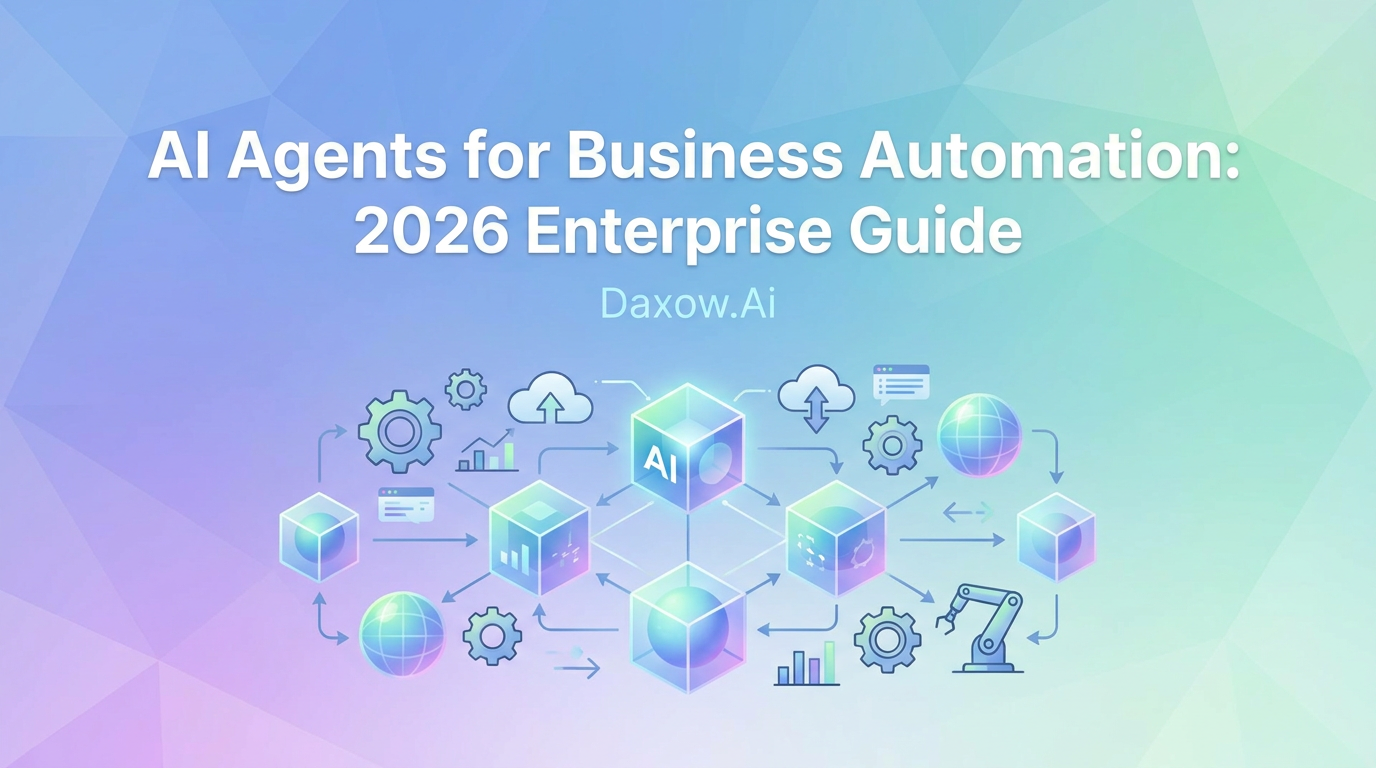
2026 guide to deploying AI agents for enterprise automation. Covers use cases, ROI, and Daxow’s roadmap to pilot, scale, and govern agents across CRM, ERP, and workflows.
AI Agents for Business Automation: The 2026 Guide to Unlocking Enterprise-Scale Efficiency
Estimated reading time: 15 minutes
Key Takeaways
- AI agents move beyond scripted automation offering adaptive, intelligent workflow execution that integrates across enterprise tools.
- Significant productivity gains of 40–70% and cost reductions up to 40% can be achieved by deploying AI agents in high-volume, decision-heavy workflows.
- Industry applications span e-commerce, healthcare, finance, real estate, and HR with tailored use cases delivering measurable ROI.
- A structured roadmap—from assessment to scaling—ensures successful AI agent implementation with continuous governance and monitoring.
- Daxow.ai provides enterprise-grade AI agents, secure integrations, and rapid pilots to accelerate automation and business transformation.
Table of Contents
- AI Agents for Business Automation: What It Means for Your Company
- Practical Use Cases and Industry Examples
- How AI Agents and Automation Drive Business Transformation
- Implementation Roadmap: Assess, Pilot, Scale (Daxow’s Approach)
- Measuring ROI and Business Value
- Why Partner with Daxow.ai for Your AI Automation Strategy
- Getting Started — Practical Next Steps
- Frequently Asked Questions
AI Agents for Business Automation: What It Means for Your Company
AI agents represent the next evolution of workflow automation. Unlike rule-bound RPA or reactive chatbots, agents combine perception, reasoning, action, and memory to handle complex, exception-prone workflows. For business leaders, this translates into fewer repetitive tasks, faster decision cycles, and tighter compliance across operations.
Key capabilities of AI agents:
- Perception: ingest emails, documents, APIs, and telemetry.
- Reasoning & planning: decompose objectives into ordered actions with contingencies.
- Tools & execution: call functions, update CRMs, send emails, create tickets.
- Memory & learning: retain context and improve via feedback loops.
Business impact at a glance:
- Reduce manual tasks across support, sales, HR, and finance.
- Improve productivity by 40–70% for targeted roles.
- Cut operational costs by up to 40% in high-volume processes.
- Scale capacity without proportional headcount growth.
Practical Use Cases and Industry Examples
AI agents are most valuable where workflows are high-volume, decision-heavy, and data-rich. Below are practical, actionable use cases across industries with example flows that show exactly how agents deliver business automation.
E-commerce — Demand Forecasting, Personalization, and Logistics
Use case 1: Demand forecasting and inventory automation
- Data sources: POS systems, web analytics, supplier catalogs, promotions calendar.
- Agent tasks: analyze historical sales and external signals, generate demand forecast, create purchase orders, and notify procurement.
- Business value: reduce overstock by 25–40%, shorten replenishment cycles, lower carrying costs.
Use case 2: Personalized customer journeys and conversion uplift
- Data sources: browsing behavior, CRM profiles, purchase history.
- Agent tasks: generate tailored recommendations, trigger segmented emails, update onsite banners, and escalate VIP signals to sales.
- Business value: increase conversions by ~30%, higher AOV, improved retention.
Use case 3: Logistics optimization
- Data sources: carrier APIs, real-time traffic, warehouse inventory.
- Agent tasks: re-route shipments, consolidate orders, request carrier updates, and manage exceptions.
- Business value: lower delivery costs and faster fulfillment with fewer support tickets.
Healthcare — Triage, Scheduling, and Compliance
Use case 1: Patient triage and automated scheduling
- Data sources: intake forms, EHRs, symptom-checker chat.
- Agent tasks: evaluate symptoms against patient history, prioritize urgency, book appointments or escalate to clinicians.
- Business value: reduce wait times by 50%, better clinic throughput, improved patient satisfaction.
Use case 2: Administrative automation and claims processing
- Data sources: EHR documents, insurance portals, billing systems.
- Agent tasks: verify eligibility, fill forms, submit claims, and monitor rejections for appeals.
- Business value: faster reimbursements and fewer manual errors, lower administrative overhead.
Finance — Fraud Detection, Virtual CFO, and Compliance
Use case 1: Real-time fraud monitoring
- Data sources: transaction streams, device signals, customer history.
- Agent tasks: score risk, trigger holds, open investigations, and notify stakeholders.
- Business value: reduce fraud losses, faster incident response.
Use case 2: Virtual CFO for SMEs
- Data sources: bank feeds, invoices, spending categories, ad platforms.
- Agent tasks: forecast cash flow, recommend cost adjustments, auto-generate monthly reports and budget alerts.
- Business value: better cash management without new hires, improved decision-making.
Use case 3: Regulatory reporting and audit trails
- Data sources: transaction logs, KYC documents, audit history.
- Agent tasks: compile reports, surface compliance exceptions, and produce immutable audit logs.
- Business value: lower compliance risk, simplified audits.
Real Estate — Lead Qualification and Transaction Management
Use case 1: Lead qualification and nurturing
- Data sources: MLS, website inquiries, CRM engagement history.
- Agent tasks: score leads, schedule virtual tours, send tailored property lists, and transition qualified leads to human agents.
- Business value: higher conversion rates, faster deal cycles.
Use case 2: Transaction coordination
- Data sources: title systems, escrow, document storage.
- Agent tasks: track milestones, auto-fill closing documents, coordinate stakeholders, and flag missing items.
- Business value: shorter time-to-close and fewer transaction errors.
HR — Recruiting, Onboarding, and Employee Support
Use case 1: Candidate screening and interview orchestration
- Data sources: ATS, resumes, coding test platforms.
- Agent tasks: screen resumes, schedule interviews, send candidate prep materials, and collect feedback.
- Business value: shorter time-to-hire and better quality-of-hire.
Use case 2: Employee IT/HR support
- Data sources: HRIS, SSO systems, ticketing tools.
- Agent tasks: reset passwords, provision access, answer policy questions, and escalate complex issues.
- Business value: reduce HR/IT support load, faster employee ramp.
How AI Agents and Automation Drive Business Transformation
AI agents enable outcomes traditional automation cannot — adaptive decision-making and cross-system orchestration. Their transformative effects are both operational and strategic.
Core reasons AI agents drive transformation:
- They handle unstructured inputs (emails, contracts, conversations) alongside structured data.
- They replan workflows when exceptions occur, preserving progress without manual intervention.
- They enforce business rules and compliance as part of execution.
- They integrate with enterprise tools (Salesforce, Zendesk, Slack, ERPs) to create end-to-end process flows.
Quantifiable business outcomes:
- Task resolution time can fall from hours to minutes.
- Error rates drop substantially as agents apply consistent rules.
- Cost per workflow can fall by 50–70% depending on the process.
- Employee utilization improves as teams refocus on strategic work.
Implementation Roadmap: Assess, Pilot, Scale (Daxow’s Approach)
1. Define Objectives & Assess Needs (1–2 weeks)
- Map current workflows and identify high-impact opportunities.
- Prioritize processes that are repetitive, exception-prone, and have measurable KPIs.
- Check infrastructure readiness: API access, data quality, security (GDPR, SOC 2).
Best practice: target processes with >20% time savings potential and clear ownership.
2. Select Platform & Design Agent (2–4 weeks)
- Choose platforms that support LLMs, function calling, and enterprise integrations.
- Design agents in modular components: perception → planner → toolset → memory.
- Define business rules and escalation paths in plain language.
Best practice: embed governance and human-in-the-loop controls for sensitive actions.
3. Pilot & Test (4–6 weeks)
- Scope the pilot tightly: one workflow, one team, measurable KPIs.
- Validate using synthetic and sampled production data.
- Conduct UAT with end users; iterate until you reach target success rates (e.g., 80%+).
Best practice: measure both automation accuracy and user adoption.
4. Deploy, Monitor, & Iterate (Ongoing)
- Roll out via existing channels (Slack, MS Teams, CRM dashboards).
- Monitor KPIs such as resolution time, error rates, and customer satisfaction.
- Retrain models and refine rules based on production data.
Best practice: implement continuous governance — audit logs, RBAC, and approval workflows for high-risk actions.
Common pitfalls and how to avoid them:
- Over-scoping pilots — start small and prove value quickly.
- Ignoring data silos — prioritize integrations early.
- Skipping security guardrails — apply least privilege and logging from day one.
Measuring ROI and Business Value
Decision-makers need clear financial justification. AI agents typically show rapid payback and strong first-year returns.
Typical ROI drivers:
- Labor cost reduction through automation of repetitive work.
- Faster throughput leading to additional revenue or customer retention.
- Error reduction lowering rework and compliance penalties.
- Scalability without linear headcount increases.
Representative metrics (before → after):
- Task resolution time: 2 hours → 20 minutes (≈83% faster)
- Error rate: 15% → 2% (≈87% reduction)
- Cost per workflow: $50 → $15 (≈70% savings)
- Employee utilization: 60% → 85% (+42%)
Real-world Daxow outcomes:
- Payback in 3–6 months for typical pilots.
- First-year ROI of 3–5x for targeted use cases.
- Ongoing compounding benefits as agents learn and reuse automation modules.
Why Partner with Daxow.ai for Your AI Automation Strategy
Daxow combines domain expertise, engineering rigor, and a practical roadmap to deliver enterprise-grade AI agents that generate business value.
How Daxow helps:
- End-to-end discovery: map processes, prioritize using an ROI calculator, and design pilot scope.
- Custom agent design: build modular, auditable agents that execute tasks across CRM, ERP, support systems, and internal tools.
- Secure integrations: implement enterprise-grade connectors, role-based access, and audit logging.
- Rapid pilot delivery: Proof of Value within 30 days to demonstrate measurable savings.
- Scale and governance: operationalize agent fleets, monitor KPIs, and manage continuous improvement.
What you get working with Daxow:
- Reduced operational costs and improved margins.
- Higher productivity and better employee experience.
- Faster customer response and improved NPS.
- A future-proof automation platform that adapts as your business changes.
Getting Started — Practical Next Steps
If you’re evaluating AI automation, start with a focused process audit. Use this checklist to move from interest to impact:
- Identify 3 target processes with clear KPIs.
- Confirm API and data access for those processes.
- Run a short feasibility assessment with synthetic data.
- Define success criteria and a 30–90 day pilot plan.
Daxow’s recommended first pilot examples:
- Customer support ticket triage and resolution for a high-volume queue.
- Sales prep agent producing account briefs and insights for reps.
- Finance automation for invoice handling and cash forecasting.
AI Agents for Business Automation: The 2026 Guide to Unlocking Enterprise-Scale Efficiency is a practical blueprint for leaders ready to replace manual toil with intelligent, autonomous systems. When designed and governed correctly, AI agents deliver measurable savings, scale quickly, and create competitive differentiation.
Ready to automate your most critical workflows? Book a free consultation with Daxow.ai, request a process analysis for your company, or contact us to build a custom AI system tailored to your business needs. Start with a 30-day Proof of Value and begin capturing efficiency and growth today.
Frequently Asked Questions
What differentiates AI agents from traditional automation?
AI agents combine perception, reasoning, action, and memory to handle complex workflows dynamically, unlike traditional rule-based automation which is scripted and static.
Which industries benefit most from AI agents?
Industries with high-volume, data-rich, and decision-heavy workflows such as e-commerce, healthcare, finance, real estate, and HR see the greatest benefits.
How long does it take to see ROI from AI agent deployment?
Typical payback occurs within 3–6 months post pilot, with first-year ROI ranging between 3–5x depending on the use case and implementation quality.
How does Daxow ensure security and compliance?
Daxow applies strict governance including role-based access control, audit logging, and adherence to industry standards like GDPR and SOC 2 to ensure data security and compliance.