
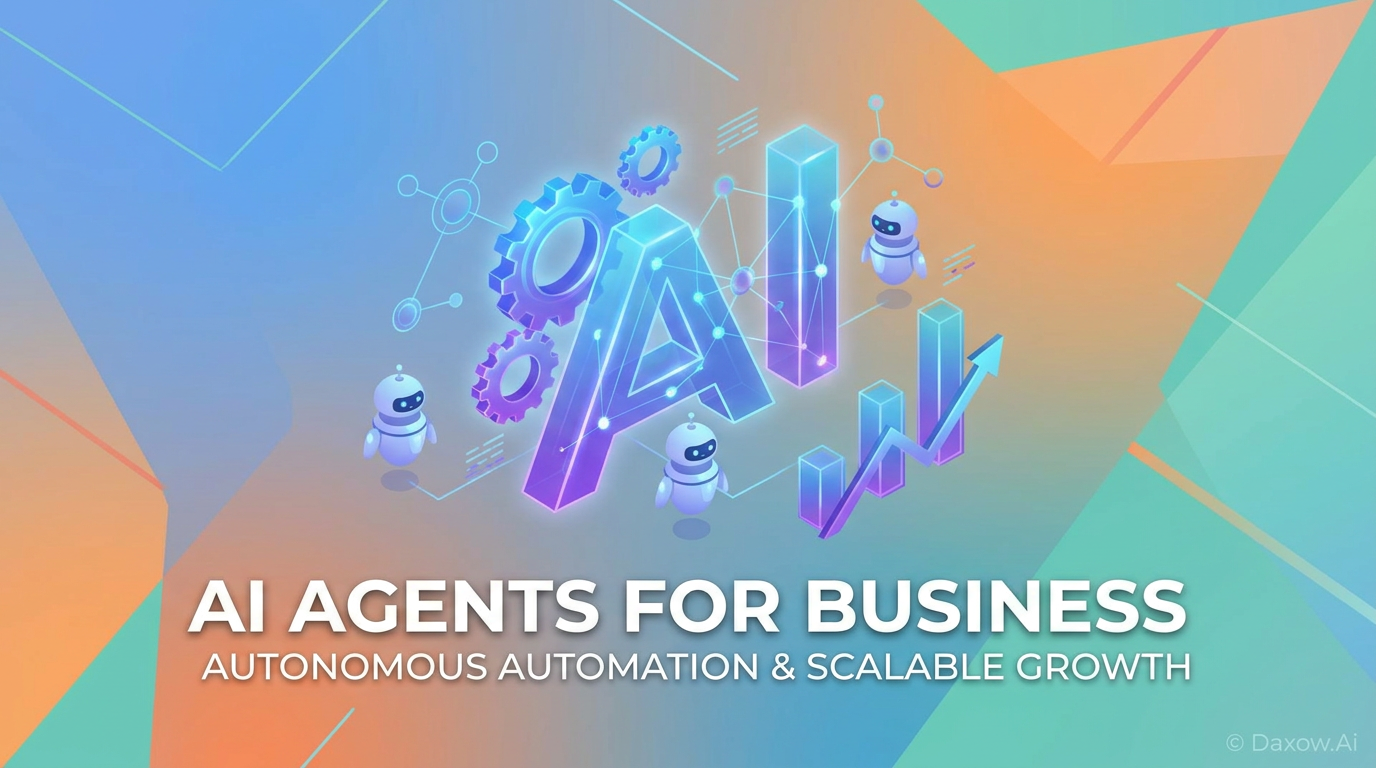
AI Agents for Business: Autonomous Automation & Scalable Growth
Practical guide to deploying AI agents that automate multi-step workflows, integrate with enterprise systems, enforce governance, and deliver measurable ROI.
AI Agents for Business: Unlocking Autonomous Automation and Scalable Growth
Estimated reading time: 15 minutes
Key Takeaways
- AI agents combine perception, reasoning, planning, action, and memory to automate complex workflows autonomously.
- Businesses can achieve productivity gains of 40–70% by deploying AI agents across sales, support, finance, HR, and more.
- Integrating AI agents tightly with core systems like CRMs, ERPs, and ticketing platforms maximizes automation value.
- A practical five-step roadmap ensures secure, scalable AI agent deployment delivering rapid ROI.
- Governance, human oversight, and continuous learning are critical for sustainable AI automation success.
Table of Contents
- AI Agents for Business: Unlocking Autonomous Automation and Scalable Growth
- Strategic Impact — How AI agents transform operations
- Practical use cases across industries
- Implementing AI agents — A practical roadmap
- Best practices and governance
- Measuring ROI and expected outcomes
- Scaling, monitoring and long-term value
- Real-world deployment examples (concise case studies)
- Frequently Asked Questions
AI Agents for Business: Unlocking Autonomous Automation and Scalable Growth
AI Agents for Business: Unlocking Autonomous Automation and Scalable Growth is not a future promise — it is a practical strategy decision for companies that want to reduce manual tasks, accelerate productivity, and convert automation into measurable ROI. Modern AI agents combine perception, reasoning, planning, action and memory to operate as goal-oriented digital employees. For decision-makers, adopting agentic AI means moving beyond brittle scripts and rule-based automation toward systems that execute multi-step workflows across CRMs, ERPs, ticketing platforms and databases autonomously.
At Daxow.ai, we design custom AI automation and AI agents that integrate with your existing systems, secure sensitive data, and deliver rapid, measurable outcomes. This article explains the strategic meaning, practical use cases across industries, an implementation roadmap, governance best practices, and how to quantify ROI — all aimed at helping you decide where to deploy business automation first.
What makes AI agents different from traditional automation or chatbots is their ability to perceive context, decompose goals, call tools and APIs, plan multi-step actions, and retain memory across interactions. These capabilities translate into substantial productivity gains — reported improvements in the range of 40–70% in workflows that involve repeated decision-making and document analysis.
Key capabilities of AI agents:
- Perception: Ingest unstructured documents, emails, and APIs.
- Reasoning and planning: Break down objectives into executable steps.
- Tool use and integrations: Update CRM records, send emails, create tickets, run queries against databases.
- Memory and context: Maintain case history and adapt behavior over time.
- Autonomy with guardrails: Execute actions while enforcing compliance rules and human approvals when needed.
These traits enable agents to reduce manual work, speed task completion, and scale processes without proportional headcount increases.
Strategic impact — How AI agents transform operations
From repetitive tasks to strategic work
AI agents act as digital employees that shoulder repetitive and decision-intensive tasks. By automating low-value manual work, human teams can focus on strategy, relationship-building, and innovation. Typical operational impacts:
- Reduce manual tasks across sales qualification, support triage, invoice processing and onboarding.
- Improve productivity by automating multi-step workflows end to end.
- Minimize errors and enforce compliance consistently.
- Scale operations without linear increases in headcount.
Integration-driven value
Agents deliver value when tightly integrated with core systems:
- CRMs and sales stacks for sales automation and lead qualification.
- Ticketing and knowledge bases for customer support automation and faster resolution.
- ERPs and procurement systems for workflow automation in finance and supply chain.
- HRIS and training platforms for employee onboarding and talent workflows.
Daxow.ai specializes in mapping these touchpoints and building agent workflows that execute business actions through secure API integrations.
Practical use cases across industries
E‑commerce — Demand forecasting, inventory and support
Use case:
- Agent analyzes sales trends, vendor lead times and current stock, then creates purchase orders and notifies procurement.
- Customer-facing agent triages support tickets, consults product docs, issues refunds, or escalates to a human for exceptions.
Business outcomes:
- Reduced stockouts and lower carrying costs.
- Faster ticket resolution and higher customer satisfaction.
- Improved productivity for operations and support teams.
Healthcare — Patient onboarding and incident response
Use case:
- Onboarding agent collects patient documents, verifies insurance coverage, and schedules appointments while enforcing compliance checks.
- Incident response agent reviews historical records, suggests triage steps, and escalates to clinicians for complex cases.
Business outcomes:
- Shorter onboarding cycles and fewer manual touches.
- Faster incident resolution with audit trails that support HIPAA compliance.
Finance — Expense automation and risk mitigation
Use case:
- Virtual CFO agent approves low-risk expense claims, flags anomalies, updates cash flow forecasts and runs compliance validations.
- Agents automatically reconcile invoices and match POs with receipts.
Business outcomes:
- Lower processing costs and faster month-end close.
- Reduced fraud risks and better cash management.
Real estate — Lead qualification and market analysis
Use case:
- Agent synthesizes CRM signals, qualifies leads, schedules viewings, and sends personalized follow-ups.
- Market agent monitors listings, analyzes trends and re-targets campaigns.
Business outcomes:
- Higher conversion rates and reduced time-per-lead.
- More effective marketing spend and faster deal cycles.
HR — Onboarding and talent acquisition
Use case:
- Onboarding agent provisions tools, answers policy questions, and sequences training modules for new hires.
- Recruitment agent screens resumes, schedules interviews and recommends candidate shortlists.
Business outcomes:
- Faster ramp time for new hires.
- Reduced recruiter workload and more homogeneous screening quality.
Implementing AI agents — A practical roadmap
1. Audit and ideation (Discovery)
- Run workshops to identify repetitive, high-impact workflows and measure current cycle times and error rates.
- Prioritize processes based on ROI potential, data accessibility and compliance risk.
- Output: prioritized backlog of automation opportunities.
2. Proof of Concept (POC)
- Scope a single workflow (for example, HR policy assistant or a ticket triage agent) and aim to deliver an initial working POC within 30 days.
- Connect core systems, validate API calls, and test basic goal decomposition and action execution.
- Output: validated agent that demonstrates value and establishes technical feasibility.
3. Technical setup and security
- Define infrastructure for API access, data storage, and identity management.
- Implement guardrails: role-based access, audit logs, human-in-the-loop for high-risk decisions.
- Ensure compliance with GDPR, SOC 2 and sector-specific regulations such as HIPAA where applicable.
4. Pilot and scale
- Launch pilots with a subset of users, monitor agent behavior, collect user feedback and refine instructions and policies.
- Track core KPIs (time saved, mean time to resolution, accuracy) and iterate.
- Output: production-ready agent with monitoring and retraining plan.
5. Enterprise rollout
- Extend integrations across departments, enable agent-to-agent collaboration where workflows span systems.
- Establish ongoing governance, performance analytics and a roadmap for continuous improvements.
Daxow.ai delivers end-to-end delivery across this roadmap, from discovery workshops and POCs to secure production deployments and ongoing optimization.
Best practices and governance
- Start small and deliver quick wins: Focus initial POCs on high-volume, well-understood processes to demonstrate ROI.
- Enforce human-in-the-loop for high-stakes decisions: Use human approvals where outcomes carry legal or safety risk.
- Use goal-based agents for most tasks: Goal-oriented design simplifies maintenance and aligns agents to business objectives.
- Instrument for continuous learning: Capture feedback loops and performance data to improve agents over time.
- Prioritize data security and compliance: Adopt encryption, access controls and audit logging from day one.
- Use semantic knowledge integration: Combine knowledge bases, documents and APIs for richer context and fewer errors.
Daxow’s hybrid custom frameworks balance off-the-shelf speed with bespoke integrations, ensuring availability and reliability (targeting enterprise-grade uptime).
Measuring ROI and expected outcomes
To prioritize and justify projects, quantify expected benefits with this approach:
- Establish baseline metrics:
- Current processing time per task.
- Volume of tasks per week/month.
- Average labor cost per FTE and error remediation costs.
- Estimate agent improvements:
- Use conservative improvement ranges (e.g., 30–50% time reduction) for initial pilots, moving to 40–70% for mature deployments.
- Calculate direct savings:
- Time saved × hourly rate × number of tasks = labor cost reduction.
- Reduction in error rate × remediation cost = avoided costs.
- Add indirect benefits:
- Faster sales cycles and improved conversion rates.
- Better inventory turnover and reduced waste.
- Higher customer retention through faster support.
Example (support team):
- Baseline: 1,000 tickets/month, average handling time 20 minutes, average cost $25 per hour.
- Agent reduces handling time by 40% to 12 minutes: monthly time saved = (8 minutes × 1,000) = 133 hours.
- Monthly labor savings ≈ 133 × $25 = $3,325.
- Add improved CSAT and reduced escalations for compounding business value.
Companies implementing agentic AI consistently report payback within months when they combine workflow automation with system integrations and continuous optimization.
Scaling, monitoring and long-term value
- Centralized orchestration for multi-agent workflows.
- Monitoring dashboards for performance and compliance.
- Versioning for agent logic and knowledge sources.
- Retraining pipelines based on user feedback and analytics.
Long-term value comes from compound learning: agents improve over time via interaction data and retraining, delivering increasing returns without proportional increases in headcount.
How Daxow.ai helps
- We run discovery workshops to map workflows and calculate ROI.
- We build POCs within 30 days, integrating with CRMs, ERPs, ticketing systems and document stores.
- We implement enterprise-grade security, compliance and governance.
- We deliver end-to-end automation: AI agents, workflow automation, chatbots & support automation, lead qualification, document automation and deep system integrations.
- We provide ongoing optimization, analytics and multi-agent orchestration to maximize productivity gains and reduce manual tasks.
Real-world deployment examples (concise case studies)
- E‑commerce: Inventory agent reduced stockouts by 35% and automated reorder creation, saving procurement teams 15 hours/week.
- Healthcare: Onboarding agent cut paperwork processing time by 60%, reducing patient wait-times and improving compliance documentation.
- Finance: Virtual CFO agent automated routine expense approvals and improved cash flow forecasting accuracy by 20%, accelerating month-end close.
- Real estate: Lead qualification agent increased conversions by 18% by automating personalized outreach and scheduling.
- HR: Onboarding and provisioning agent reduced manual provisioning time from 3 days to under 4 hours and shortened new-hire ramp time.
Conclusion and call to action
AI Agents for Business: Unlocking Autonomous Automation and Scalable Growth is a strategic lever for organizations that want to reduce manual work, increase productivity and convert automation into measurable business value. With targeted pilots, secure integrations, and continuous optimization, agentic AI becomes a compounding advantage — reducing costs, improving customer experience and enabling scalable growth.
If you want to evaluate where agents can drive the most value in your organization, Daxow.ai can help. Book a free consultation to start a discovery workshop, or request a process analysis to identify the highest-impact automation opportunities for your company. Contact us to build a custom AI system that delivers measurable ROI and operational transformation.
Frequently Asked Questions
What distinguishes AI agents from traditional automation?
AI agents perceive context, plan multi-step workflows, integrate tools and retain memory, allowing autonomous execution beyond rigid rule-based automation.
Which industries benefit most from AI agents?
E-commerce, healthcare, finance, real estate, and HR have demonstrated clear productivity gains and process improvements using AI agents.
How does Daxow.ai ensure data security with AI agents?
We implement enterprise-grade security including role-based access, audit logs, encryption, and compliance with GDPR, SOC 2, HIPAA, and other relevant regulations.
What is the typical ROI timeline for deploying AI agents?
Most companies see payback within months by combining workflow automation with system integrations and continuous optimization.