
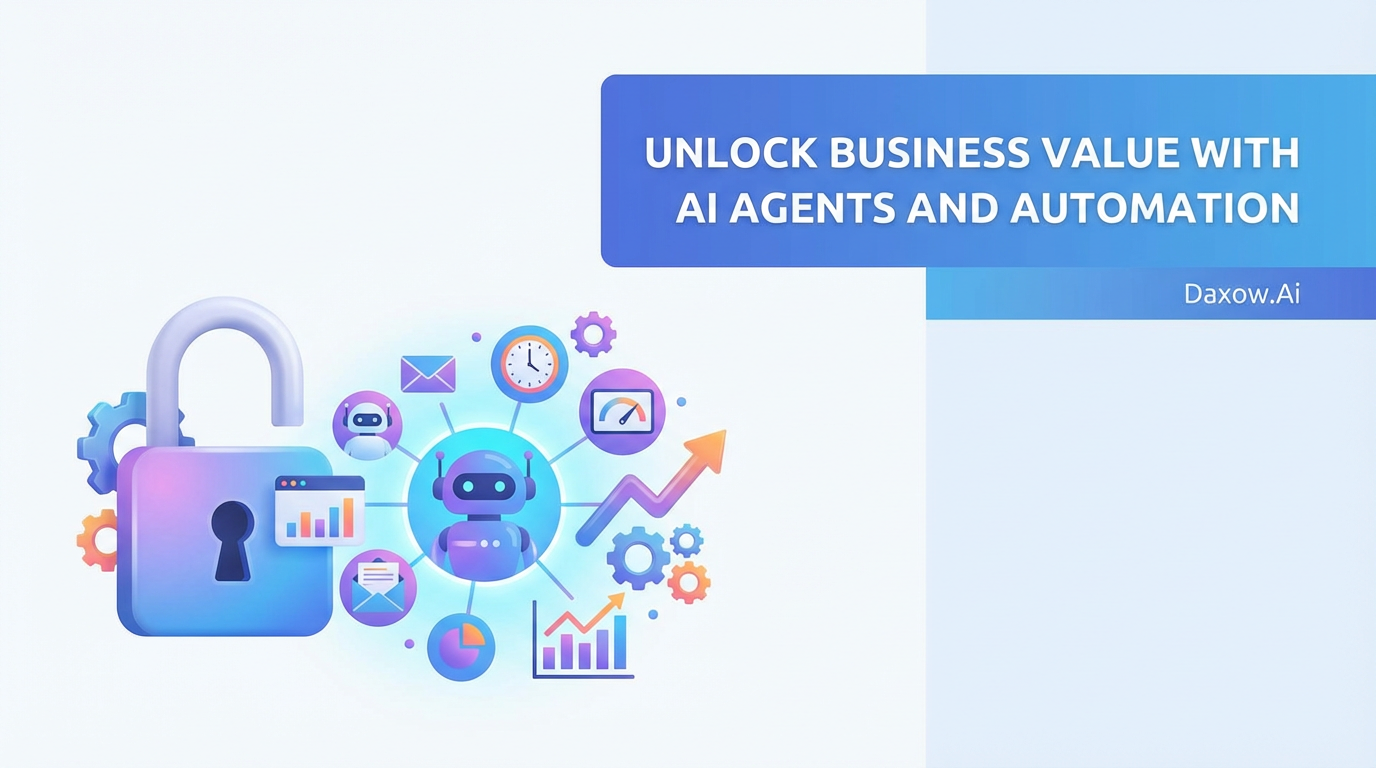
Unlock Business Value with AI Agents and Automation
Practical guide to AI agents and workflow automation—use cases, ROI, security, and a Daxow.ai roadmap to boost productivity and reduce manual work.
Unlocking Business Value with AI Agents and Automation
Estimated reading time: 15 minutes
Key Takeaways
- AI agents enable end-to-end automation of complex workflows beyond traditional rule-based scripts.
- Significant ROI and productivity gains have been reported across sales, customer support, finance, healthcare, and more.
- Daxow.ai delivers custom AI automation solutions tailored to industry-specific workflows and integration needs.
- Implementation requires strategic identification of workflows, data readiness assessments, pilot testing, and scaling.
- Best practices include human-in-the-loop, secure integrations, continuous measurement, and compliance adherence.
Table of Contents
- Unlocking Business Value with AI Agents and Automation — what it means for your company
- How AI agents differ from traditional automation
- Practical Use Cases Across Industries
- Implementation roadmap for AI agents and workflow automation
- Best practices and risk mitigation
- Measuring ROI and business outcomes
- Security, compliance, and governance
- How Daxow.ai designs and delivers end-to-end AI automation
- Frequently Asked Questions
Unlocking Business Value with AI Agents and Automation — what it means for your company
AI agents combine natural language understanding, decision-making, and tool-level execution to automate complex workflows end-to-end. Unlike traditional rule-based automation, AI agents adapt to changing inputs and incomplete data, execute multi-step processes, and integrate with CRMs, ticketing systems, ERPs, and third-party services.
Key business impacts:
- Proven ROI: Early adopters report average returns exceeding 171% by automating high-volume tasks and redirecting human effort to strategic work.
- Productivity gains: Sales and operations teams see 25–47% improvements in productivity through intelligent lead qualification and pipeline management.
- Faster resolution: Time-to-resolution for customer issues shifts from days to minutes with always-on customer support automation.
- Scalability: Businesses handle 10x volume increases without proportional headcount growth, reducing cost-per-transaction.
- Customer outcomes: Consistent, accurate interactions increase NPS and lifetime value — small percentage improvements can yield large revenue gains.
These outcomes make AI automation and business automation strategic requirements, not just efficiency projects.
How AI agents differ from traditional automation
Traditional automation executes predefined rules. AI agents reason, learn, and orchestrate actions across systems.
Core capabilities of AI agents:
- Natural language understanding for support and sales conversations.
- Autonomous decision-making and multi-step action execution (e.g., validate data, update records, trigger refunds).
- Integrations with CRMs, ticketing platforms, payment gateways, and internal databases.
- Continuous learning from outcomes to improve accuracy and reduce escalations.
Business advantages:
- Reduced manual tasks across repetitive, mission-critical workflows.
- Higher-quality decisions in uncertain environments (pricing, risk assessment, routing).
- Improved productivity by freeing specialists for high-value work.
Practical Use Cases Across Industries
E-commerce and Retail — personalization, inventory, and recruiting
Use case: Lead enrichment, intent scoring, personalized outreach, inventory rerouting.
- What AI agents do: Automatically score incoming leads, draft personalized emails or messages, update CRM records, and simulate supply-chain disruptions to reroute shipments and notify customers proactively.
- Business value: 25–47% productivity boost for sales teams, fewer stockouts, higher conversion rates.
- Daxow.ai approach: Map customer journeys, integrate ecommerce platforms and CRM, build AI agents that update records and trigger workflows, and monitor conversion lift.
Healthcare — triage and operational load reduction
Use case: Digital symptom checkers, appointment routing, sensor data triage.
- What AI agents do: Triage patient interactions, prioritize urgent cases, suggest appointment types, and extract structured data from patient forms.
- Business value: Reduced clinician administrative load, faster patient routing, high-volume handling (examples show hundreds of thousands of interactions).
- Daxow.ai approach: Ensure clinical data grounding, integrate with scheduling and EMR systems, and implement secure, auditable automation that escalates to clinicians when needed.
Finance and Banking — loan processing, compliance, and HR
Use case: Automated KYC checks, fraud detection workflows, employee support.
- What AI agents do: Collect and verify documents, update KYC status in the core system, run risk scoring, and automate routine HR ticket responses.
- Business value: Faster approvals, improved compliance, and employee support without added headcount (real-world deployments handle 20,000+ monthly conversations).
- Daxow.ai approach: Connect to banking systems securely, apply compliance rules, provide human-in-the-loop controls for high-risk decisions, and deliver audit trails.
Real Estate — lead qualification and predictive maintenance
Use case: Lead qualification, demand forecasting, and IoT-driven maintenance triage.
- What AI agents do: Qualify incoming tenant or buyer leads, prioritize follow-ups, forecast demand by region, and analyze sensor data to predict maintenance needs.
- Business value: Faster conversions, reduced downtime, and lower reactive repair costs.
- Daxow.ai approach: Integrate MLS/CRM systems, configure predictive models for maintenance, and automate service partner scheduling.
HR and IT Service Desk — onboarding and ticket resolution
Use case: Employee onboarding assistants, policy Q&A, tier-1 IT ticket automation.
- What AI agents do: Automate document collection, answer policy questions, and resolve common IT issues with guided runbooks.
- Business value: 80% query automation in some deployments, reduced escalations, and faster new-hire productivity.
- Daxow.ai approach: Map employee journeys, integrate HRIS and service desk tools, and deploy agents that escalate only complex issues.
Implementation roadmap for AI agents and workflow automation
1. Identify high-impact workflows
- Prioritize repetitive, high-volume, mission-critical tasks (support tickets, approvals, lead qualification).
- Use measurable criteria: volume, handling time, error rate, and revenue impact.
- Daxow.ai role: Run workshops to uncover bottlenecks and quantify potential gains.
2. Assess data readiness and tech stack
- Verify data quality, access to CRMs and databases, and readiness of APIs.
- Ensure data governance, privacy, and compliance posture for regulated industries.
- Daxow.ai role: Conduct data audits, design integration maps, and propose secure architectures.
3. Pilot and validate
- Build a narrow pilot (e.g., IT helpdesk or a single sales segment) to measure automation rate, resolution time, and user satisfaction.
- Define KPIs: automation rate, mean time to resolution, cost per interaction, and conversion lift.
- Daxow.ai role: Deliver a short pilot, configure observability, and train the agent on in-scope data.
4. Scale and optimize
- Expand coverage, add integrations, and refine decision logic with human feedback loops.
- Implement continuous monitoring, retraining, and error handling workflows.
- Daxow.ai role: Operate iterative sprints, provide A/B testing for dialog flows, and scale across departments.
Best practices and risk mitigation
- Assist, don’t replace: Use agents to handle routine tasks and surface complex decisions to humans.
- Ground agents in approved data: Ensure the knowledge base and decision rules are auditable and maintained.
- Secure integrations: Use encrypted connections, role-based access, and logging for all actions.
- Human-in-the-loop: Provide escalation paths and review mechanisms for edge cases.
- Measure continuously: Track both efficiency metrics and customer-facing KPIs like NPS and conversion rates.
Measuring ROI and business outcomes
Quantifying value is essential to justify investment.
Key metrics to track:
- Automation rate (% of interactions handled without human intervention).
- Resolution time reduction (minutes vs. days).
- Productivity gains (e.g., 25–47% in sales workflows).
- Financial impact (revenue uplift, cost saved, e.g., enrollment increases that drive millions).
- Long-term scalability (capacity to handle 10x volume without proportional staffing increases).
Modeling ROI:
- Start with baseline metrics (cost per ticket, conversion rate, average handle time).
- Apply estimated automation rates and expected improvements.
- Include implementation and running costs (platforms, integrations, monitoring).
- Iterate using pilot results — many organizations report realized ROI exceeding projections when agents are deployed incrementally.
Security, compliance, and governance
- Maintain audit logs for agent actions.
- Apply data minimization and encryption for sensitive fields.
- Implement version control and approval flows for knowledge bases.
- Regularly test for model drift and unintended behavior.
- Daxow.ai ensures enterprise-grade security practices and provides compliance consulting as part of solution delivery.
How Daxow.ai designs and delivers end-to-end AI automation
Daxow.ai helps businesses understand their current workflows and builds custom AI systems that automate tasks and deliver measurable ROI. Our approach is pragmatic, collaborative, and focused on business outcomes.
What Daxow.ai delivers:
- Process discovery and workflow mapping to identify quick wins.
- Custom AI agents that execute real tasks: update CRMs, issue refunds, qualify leads, route tickets, and manage vendor collaboration.
- Workflow automation across tools and systems to reduce manual handoffs.
- Chatbots and support automation that resolve common queries and escalate with context.
- Lead qualification systems to increase sales velocity and pipeline quality.
- Data extraction and document automation for contracts, invoices, and forms.
- Integrations with your tech stack (CRMs, ERPs, scheduling systems, payment gateways).
- Monitoring, reporting, and continuous optimization to maintain high automation rates.
Sample engagement flow:
- Discovery — map workflows and quantify impact.
- Prototype — deliver a pilot agent integrated with one or two systems.
- Validate — measure KPIs and refine behavior.
- Scale — expand scope and add automations across departments.
- Operate — maintain, monitor, and iterate to sustain ROI.
Daxow.ai brings cross-industry experience, technical integration expertise, and an operations-first mindset to ensure automation projects deliver measurable business value, not just technical novelty. Learn more on our Services and Case Studies pages.
Conclusion and next steps
AI agents and workflow automation are proven levers for reducing manual tasks, increasing productivity, and unlocking new revenue potential. Whether your priority is customer support automation, sales automation, or end-to-end process automation, the right strategy combines focused pilots, secure integrations, and continuous measurement.
If you want to quantify potential savings and design a custom automation roadmap, Daxow.ai can help. Book a free consultation to discuss your workflows, request a process analysis for your company, or contact us to build a custom AI system that reduces operational costs and improves ROI.
Frequently Asked Questions
What makes AI agents different from traditional automation?
AI agents reason, learn, and execute multi-step workflows autonomously while integrating with multiple systems, unlike traditional automation which follows predefined rules.
Can AI agents be customized for specific industries?
Yes, Daxow.ai designs custom AI agents tailored to industry-specific workflows, compliance requirements, and systems integrations.
How do AI agents improve customer experience?
By enabling faster resolution times, personalized interactions, and consistent service, AI agents help increase NPS and customer lifetime value.
Is security addressed when deploying AI agents?
Absolutely. Daxow.ai implements audit logging, encrypted integrations, data minimization, and compliance protocols to maintain enterprise-grade security.