
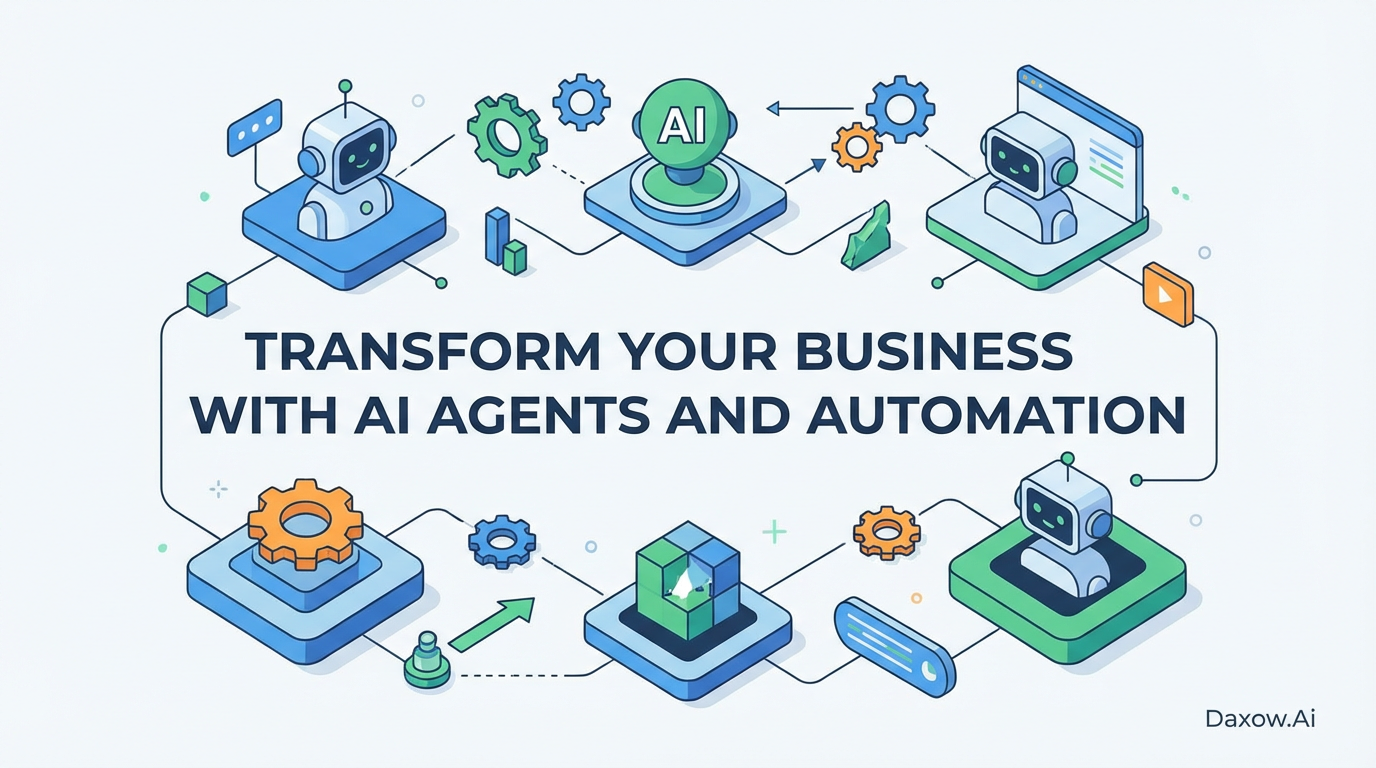
Transform Your Business with AI Agents and Automation
Six-stage roadmap, use cases, and Daxow.ai's approach to deploying AI agents and automation to cut costs, boost ROI, and maintain compliance.
Harnessing AI Agents and Automation for Business Transformation
Estimated reading time: 15 minutes
Key Takeaways
- AI agents and automation drastically reduce manual workloads and errors while improving speed and ROI.
- Implement practical AI applications across industries such as e-commerce, healthcare, finance, and HR.
- A clear six-stage roadmap guides successful AI automation deployments, focusing on goals, data, compliance, tools, training, and iteration.
- Best practices include prioritizing quick wins, engaging end-users, and setting measurable KPIs; avoid automating nuanced decisions and neglecting data quality.
- Daxow.ai offers tailored end-to-end AI solutions ensuring security, compliance, and scalable business impact.
Table of Contents
- Harnessing AI Agents and Automation for Business Transformation — why it matters
- Practical use cases across industries
- A six-stage roadmap to deploy AI agents and automation
- Best practices and pitfalls to avoid
- How Daxow.ai designs and delivers end-to-end business automation
- ROI, KPIs, and what to measure
- Common implementation scenarios and quick wins
- Mitigating risks: governance, human oversight, and continuous improvement
- Frequently Asked Questions
- Conclusion and call to action
Harnessing AI Agents and Automation for Business Transformation — why it matters
From repetitive tasks to strategic capacity
Businesses today are overloaded with routine, high-volume tasks: invoice processing, support ticket triage, lead qualification, and manual data entry. These tasks consume time, introduce errors, and limit teams’ capacity for strategic work. AI agents and workflow automation address this by executing repeatable processes, making data-driven decisions, and coordinating systems with minimal human intervention. The result is faster processes, fewer errors, and measurable productivity gains.
Quantifiable business impact
- Faster processes: Organizations adopting AI automation report up to 40% faster cycle times in targeted workflows.
- Error reduction: Automation can reduce transactional errors by as much as 90%, particularly in data extraction and compliance reporting.
- Improved ROI: Focused deployments often achieve ROI within 3–6 months, with mid-sized firms seeing 3–5x returns in the first year when high-impact workflows are prioritized.
These outcomes are realized by pairing intelligent agents (capable of natural language, prediction, and decision-making) with robust integrations into existing systems.
Practical use cases across industries
E-commerce — inventory, personalization, and retention
Problem: Manual stock reconciliation, delayed order responses, and generic promotions cause missed sales and high cart abandonment.
Solution: Deploy AI agents to automate inventory management, forecast demand, generate personalized product recommendations, and run automated chatbots for 24/7 customer support.
Benefits:
- Reduce manual tasks in inventory by automating reorder triggers and supplier communications.
- Increase conversion with personalized recommendations and faster customer responses.
- Typical impact: Lower stockouts, reduced fulfillment time, and improved AOV (average order value).
Healthcare — scheduling, triage, and secure data handling
Problem: Administrative burden on staff, inefficient appointment scheduling, and pressure to remain HIPAA-compliant.
Solution: Use conversational AI agents for symptom triage, automated scheduling across providers, and document automation for intake forms with secure data tagging.
Benefits:
- Cut administrative time by ~30%, improve patient throughput, and reduce scheduling errors.
- Maintain compliance through automated data classification and audit trails.
Finance — fraud detection and regulatory reporting
Problem: High-volume transactions require fast anomaly detection and precise compliance reporting.
Solution: Combine anomaly-detection models with workflow automation to flag suspect activity, initiate investigation tasks, and populate regulatory reports automatically.
Benefits:
- Real-time fraud detection reduces losses and manual review time.
- Automated compliance reduces reporting delays and audit risk.
Real estate — lead qualification and virtual viewings
Problem: Slow lead response and manual qualification slow deal cycles.
Solution: Deploy AI agents to qualify leads from web and MLS inputs, auto-schedule viewings, and generate property valuations using image recognition and comparable analysis.
Benefits:
- Accelerated deal cycles, higher lead-to-appointment conversion, and reduced agent overhead.
HR — hiring, onboarding, and employee insights
Problem: Long candidate screening times and fragmented onboarding processes reduce hiring velocity.
Solution: Automate CV parsing, candidate scoring, interview scheduling, and onboarding checklists. Use sentiment analysis on employee feedback to drive retention initiatives.
Benefits:
- Reduce time-to-hire by up to 50%, improve new hire experience, and uncover retention risks earlier.
Customer support and sales automation — faster responses, better leads
Problem: Support teams are overwhelmed with repetitive queries; sales teams spend time on unqualified leads.
Solution: Implement customer support automation with AI chatbots and ticketing agents that handle Tier 1 issues and escalate appropriately. For sales, use AI agents to preprocess inbound leads, enrich CRM data, and route qualified opportunities to reps.
Benefits:
- Higher first-contact resolution, lower support costs, and improved sales productivity through prioritized lead routing.
A six-stage roadmap to deploy AI agents and automation
1. Define goals and conduct a bottleneck audit
- Map key processes and measure baseline metrics.
- Identify high-volume, error-prone tasks and prioritize via an impact-effort matrix.
- Example objective: reduce invoice processing cost by 20% in six months.
2. Assess and prepare data
- Locate sources (ERP, CRM, email, documents), cleanse duplicates, and standardize formats.
- Establish data governance and access controls.
- Target: Data accuracy >95% for automation-ready datasets.
3. Ensure compliance and classification
- Tag data for regulatory controls (HIPAA, GDPR, industry-specific rules).
- Implement encryption, retention policies, and auditability.
- Important for healthcare and finance deployments.
4. Select tools and build the team
- Choose the right stack (NLP for chatbots, ML models for prediction, RPA for integrations).
- Assemble cross-functional teams: product, ML engineers, DevOps, and domain SMEs.
- Integrate with business systems (CRMs, ERPs, Microsoft 365) for end-to-end automation.
5. Train, test, and deploy
- Use transfer learning to accelerate model readiness.
- Pilot in low-risk workflows, validate with real users, and measure KPIs.
- Pilot success criteria: reduction in manual interventions and maintained or improved quality.
6. Monitor and iterate
- Define monitoring dashboards and alerts for drift or regressions.
- Schedule quarterly reviews and continuous retraining cycles.
- Success metric examples: throughput increase, reduced TAT, and satisfaction scores.
Best practices and pitfalls to avoid
Best practices
- Prioritize quick wins: start where automation unlocks immediate efficiency.
- Involve end-users early: they reveal hidden handoffs and exceptions.
- Use pre-integrated tools to reduce implementation time and security overhead.
- Set measurable KPIs and tie automation goals to business outcomes.
Pitfalls to avoid
- Automating low-value or highly nuanced decisions that require human judgment.
- Ignoring data quality; garbage in yields poor model performance.
- Underestimating change management; adoption failures nullify potential ROI.
How Daxow.ai designs and delivers end-to-end business automation
Process discovery and solution design
- We begin with a process analysis and bottleneck audit to identify high-impact opportunities.
- Deliverables: prioritized automation backlog, ROI estimates, and a pilot plan.
Custom AI agents that execute real work
Daxow builds AI agents tailored to your workflows — from conversational assistants that handle customer support automation to decision agents that qualify leads or approve invoices. Agents are designed to integrate with CRMs, ticketing systems, ERPs, and productivity suites to reduce manual tasks and enforce consistent processing.
Workflow automation and systems integration
We design end-to-end workflows that combine ML models, RPA, API integrations, and human-in-the-loop checkpoints. Integrations ensure data flows securely between systems so teams can focus on strategy while agents handle execution.
Data engineering, compliance, and security
Daxow implements data preparation pipelines, classification rules, and audit trails to meet regulatory requirements. Security-first development includes encryption, role-based access, and compliance documentation for regulated industries.
Pilot, scale, and managed monitoring
Start with a pilot that delivers measurable wins, then scale using repeatable patterns. Ongoing monitoring, retraining, and performance reviews secure continuous improvement and sustained ROI.
ROI, KPIs, and what to measure
To demonstrate business value, focus on these KPIs:
- Cost per process (before and after automation).
- Throughput and cycle time (e.g., invoices processed per day).
- Error rate and compliance violations.
- Time saved (hours per week) and headcount redeployment.
- Customer satisfaction (NPS, CSAT) and first-contact resolution.
- Sales metrics: lead response time and conversion rate.
Example targets:
- Integration time for pilots: <30 days.
- ROI realization: 3–6 months for prioritized workflows.
- Data accuracy for automation readiness: >95%.
- Decision-makers who follow this discipline typically see 20–50% efficiency gains and significant reductions in manual errors.
Common implementation scenarios and quick wins
Scenario A — Mid-sized retailer: reduce manual order exceptions
- Quick win: Deploy AI agents to classify exception types, auto-route to responsible teams, and auto-suggest resolutions.
- Outcome: fewer manual handoffs, faster resolution, and saved labor hours.
Scenario B — Financial services firm: speed up KYC and compliance
- Quick win: Automate document extraction, data normalization, and preliminary risk scoring.
- Outcome: faster onboarding, fewer compliance delays, and lower audit preparation costs.
Scenario C — SaaS company: improve lead qualification and demo booking
- Quick win: AI lead-scoring agents enrich leads and schedule discovery calls automatically.
- Outcome: more qualified demos, higher conversion, and increased sales productivity.
Mitigating risks: governance, human oversight, and continuous improvement
AI agents should operate within a governance framework:
- Define clear escalation paths for uncertain decisions.
- Maintain human-in-the-loop for edge cases and final approvals.
- Implement retraining schedules to counter model drift.
- Keep stakeholders aligned via periodic reviews and transparent metrics.
Frequently Asked Questions
What kinds of businesses can benefit most from AI agents and automation?
Virtually any business with repetitive workflows, high data volume, or customer touchpoints can benefit, from retail and finance to healthcare and SaaS companies.
How does Daxow.ai ensure compliance with regulations like HIPAA and GDPR?
We implement data classification, encryption, audit trails, and role-based access controls tailored to each regulation and industry-specific requirements.
What is the typical timeline for seeing ROI after deploying AI automation?
Focused AI automation deployments often achieve ROI within 3–6 months, especially when targeting high-impact workflows and quick wins.
How do you integrate AI agents with existing business systems?
Daxow.ai integrates AI agents through APIs, RPA tools, and connectors with CRMs, ERPs, ticketing, and productivity suites to ensure smooth data flow and automation.
Conclusion and call to action
Harnessing AI Agents and Automation for Business Transformation delivers measurable efficiency, lower costs, and improved customer and employee experiences when executed with a disciplined, business-first approach. Daxow.ai helps organizations map processes, build custom AI agents, implement secure integrations, and scale automation while protecting compliance and maximizing ROI.
Book a free consultation with Daxow.ai to assess your highest-value automation opportunities. Request a process analysis for your company or contact us to build a custom AI system that reduces manual tasks, boosts productivity, and transforms operations.