
AI Agents: 2026 Guide to Agentic Automation
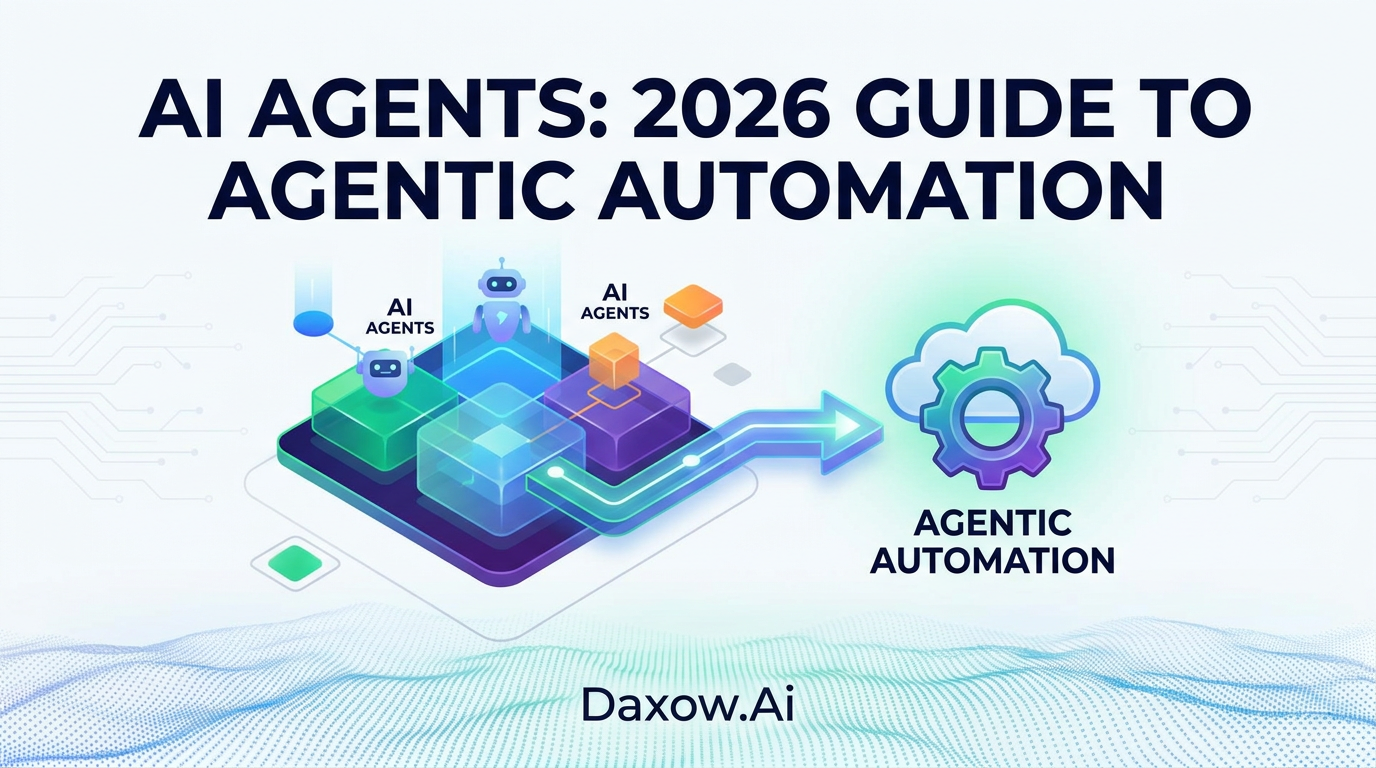
2026 guide to AI agents and agentic automation: use cases, a 90-day pilot playbook, measurable ROI, and how Daxow.ai designs and scales agents for business.
AI Agents: The 2026 Guide to Agentic Automation for Business Transformation
Estimated reading time: 15 minutes
Key Takeaways
- AI agents enable autonomous workflows that scale business processes without proportional staff increases.
- Agentic automation improves operational efficiency, employee productivity, customer experience, and decision-making speed.
- Proven use cases span e-commerce, healthcare, finance, real estate, and HR with measurable KPIs.
- Successful deployment follows a structured 90-day playbook combined with best practices like human-in-the-loop and ethical governance.
- Daxow.ai offers end-to-end custom AI agent design, integration, and continuous improvement to deliver tangible business outcomes.
Table of Contents
- AI Agents: The 2026 Guide to Agentic Automation for Business Transformation
- What AI Agents Mean for Businesses
- Practical Use Cases Across Industries
- Implementation Steps and Best Practices
- Measuring ROI and Business Impact
- How Daxow.ai Delivers Agentic Automation
- Practical Roadmap — From Pilot to Enterprise Scale
- Frequently Asked Questions
AI Agents: The 2026 Guide to Agentic Automation for Business Transformation
AI agents are autonomous systems built on advanced large language models and orchestration frameworks that combine observation, planning, and execution. Unlike rule-based bots, these agents learn from data, adapt to changing conditions, and collaborate with other agents or humans to complete end-to-end workflows. For decision-makers, the business case is clear:
- Scale without proportional headcount growth.
- Reduce manual tasks that create bottlenecks.
- Enable always-on customer support automation and sales automation.
- Turn disparate data into actionable workflows across CRM, ERP, and third-party tools.
Gartner’s projections and enterprise deployments show agent-driven automation handling a growing share of daily decisions and delivering material cost savings. For teams facing talent constraints and rising operational costs, agentic automation becomes a strategic lever for competitiveness.
What AI Agents Mean for Businesses
AI agents change how work gets done by taking on complex, repeatable, and data-heavy workstreams. Key business impacts include:
- Operational Efficiency: Agents complete processes faster and with fewer errors than manual workflows.
- Employee Productivity: Repetitive tasks are reduced, enabling staff to focus on strategic activities.
- Customer Experience: Personalized, timely interactions at scale improve CSAT and retention.
- Decision Acceleration: Agents synthesize data from multiple systems to recommend or autonomously take action.
How agents differ from traditional automation
- Traditional workflow automation executes predefined steps.
- AI agents observe outcomes, adapt strategies, and escalate when confidence is low.
- Agents integrate learning loops to improve over time, reducing maintenance and increasing ROI.
Practical Use Cases Across Industries
E-commerce — Streamlined Order and Inventory Mastery
Use case: An order lifecycle agent that confirms orders, checks stock, routes fulfillment, handles exceptions, and communicates with customers.
- Integrations: E-commerce platform (Shopify/Magento), WMS, shipping carriers, CRM, supplier portals.
- KPIs: Reduce stockouts by 30%, cut fulfillment exceptions by 40%, shorten order-to-ship time by 50%.
- Pilot design: Start with one product category. The agent monitors inventory thresholds, triggers reorders, and reroutes stock across warehouses when demand shifts. Include human-in-the-loop for supplier exceptions.
Healthcare — Predictive Care and Administrative Relief
Use case: Patient orchestration agent that schedules, monitors vitals, and flags anomalies.
- Integrations: EHR systems, telehealth platforms, device telemetry, insurance providers.
- KPIs: Reduce no-shows by 30%, cut administrative time per patient by 25%, improve early intervention rates.
- Pilot design: Deploy for chronic-care cohort. Agent sends reminders, conducts pre-visit intake, and escalates clinically significant data to clinicians.
Finance — Fraud Detection and Compliance Automation
Use case: Transaction monitoring agent that blocks suspicious activity, completes reconciliations, and generates audit packages.
- Integrations: Payment gateways, transaction ledgers, AML systems, compliance databases.
- KPIs: Decrease fraud response time by 70%, speed reconciliations by 80%, reduce compliance preparation time by 60%.
- Pilot design: Run in parallel with current fraud systems. Agents flag cases with confidence scoring and hand off high-risk items to investigators.
Real Estate — Lead Nurturing and Portfolio Management
Use case: Lead qualification and property optimization agent that schedules tours and dynamically prices rentals.
- Integrations: CRM, listing platforms, IoT sensors, property management systems.
- KPIs: Improve lead-to-visit conversion by 25%, increase occupancy rates, reduce manual listing updates by 90%.
- Pilot design: Focus on a subset of listings. Agent qualifies leads via chat/email, schedules viewings, and updates pricing based on market analytics.
HR — Onboarding and Employee Support
Use case: Onboarding agent that provisions accounts, schedules orientation, and answers policy questions.
- Integrations: HRIS, IT ticketing systems, payroll, knowledge base.
- KPIs: Reduce onboarding time by 60%, lower first-week helpdesk tickets, improve new hire satisfaction.
- Pilot design: Target one department. Agent automates equipment provisioning and routine IT tasks with escalation rules for exceptions.
Implementation Steps and Best Practices
Daxow’s 90-Day Playbook
- Assess and Prioritize (Days 1-15)
- Audit workflows to identify high-volume, repetitive tasks.
- Score opportunities by impact, feasibility, and data availability.
- Goal: Select an initial pilot with clear ROI potential (20–40% time savings).
- Select Platforms and Integrate Data (Days 16-30)
- Choose orchestration platforms that support multi-agent workflows and APIs.
- Map data sources (CRM, ERP, ticketing, databases) and implement secure connectors.
- Goal: Ensure single source of truth and role-based access control.
- Build and Test Agents (Days 31-60)
- Prototype single agents for critical processes (e.g., support triage).
- Define objectives, success metrics, and escalation rules.
- Test in sandbox environments using real, anonymized data.
- Goal: Achieve target accuracy and confidence thresholds before production.
- Deploy, Monitor, and Scale (Days 61-90)
- Roll out to one department with monitoring dashboards.
- Collect feedback and logs for continuous learning.
- Expand to multi-agent orchestration across adjacent workflows.
- Goal: Demonstrate measurable impact and prepare for scaling.
Best Practices
- Human-in-the-Loop: Keep humans for edge cases to build trust and reduce risk.
- Continuous Learning: Implement feedback loops so agents improve from real interactions.
- Ethical Guardrails: Maintain audit trails, bias checks, and data governance.
- Change Management: Train teams to collaborate with agents and reshape roles.
- Avoid Over-Customization: Use templates where possible to accelerate deployment.
Measuring ROI and Business Impact
Typical Improvements and Metrics
- Resolution Time: 50–70% faster — reduces downtime and improves customer satisfaction.
- Cost Savings: 20–40% reduction in labor for automated tasks.
- Productivity: 40–67% uplift as employees shift to higher-value work.
- CSAT/EX Scores: 20–30% increase through consistent, personalized interactions.
- ROI Timeline: Positive within 3–6 months in most pilots.
How to measure effectively
- Define baseline metrics before the pilot.
- Track leading indicators (time-to-first-response, ticket reassignments) and lagging indicators (cost per case, churn).
- Use agent logs for root-cause analysis and continuous improvement.
- Report outcomes to stakeholders monthly during the pilot and quarterly thereafter.
How Daxow.ai Delivers Agentic Automation
Design and Discovery
We begin with a workflow audit to identify where AI agents will reduce manual tasks and unlock growth. Our discovery aligns automation with strategic goals—whether that’s reducing operational costs, improving customer support automation, or accelerating sales automation.
Custom Agent Development
Daxow builds custom AI agents tailored to your data and processes. Our agents are designed to:
- Integrate with your tools and CRMs.
- Execute real tasks (e.g., process refunds, qualify leads, update inventory).
- Collaborate with human teams via escalation and feedback loops.
End-to-End Automation and Integrations
We handle integrations across CRM, ERP, ticketing, and third-party services to ensure seamless workflow automation. Our approach includes:
- Secure API connectors and data mapping.
- Error handling and transaction reconciliation.
- Monitoring dashboards and governance controls.
Continuous Improvement and Support
After deployment, Daxow provides continuous monitoring, retraining, and feature expansion. Agents receive feedback loops and performance optimization to increase accuracy and deliver continued ROI.
Business Outcomes
Clients working with Daxow.ai report:
- 30–50% reductions in operational expenses.
- 40% productivity gains.
- Faster decision cycles and improved customer satisfaction.
These outcomes come from combining AI agents with pragmatic change management and measurable KPIs.
Practical Roadmap — From Pilot to Enterprise Scale
- Validate with a measurable pilot (3 months).
- Standardize integrations and data models.
- Build a multi-agent architecture with clear ownership and escalation paths.
- Establish governance: security, compliance, and auditability.
- Scale horizontally (add departments) and vertically (add capabilities).
- Embed continuous learning and periodic model audits.
Governance Checklist
- Data access policies and encryption.
- Incident and rollback procedures.
- Regular bias and fairness audits.
- Clear KPIs and owner responsibilities.
Frequently Asked Questions
What differentiates AI agents from traditional automation?
AI agents learn from data, adapt to changes, and collaborate across systems, unlike traditional automation that follows fixed, rule-based sequences.
How long does it take to see ROI from deploying AI agents?
Most pilots demonstrate positive ROI within 3 to 6 months, driven by cost savings, productivity gains, and improved customer experience.
Can AI agents handle complex multi-system workflows?
Yes, AI agents can orchestrate across CRM, ERP, ticketing, and third-party APIs to execute end-to-end workflows and adapt dynamically.
How does Daxow.ai ensure security and governance?
We implement role-based access, encryption, audit logs, and compliance checks as part of our integrations and continuous monitoring.